Visibility Improved, Guidance Did Not, and Dominion Stayed Contested
Earnings Reports
PG&E Corporation FQ3 2026 Earnings Report
PG&E Corporation (PCG) FQ3 2026 earnings: Earnings Resilient Near Term; the Financing Model Is Unresolved. Full earnings analysis, key read-throughs, and the one-page exhibit from Atlas Peak Research.
PG&E Corporation (PCG)
Sector: Utilities · FQ3 2026 · Period end September 30, 2026 · Reported October 22, 2026
PG&E’s Q3 2026 earnings call supports a HOLD stance rather than a fundamental upgrade. Near-term earnings remain resilient, but the central investment issue has shifted from operating execution to the durability of the company’s financing and ownership model.
Download the one-page report (PDF)
View one-page exhibit
Download analysis (.md)
Download read-throughs (.md)
Post to X
One-Page Exhibit
Earnings Analysis
EXECUTIVE CALL SUMMARY: PG&E Corporation (10/22/26)
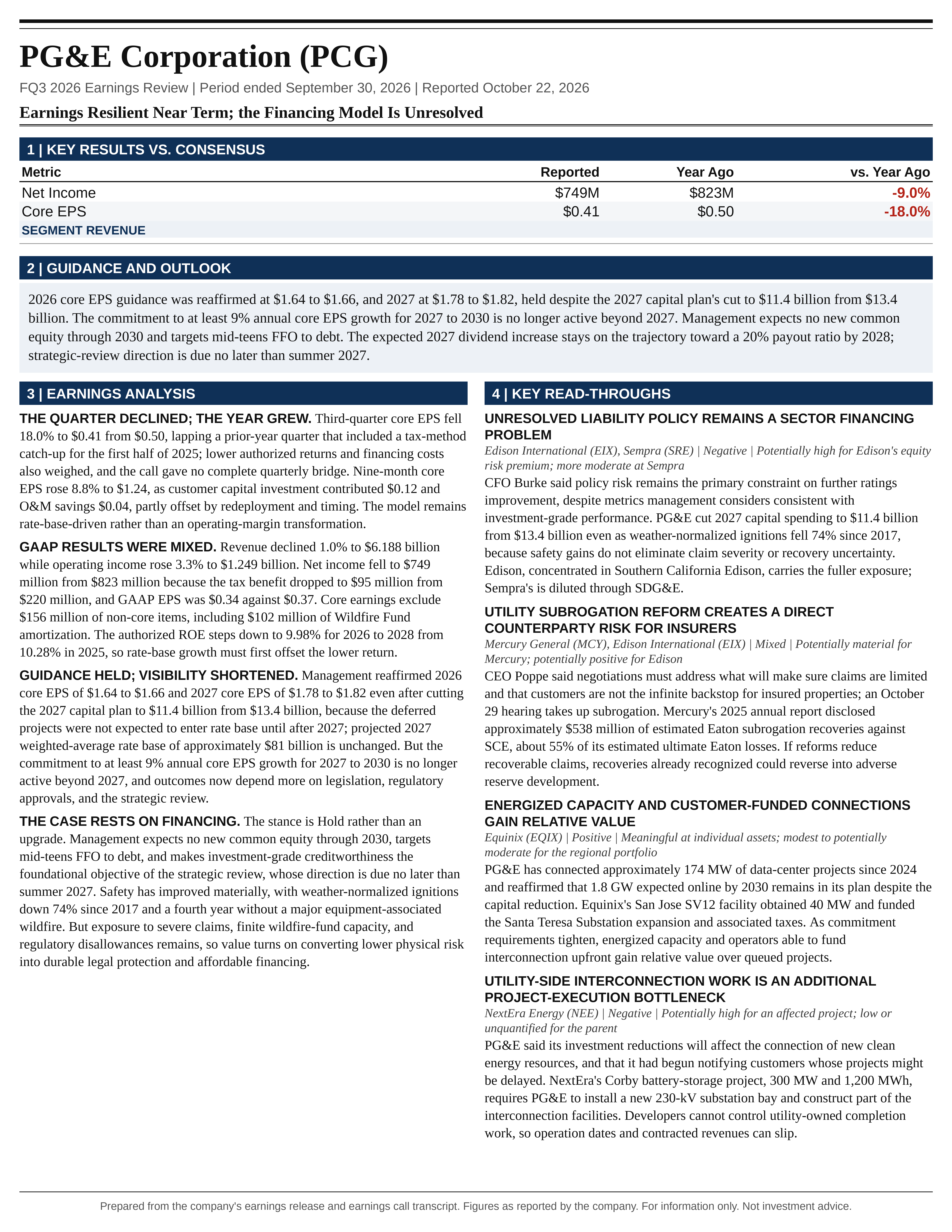
PG&E’s Q3 2026 earnings call supports a HOLD stance rather than a fundamental upgrade. Near-term earnings remain resilient, but the central investment issue has shifted from operating execution to the durability of the company’s financing and ownership model. Management reaffirmed 2026 core EPS of $1.64–$1.66 and 2027 core EPS of $1.78–$1.82 despite a previously announced $2 billion reduction in 2027 capital spending. That combination demonstrates protection from projects already approaching service and continued operating efficiencies. It does not establish that earnings growth beyond 2027 is protected. The withdrawal of longer-term guidance remains economically significant because the capital reductions predominantly affect projects that would have entered rate base after 2027.
The principal incremental disclosure was a clearer timetable and broader framework for the strategic review. Management intends to communicate its direction no later than summer 2027, with earlier announcements possible. Potential actions include capital-allocation changes, ring-fencing, asset sales, separations, and regulatory reforms. Investment-grade creditworthiness is the foundational objective. However, the call provided neither a transaction proposal nor evidence that regulators would approve a particular structure. The review creates credible alternatives to waiting indefinitely for legislation, but those alternatives remain contingent rather than executable valuation catalysts.
Quarterly core EPS declined 18.0% to $0.41 from $0.50, while 9-month core EPS increased 8.8% to $1.24. The quarterly decline was affected by a difficult tax-method comparison, including a catch-up benefit recognized in Q3 2025. Nevertheless, it should not be characterized as entirely timing-related: lower authorized returns and financing costs also matter, and the call did not provide a complete quarterly EPS bridge. The reaffirmed annual outlook requires Q4 core EPS of approximately $0.40–$0.42, compared with $0.36 in Q4 2025. Execution remains necessary, but the implied requirement is not inconsistent with the earnings level already achieved this quarter.
The investment distinction is between improved physical safety and unresolved financial tail risk. PG&E reported a 74% reduction in weather-normalized ignitions since 2017 and is operating in its 4th year without a major wildfire associated with its equipment. These are material improvements. They do not eliminate exposure to exceptionally severe claims, finite wildfire-fund capacity, regulatory disallowances, or deterioration in financing access. The strongest prospective catalyst is a durable reduction in those risks. The strongest counterargument is that capital restraint and asset separation could preserve liquidity while reducing the growth and diversification that currently support consolidated equity value.
OBSERVATION: QUARTERLY PERFORMANCE AND EARNINGS QUALITY
The reported earnings progression is substantially less uniform than the annual growth narrative suggests. Core EPS increased from $0.64 in H1 2025 to $0.83 in H1 2026, a 29.7% increase, before declining from $0.50 to $0.41 in Q3. Consequently, 9-month growth moderated to 8.8%. The Q3 2025 release also reported Q3 2024 core EPS of $0.37, placing Q3 2026 approximately 10.8% above the level recorded 2 years earlier. This longer comparison is useful because Q3 2025 was unusually strong, although it is not a substitute for adjusting each period for tax timing, authorized returns, financing, and dilution.
CFO Carolyn Burke explained the tax comparison directly: “While we benefited from the method change in the third quarter of both years, last year’s third quarter also included a catch-up for the first and second quarters.” The analytical implication is that the prior-year quarter contained benefits associated with earlier periods, making the 18.0% headline decline a poor standalone measure of underlying operating momentum. However, the explanation does not quantify the complete quarterly adjustment. It would therefore be inappropriate to assert a precise normalized quarterly growth rate or to classify the entire decline as nonrecurring.
The 9-month EPS bridge is more informative. Customer capital investment contributed $0.12, O&M savings contributed $0.04, redeployment absorbed $0.02, and timing and other items reduced earnings by $0.04. These items reconcile the increase from $1.14 to $1.24. Capital investment thus contributed more than the entire net increase, while the retained contribution from O&M savings was $0.02 after redeployment. The economic model remains predominantly rate-base-driven rather than an operating-margin transformation. Efficiency improvements provide useful support, but they do not replace the earnings contribution associated with sustained investment.
PG&E’s October 22 earnings release adds a more nuanced GAAP perspective. Revenue declined 1.0% to $6.188 billion, while operating income increased 3.3% to $1.249 billion and pretax income rose 8.1% to $681 million. The tax benefit fell to $95 million from $220 million, explaining why common-shareholder income declined to $749 million from $823 million despite pretax improvement. GAAP EPS was $0.34 versus $0.37; 9-month GAAP EPS increased to $1.06 from $0.89. Interest expense increased $55 million to $825 million. Non-core adjustments totaled $156 million after tax versus $295 million, including $102 million of Wildfire Fund amortization and $42 million of strategic-repositioning costs, partially offset by a $29 million legal benefit. Core earnings therefore remain useful but do not fully represent shareholder economics. YTD core earnings increased 12.3%, exceeding EPS growth partly because diluted shares increased 3.7%. Reported O&M declined 3.7% in Q3 but increased 0.5% YTD, illustrating why GAAP expense should not be equated with management’s adjusted non-fuel savings measure. The release also identifies lower authorized ROE as an earnings headwind.
The operating-cost commitment remains a 2%–4% annual reduction in non-fuel O&M. The company’s full-year 2025 release reported a 2.5% reduction, establishing a relevant execution precedent. However, the durability of savings depends on their composition. Procurement improvements, process simplification, and avoided maintenance can be structurally valuable. Temporary vacancy savings, deferred work, or expenditure migration into capital would require a different interpretation. The call did not provide sufficient detail to independently distinguish these effects. Continued savings should therefore be evaluated alongside reliability, safety outcomes, capitalized labor, and subsequent regulatory treatment.
Authorized returns also constrain the conversion of asset growth into EPS growth. PG&E’s earlier presentation identified a 10.28% CPUC ROE for 2025, while the CPUC’s published 2026–2028 cost-of-capital schedule specifies 9.98%. That 30-basis-point reduction decreases the earnings contribution of an unchanged equity-funded rate base by approximately 2.9%. Rate-base expansion must first offset this reduction before producing incremental earnings. The authorized return is also not a guaranteed realized return; disallowances, unrecovered financing costs, and operating performance can create meaningful differences.
GUIDANCE: NEAR-TERM AFFIRMATION, LONGER-TERM VISIBILITY REDUCTION
The 2026 guidance history is reassuring but should not be mistaken for a new increase. PG&E initiated 2026 core EPS guidance at $1.62–$1.66 in October 2025, raised the lower bound to $1.64 in February 2026, reaffirmed that range in Q2, and maintained it again this quarter. The current $1.65 midpoint represents 10.0% growth over actual 2025 core EPS of $1.50. The Q3 call therefore confirms execution against the existing commitment rather than providing an incremental earnings upgrade.
With $1.24 earned through September, approximately 75% of the full-year midpoint has been achieved. The remaining requirement is $0.40–$0.42, implying Q4 growth of approximately 11.1%–16.7% over the $0.36 reported in Q4 2025. The midpoint requires 13.9% growth. These calculations use rounded quarterly EPS and should be treated as approximate. They nevertheless establish a clear near-term test: the company must return to positive quarterly growth after the Q3 comparison decline.
The 2027 range of $1.78–$1.82 was initiated with the September 2 strategic-review announcement and is unchanged. Its $1.80 midpoint implies 9.1% growth over the 2026 midpoint. The particularly important affirmation is that management still expects this result after reducing capital spending by approximately 14.9% from the prior 2027 plan. The explanation is timing: the deferred projects generally were not expected to contribute materially to 2027 rate base, while existing construction is being converted into earning assets.
The longer-term change is substantially more consequential. The October 2025 earnings release reaffirmed at least 9% annual core EPS growth for 2027–2030. That commitment is no longer active beyond 2027. Mechanically extending $1.80 at 9% for another 3 years would produce approximately $2.33 in 2030, but that calculation is now a historical reference, not current guidance. It should not remain embedded in valuation as an unchanged management commitment.
The withdrawal does not prove that growth will fall below 9%. A successful reform package or advantageous restructuring could restore or improve the trajectory. It does mean that the probability distribution has widened. Future outcomes now depend more explicitly on legislation, regulatory approvals, ownership changes, financing terms, and revised investment priorities. An unchanged 2027 EPS estimate can coexist with a lower equity valuation if the duration or certainty of subsequent growth has deteriorated.
IMPLICATION: CAPITAL DEFERRALS PROTECT LIQUIDITY BEFORE THEY AFFECT EARNINGS
The 2027 capital plan is now $11.4 billion, compared with $13.4 billion previously. The earlier company presentation forecast $12.4 billion for 2026, making the revised 2027 amount approximately 8.1% lower than that prior-year spending forecast. This is a meaningful capital reset, even though spending remains substantial in absolute terms. It is not simply a symbolic response to legislative inaction.
Management’s assertion that 2027 rate-base guidance is unchanged is credible in the context of long project lead times. The earlier presentation projected approximately $75 billion of weighted-average rate base in 2026 and $81 billion in 2027. The call’s reaffirmation therefore preserves an approximately 8% near-term increase relative to that framework. Construction spending, in-service dates, and average earning balances do not move simultaneously. Deferring early-stage development can reduce immediate funding requirements without immediately reducing the next year’s rate base.
The resulting protection is temporary rather than economically costless. Projects not advanced in 2027 may contribute less to rate base in later years, delay customer connections, or postpone the operating and affordability benefits associated with those connections. Management explicitly identified effects on clean-energy interconnections, system expansion, housing, and customer upgrades. These consequences are relevant to both the political strategy and the investment case. Making the cost of policy inaction visible may strengthen the argument for reform, but it also means that foregone investment is beginning to affect actual customers.
An illustrative sensitivity demonstrates why the capital reduction should not be translated directly into an equivalent percentage EPS reduction. At a 52% common-equity layer, 9.98% allowed ROE, and approximately 2.28 billion diluted shares, $1 billion of additional CPUC equity-earning rate base supports roughly $0.023 of annual EPS before parent financing costs and other adjustments. A $2 billion difference would correspond to approximately $0.045 under those assumptions. This is not a forecast of the deferral’s impact: capital expenditure is not identical to rate base, project timing matters, some spending may not earn an equity return, and financing savings can offset part of the effect.
The financial trade-off is therefore lower immediate borrowing against a potentially smaller future earning-asset base. Deferral can create value when the current financing burden exceeds the value of proceeding immediately, particularly if the project can be resumed under better conditions. It destroys value when delays permanently remove attractive projects, raise ultimate construction costs, or impair the utility’s ability to serve economically valuable load. The call did not quantify the net present value of the deferred portfolio or identify how readily individual projects can be restarted.
FINANCING AND CREDIT: NO NEW EQUITY IS NOT THE SAME AS NO FINANCIAL RISK
Management expects to finance 2027 investment through operating cash flow and $4 billion–$5 billion of utility debt issuance, including approximately $1 billion of maturities. Net incremental utility borrowing is therefore approximately $3 billion–$4 billion. Against $11.4 billion of capital spending, this leaves approximately $7.4 billion–$8.4 billion to be supported by operating cash generation or other financing-account movements before separately considering distributions and additional uses. This is a simplified reconciliation, not formal cash-flow guidance.
The no-new-equity statement through 2030 is stronger than the earnings commitment beyond 2027. Burke argued that the original $73 billion program already had its equity requirements addressed and that the alternatives under consideration should not require additional equity. Poppe reinforced the financing constraint by stating that issuance at the current valuation was “not an option for us.”
This statement is best understood as a planning commitment under the alternatives management considers feasible, not an unconditional guarantee against every adverse outcome. Unexpected wildfire liabilities, large disallowances, deterioration in operating cash generation, or severe credit-market disruption could change the available choices. Even without a new common-equity offering, existing convertible securities and other previously established arrangements can affect the common-share denominator. The distinction between no incremental equity financing and no future dilution remains important.
Burke also reiterated the objective of “mid-teens FFO-to-debt.” The response did not endorse the analyst’s 14% reference as an exact threshold or provide a current ratio with quantified headroom. Consequently, the call supports a continued commitment to investment-grade-compatible financial metrics but does not establish the amount of stress the balance sheet can absorb before those metrics become inadequate.
The parent-debt discussion was a notable change in specificity. Asked whether the previously discussed objective of parent debt below 10% of total debt remained intact, Burke responded: “we’re not necessarily indicating any target for parent debt at this point in time.” This does not establish that management intends to increase parent leverage. It does establish that the former threshold is not being reaffirmed while debt allocation, capital growth, and shareholder distributions are reconsidered.
Management’s credit objective also requires entity-level analysis. A corporate investment-grade objective does not imply that every PG&E security currently has an identical rating or risk profile. Secured utility debt, unsecured utility obligations, and parent obligations can have different protections and dependencies. A separation could improve credit quality for an individual business while weakening cash-flow diversification or structural protection elsewhere. Consolidated ratios alone would not capture those changes.
WILDFIRE POLICY: IMPROVED PREVENTION DOES NOT ELIMINATE SEVERITY RISK
PG&E’s operational progress is meaningful. More than 700 AI-enabled cameras and 1,600 weather stations provide greater system visibility, while weather-normalized ignitions have declined 74% from 2017. Weather normalization makes the ignition statistic more informative than an unadjusted incident count because it attempts to separate operating improvement from favorable conditions. However, the call did not disclose the full methodology, confidence intervals, or relationship between ignition frequency and expected catastrophic loss.
The absence of a major equipment-associated wildfire over the current multiyear period is favorable evidence, not proof of elimination. Catastrophe exposure depends on the interaction of ignition probability, weather, fuel conditions, location, property values, evacuation conditions, and ultimate claim severity. A lower frequency can coexist with a very large residual loss distribution. The relevant investment question is whether that residual exposure is financeable and recoverable, not merely whether average operational performance has improved.
Management correctly distinguished the current framework from the pre-2019 environment. The call identified self-insurance up to $1 billion, Wildfire Fund and Continuation Account liquidity, a revised prudency standard, safety-certification protections, reimbursement limits, and securitization precedent. These protections are economically valuable. California’s Office of Energy Infrastructure Safety explains that certification provides a presumption of reasonable conduct unless demonstrated otherwise and can limit repayments to the fund when conduct is found unreasonable. Certification is therefore not blanket immunity or an unconditional guarantee of full recovery.
The residual concern is that liquidity protection and ultimate loss allocation are different. A fund can provide near-term claim-paying capacity without permanently resolving who bears the losses. Securitization can spread financing over time without eliminating the underlying cost. Moreover, a shared fund exposes PG&E to deterioration in available protection arising from events elsewhere in California. Strong company-specific safety performance cannot fully insulate shareholders from statewide framework risk.
Management’s legislative commentary was constructive but not sufficiently specific to support a high-confidence passage assumption. Assembly hearings were progressing, an additional hearing was expected on October 29, and the CPUC report was due November 1. However, the call did not identify an agreed legislative package, committed voting support, or a confirmed Senate process. Expressions of support from political candidates are relevant context but do not substitute for enacted statutory language.
The discussion of insurance subrogation also confirms that reform is fundamentally a loss-allocation negotiation. Insurers, property owners, plaintiffs, utilities, and customers have different economic interests. A durable solution must establish how claims are valued, funded, recovered, or limited without merely moving an unsustainable burden from 1 constituency to another. The breadth of the stakeholder coalition may increase political attention, but it does not establish agreement on the distribution of costs.
THE COST OF CAPITAL: THE VALUE OPPORTUNITY IS REAL, BUT NOT ALL SAVINGS ACCRUE TO EQUITY
Management stated that debt issued while PG&E has been below investment grade since 2017 will impose approximately $4 billion of incremental interest expense on customers over the life of that financing. This is a cumulative lifetime estimate, not an annual earnings opportunity. It provides a strong affordability argument for reform, but the amount cannot be treated as immediately recoverable equity value.
Existing fixed-rate debt generally continues to incur its contractual coupon until maturity, refinancing, or another permitted transaction. An improved rating can reduce the cost of new issuance and future refinancing more quickly than it changes the embedded cost of the entire debt portfolio. For scale, a 100-basis-point reduction on $4 billion–$5 billion of issuance represents $40 million–$50 million of annualized pretax interest savings once fully outstanding, before considering issuance timing and other financing terms.
The allocation of those savings also matters. Lower utility borrowing costs can reduce customer revenue requirements, support affordability, improve cash-flow timing, and create capacity for additional investment. They do not necessarily increase shareholder earnings by the full amount because regulated debt costs are generally reflected in rates. Savings on unrecovered parent financing can have a more direct EPS effect. The strongest equity benefit may therefore come from a lower required return, improved financing access, and preservation of future investment opportunities rather than immediate interest-expense accretion.
The Wildfire Fund accounting discussion requires similar precision. Asked whether faster amortization would affect the financing plan, Burke replied: “It has no bearing. You’re right. It’s an accounting charge. We’re just waiting for the right trigger.” The narrow accounting conclusion is reasonable: accelerated recognition of a previously funded asset need not require an equivalent new cash payment when recognized. However, the underlying reason for accelerated amortization could still be economically relevant if it reflects shorter expected fund protection or other adverse developments. The noncash charge and the condition causing it should not be conflated.
STRATEGIC REVIEW: IDENTIFIABLE OPTIONS, UNPROVEN NET VALUE
The strategic review became more actionable through the establishment of a reporting deadline. Poppe stated: “We expect to share the outcome of our review and our planned path forward with you no later than next summer.” Management also clarified that the previously discussed 12–18-month period referred to typical corporate processes rather than a formal PG&E commitment. The summer 2027 statement therefore clarifies timing; it should not automatically be characterized as an acceleration of a previously binding timetable.
The deadline concerns a decision and planned direction, not necessarily transaction completion, regulatory approval, or achievement of investment-grade ratings. These subsequent steps could take materially longer. Management’s disclosure that internal work began approximately 1 year earlier increases confidence that the review is substantive rather than newly improvised. It does not demonstrate that the legal, regulatory, financing, or execution issues have been resolved.
The core valuation proposition was articulated clearly: “Today, a discount for wildfire risk burdens all of our assets, including businesses with little or no exposure to that risk.” This is a plausible explanation for why the integrated company might trade below the aggregate value of businesses assessed independently. However, a sum-of-the-parts premium is not automatically realizable. Debt allocation, taxes, transaction costs, customer-sharing obligations, stranded overhead, intercompany dependencies, and the economics of the remaining company must be included.
The gas business is the most explicit example offered by management. Approximately 4 million gas customers bear financing costs influenced by the broader wildfire exposure. A standalone or more effectively ring-fenced gas business could potentially obtain credit treatment more closely aligned with its own risk. Operational performance strengthens that argument: management cited approximately 20-minute emergency response times, favorable dig-in performance, and an expected 62% reduction in annual methane emissions against the 2015 baseline. The Q2 release had reported a 60% reduction for 2025, making the new expectation directionally favorable without constituting a realized current-year outcome.
Gas separation would nevertheless create its own underwriting requirements. Standalone debt capacity, pension and environmental obligations, shared-service costs, the allocation of historical liabilities, and long-term gas demand would affect valuation. California’s decarbonization trajectory can also create differences between the useful life of gas assets, the timing of cost recovery, and the durability of customer demand. Lower direct wildfire exposure does not mean an absence of material long-duration risks.
Transmission represents another substantial business, with approximately 18,000 circuit miles and $13 billion of FERC rate base. Federal rate regulation and future investment opportunities can make this business attractive, but transmission is not physically immune to wildfire exposure. A favorable separation case would need to distinguish regulatory economics from actual ignition risk and determine which liabilities remain attached to transferred assets.
The 7.8 GW generation portfolio offers further optionality, including hydroelectric assets and Diablo Canyon. Its value cannot be assessed simply by applying merchant generation multiples or wholesale power prices to capacity. Operating rights, regulatory treatment, hydro conditions, environmental obligations, nuclear operating requirements, decommissioning responsibilities, and customer entitlements influence realizable cash flow and transaction feasibility.
The prior Pacific Generation rejection remains a relevant precedent. Management argued that the current circumstances differ because customer benefits from lower financing costs could now be demonstrable, whereas the earlier proposal was primarily a capital-raising exercise. That distinction may improve the regulatory case, but it does not establish approval. Regulators can reasonably require evidence that customers benefit after accounting for transaction costs, lost integration benefits, and the financial condition of the retained electric business.
The most important test is net value across the entire structure. Selling a lower-risk asset at an attractive multiple could crystallize value and fund debt reduction. It could also leave shareholders with a smaller, more concentrated wildfire-exposed company. Similarly, ring-fencing could protect creditors of a separated subsidiary while restricting cash available to the parent. A valid transaction thesis must show that benefits exceed these costs rather than assuming that a higher standalone multiple automatically creates equivalent consolidated shareholder value.
DIVIDENDS AND CAPITAL ALLOCATION
The dividend message was continuity for 2027, optionality thereafter. Burke said the expected 2027 increase remains consistent with the previously described trajectory toward a 20% payout ratio by 2028. The board is expected to set the annual rate in December. No specific 2027 dividend amount was committed, and management explicitly retained the ability to revisit dividend policy through the strategic review.
PG&E’s September 18 dividend declaration established a quarterly common dividend of $0.05, equivalent to $0.20 annualized. That represents approximately 12.1% of the 2026 EPS guidance midpoint. There is therefore room to increase the payout ratio while retaining most earnings, but the available amount depends on the broader financing framework. A larger dividend would provide shareholders with more direct participation in current earnings while reducing internally retained funding for investment and deleveraging.
The financing implications should be assessed dynamically. Dividends do not directly reduce FFO before distributions, but they can increase subsequent borrowing requirements and weaken debt ratios over time. A higher payout financed by lower capital spending is economically different from a higher payout supported by sustainably stronger cash generation. The call did not announce a special dividend, share repurchase, or accelerated capital-return program.
UNDERGROUNDING: SIGNIFICANT RISK-REDUCTION POTENTIAL, UNRESOLVED APPROVAL ECONOMICS
The proposed Electric Undergrounding Plan covers 5,000 additional miles between 2028 and 2037, following approximately 1,900 miles expected to be completed by the end of 2027. The disclosed $16.6 billion investment implies an average of approximately $3.32 million per mile and $1.66 billion annually over 10 years. These are arithmetic averages rather than project-level cost forecasts; actual expenditure would depend on location, construction complexity, sequencing, and inflation.
The annual average of 500 miles is approximately 50% above the 334 miles completed in 2025, according to the company’s full-year release. The plan therefore requires a sustained increase in execution relative to that historical level, although the extended schedule allows for procurement, labor, and process improvements. The Q&A description of spending as “just over $1 billion a year” is less precise than the $16.6 billion prepared-remarks estimate. Without a reconciliation, the stated aggregate plan cost is the more appropriate planning anchor.
Management estimates approximately $117 billion of long-term customer benefits and $6 billion of avoided future vegetation-management, operating, and maintenance costs. These figures should not be interpreted as shareholder earnings or annual cash savings. They also should not be added together without confirming whether the avoided operating costs are already included in the broader benefit estimate. The arithmetic ratio of $117 billion to $16.6 billion is approximately 7.0, but it is not a validated regulatory benefit-cost ratio unless scope, discounting, timing, and included benefits are consistent.
The proposed CPUC benefit-cost methodology is a meaningful uncertainty because it could reduce the mileage that qualifies economically even if undergrounding remains physically effective. Management said the methodology could “dramatically reduce the number of miles we would do,” but did not quantify the affected mileage or the change in expected benefits. The dispute therefore remains unresolved at the level necessary for financial modeling.
Undergrounding also requires comparison with realistic alternatives, including covered conductor, vegetation management, protective settings, sectionalization, and operational shutoffs. The appropriate economic comparison includes residual fire risk, reliability, customer interruption costs, and lifecycle operating expenses. It cannot be settled solely by comparing construction costs or by asserting that a physically safer option should always receive approval.
The approval sequence is another constraint. Management expects an OEIS review followed by a CPUC cost review, each with a 9-month framework, and anticipates completion in Q2 2028. The plan begins in 2028, making early-year sequencing and authorization important. Furthermore, the 2028–2037 undergrounding proposal and the former 2026–2030 capital plan cover different periods. The entire $16.6 billion should not be added to the former $73 billion program or treated as wholly overlapping with it.
DATA CENTERS: CONNECTED LOAD IS MORE VALUABLE EVIDENCE THAN THE APPLICATION QUEUE
The new disclosure of approximately 174 MW of connected data-center projects since 2024 improves transparency by identifying load that has progressed beyond application and engineering. It is a cumulative figure, not a statement that 174 MW was energized during Q3. Management also reaffirmed that the previously identified 1.8 GW expected online by 2030 remains within the plan despite the 2027 capital reduction.
The scale difference remains substantial. The 174 MW is approximately 9.7% of 1.8 GW, illustrating the execution still required to reach the stated 2030 scale. However, the call did not clearly establish whether the connected total is included in or incremental to the 1.8 GW figure. Those amounts should therefore not automatically be added. Similarly, the Q2 release’s broader pipeline exceeding 12 GW represented projects at different stages and should not be treated as contracted demand or an equivalent earnings opportunity.
Load quality is more important than headline size. Management emphasized appropriate pricing and meaningful financial commitments. Those principles need to translate into enforceable provisions covering infrastructure contributions, minimum demand payments, ramp schedules, credit support, cancellation, and recovery of stranded investment. Without such protections, rapid load growth can transfer construction and utilization risk to existing customers rather than improving affordability.
At an illustrative 90% load factor, 1.8 GW would represent approximately 14.2 TWh of annual demand at full operation. That demonstrates potential system significance, not an earnings estimate. PG&E is a regulated utility, so incremental volume does not automatically generate merchant-style incremental margins. The equity opportunity arises through approved infrastructure investment, improved utilization, customer affordability, and the ability to sustain a broader capital program. Power procurement costs, customer-funded facilities, and regulatory sharing can substantially change the relationship between load and shareholder returns.
The reaffirmation is therefore positive primarily because it preserves a defined near-term growth opportunity through the capital reset. It does not support capitalizing the full application pipeline or extrapolating unrestricted acceleration beyond 2030. The call explicitly acknowledged that the liability framework constrains PG&E’s capacity to serve future growth.
REGULATORY CATALYSTS AND THEIR ECONOMIC TRANSMISSION
The proposed $456 million of interim 2027 general-rate-case recovery is the most direct near-term cash-flow catalyst. If approved, collection would begin in January and occur over 12 months, equivalent to approximately $38 million monthly. The commission could consider the proposal as early as October 29. The principal benefit is better alignment of collections with costs and less financing of regulatory lag. The amount should not be treated as equivalent incremental net income or evidence that the entire general rate case has been favorably resolved.
The expected November proposed decision on Kincade and Dixie recovery is potentially more important for the risk premium than its immediate accounting impact. Management described it as the initial wildfire-recovery proceeding involving a utility operating under AB 1054 certification and its associated presumption of prudency. The decision can provide evidence about how those protections operate in practice. A supportive outcome would strengthen confidence in recoverability, while a restrictive interpretation could undermine the value assigned to statutory protections even without a new wildfire.
The relevant questions include the scope of allowed recovery, the basis of any disallowance, collection timing, financing treatment, and the commission’s interpretation of reasonable conduct. The call did not quantify the complete EPS and cash-flow consequences under alternative outcomes. A proposed decision is also not a final order. The evidentiary and legal reasoning may be as consequential as the initial dollar amount.
The catalyst sequence is unusually concentrated. October 29 brings potential interim-rate action and the anticipated subrogation hearing. November 1 brings the expected CPUC report. Undergrounding-methodology comments are due November 5, with a possible vote as early as November 19. November also carries the expected Kincade/Dixie proposal. December should clarify the 2027 dividend, and summer 2027 is the outside communication deadline for the strategic-review direction. These are distinct events with different effects on cash flow, legal protection, capital deployment, and valuation; they should not be grouped into a single assumption of favorable regulatory momentum.
SCENARIO ANALYSIS AND VALUATION IMPLICATIONS
A base case with an illustrative 50% probability assumes continued safe operations, delivery of the reaffirmed 2026 and 2027 ranges, constructive but incomplete regulatory progress, and no immediately transformative transaction. Core EPS reaches approximately $1.80 in 2027. Capital deferrals begin to affect subsequent growth, with illustrative 2028 growth moderating to 4%–6%, producing approximately $1.87–$1.91. The company remains financeable without incremental common-equity issuance under its plan, but the valuation discount persists because long-duration growth and catastrophic-loss allocation remain unresolved. These post-2027 assumptions are analytical estimates, not management guidance.
A bull case with an illustrative 30% probability assumes durable wildfire reform or a regulatorily credible structural solution that improves financing access without transferring excessive value to customers, counterparties, or creditors. The primary benefit is not necessarily higher 2027 EPS, which is already supported by existing projects. It is greater confidence in restoring investment and sustaining approximately 9%–11% EPS growth in 2028, implying roughly $1.96–$2.00 from the 2027 midpoint. A lower required equity return and stronger confidence in subsequent growth could contribute more to shareholder value than modest near-term estimate increases.
A bear case with an illustrative 20% probability assumes continued legislative impasse, worsening credit conditions, regulatory friction, and a strategic review that fails to produce an attractive executable outcome. Additional capital restraint, financing pressure, or disallowances could reduce 2027 core EPS to approximately $1.65–$1.75, with flat to declining earnings thereafter. A major wildfire with materially unrecovered liabilities represents a more severe outcome within this adverse branch and cannot be adequately described by a normal EPS range. Core EPS can remain positive while liquidity, book value, or equity value deteriorates substantially.
These probabilities are judgmental scenario weights, not market-implied estimates or a calibrated catastrophe model. Their purpose is to separate operating delivery from policy resolution and to prevent the reaffirmed 2027 range from being mistaken for a narrow distribution of equity outcomes. The company’s current disclosure supports relatively high confidence in ordinary near-term earnings, but substantially less confidence in terminal growth and extreme-loss protection.
Valuation is particularly sensitive to the multiple applied to the same earnings base. At $1.80 of 2027 EPS, each 1.0x change in the forward P/E corresponds to $1.80 per share of equity value. A 3.0x change therefore represents $5.40 per share without any earnings revision. This explains why regulatory credibility, fund protection, and structural feasibility can dominate a modest quarterly earnings variance. It also explains why an apparently inexpensive multiple is not sufficient evidence of mispricing when the underlying liability distribution is unresolved.
A substantiated price target would require a contemporaneous share price, comparable-company valuation set, updated debt and cash-flow forecasts, and a transaction-adjusted valuation of the retained businesses. Management’s assertion of trapped value alone does not establish the magnitude of realizable upside. A sum-of-the-parts framework should explicitly deduct transaction costs, taxes, stranded costs, customer-sharing requirements, and the value impact of concentrating remaining wildfire exposure.
RECOMMENDATION: HOLD PENDING EVIDENCE THAT RISK REDUCTION CAN BE MONETIZED
The call supports maintaining confidence in the 2026–2027 operating plan while withholding a fundamental upgrade based solely on strategic optionality. The positive thesis is that PG&E’s improved safety performance, substantial regulated assets, protected near-term rate-base growth, and defined alternatives create a credible path to lower financing costs and a higher-quality earnings stream. The unresolved issue is whether that path can be implemented on terms that increase net shareholder value.
The most persuasive upgrade evidence would be enacted reform that durably improves loss allocation, a favorable interpretation of AB 1054 protections in the Kincade/Dixie proceeding, or a specific structural proposal with demonstrable customer benefits, manageable retained-company leverage, and a credible approval path. A restoration of longer-term guidance supported by explicit capital, cash-flow, and financing assumptions would further strengthen the case.
The thesis would weaken if safe operating performance fails to translate into improved financing access, if further capital reductions begin impairing customer growth and earnings, if regulatory decisions materially restrict recovery, or if separations improve individual asset valuations while leaving the remaining company structurally weaker. Additional equity needs outside the stated plan or a dividend policy that materially compromises retained funding would also challenge management’s financing framework.
The quarter’s conclusion is therefore differentiated rather than uniformly positive or negative. Operating execution is stronger than the headline quarterly EPS decline suggests. Near-term guidance is more resilient than the capital reduction might initially imply. Long-term equity value is less certain than an unchanged 2027 earnings estimate would indicate. The decisive investment variable is whether lower physical risk can be converted into durable legal protection, affordable financing, and sustainable shareholder cash flows.
COMPANY EMPLOYEES ON THE CALL
• Patricia K. Poppe, Chief Executive Officer. • Carolyn J. Burke, Executive Vice President and Chief Financial Officer. • Jonathan Arnold, Vice President, Investor Relations.
RESEARCH ANALYSTS ON THE CALL
• Steve Fleishman, Wolfe Research. • Marcella Petiprin, Wells Fargo. • Nicholas Campanella, Barclays. • Ross Fowler, Bank of America. • Carly Davenport, Goldman Sachs. • Anthony Crowdell, Mizuho. • David Arcaro, Morgan Stanley. • Richard Sunderland, Truist Securities. • Aidan Kelly, J.P. Morgan.
Key Read-Throughs
KEY READ-THROUGHS FROM PG&E’S Q3 2026 EARNINGS CALL
PG&E’s call shows how California’s wildfire-liability framework is becoming a constraint on investment across sectors, even while utility earnings remain comparatively resilient. The distinction is important: PG&E reduced planned 2027 capital spending by $2 billion without reducing 2027 EPS guidance because affected projects generally would not enter rate base until later. Contractors, developers, and customers awaiting electricity can experience the consequences before the utility’s reported earnings do. The strongest read-throughs concern California utility financing, insurance subrogation, electricity-infrastructure spending, data-center power availability, renewable-project interconnections, and housing completion schedules. The evidence does not support extrapolating this regional financing constraint into a national deterioration in electricity demand or AI infrastructure spending. Magnitudes below distinguish project-level exposure from consolidated-company impact; the call does not disclose enough counterparty detail to support precise company-wide earnings revisions.
CALIFORNIA REGULATED UTILITIES
UNRESOLVED LIABILITY POLICY REMAINS A SECTOR FINANCING PROBLEM, NOT JUST A PG&E PROBLEM (READ-THROUGH 1)
Affected companies: Edison International (EIX: United States) and Sempra (SRE: United States). Direction: negative for financing flexibility and valuation certainty. Magnitude: potentially high for Edison’s equity risk premium; more moderate at Sempra because exposure through San Diego Gas & Electric is diluted by other businesses.
Call evidence: CFO Carolyn Burke stated that “policy risk remains the primary constraint on further ratings improvement,” despite financial metrics that management considers consistent with investment-grade performance. PG&E also reported a negative Fitch outlook and reduced 2027 capital spending from $13.4 billion to $11.4 billion. These developments occurred despite a 74% reduction in weather-normalized ignitions since 2017 and continued improvement in operating performance.
The transmission mechanism is the separation between operational improvement and financial insurability. California utilities can reduce ignition frequency without eliminating extreme claim severity, uncertainty over cost recovery, or exposure to the capacity of a shared wildfire fund. Consequently, better safety statistics do not necessarily produce proportionate reductions in credit spreads or required equity returns. For Edison, whose utility business is concentrated in Southern California Edison, this is a significant warning against valuing safety improvements as though they automatically resolve the liability discount. Sempra retains exposure through SDG&E, but its separate businesses and geographic diversification make an equivalent consolidated valuation response less justified.
The additional non-obvious implication is that capital-growth forecasts can become financing-constrained before near-term EPS forecasts change. A utility can preserve current earnings through previously committed construction while reducing investment that supports later growth. Accordingly, unchanged guidance at another California utility would not, by itself, invalidate concern about the duration of its earnings-growth trajectory. PG&E’s actions are evidence of this mechanism, not evidence that Edison or Sempra has announced an equivalent capital reduction.
Near-term trading catalysts are the November 1 CPUC report and the expected November proposed decision on PG&E’s Kincade/Dixie recovery application. Management described the latter as the initial recovery proceeding involving AB 1054 certification and its associated presumption of prudency. The commission’s interpretation could influence how investors value comparable protections at SCE and SDG&E, although factual findings about PG&E’s conduct would not automatically determine another utility’s case. The longer-duration issue is whether reform changes ultimate loss allocation sufficiently to improve financing access, rather than merely providing temporary liquidity.
PROPERTY AND CASUALTY INSURANCE
UTILITY SUBROGATION REFORM CREATES A DIRECT COUNTERPARTY RISK FOR INSURERS (READ-THROUGH 2)
Affected companies: Mercury General (MCY: United States), with Edison International (EIX: United States) representing the relevant utility counterparty for Mercury’s Eaton recovery exposure. Direction: negative for Mercury under reforms that reduce recoverable utility claims; potentially positive for Edison under that same specific reform mechanism. Magnitude: potentially material for Mercury, but dependent on statutory scope, treatment of existing claims, and reinsurance arrangements.
Call evidence: Asked about negotiations with insurers, CEO Patricia Poppe said discussions must address “what is going to occur to make sure that claims are limited and our customers are not the infinite backstop for insured properties.” She identified the October 29 hearing as intended to discuss subrogation. This is more specific than a generic request for wildfire-fund replenishment: it points directly to negotiations over insurers’ recovery rights and ultimate claim amounts.
Mercury provides a particularly concrete exposure rather than a generic insurance-sector proxy. Its 2025 annual report disclosed approximately $538 million of estimated Eaton subrogation recoveries against SCE, equivalent to approximately 55% of estimated ultimate Eaton losses. That is a historical disclosed amount, not a verified current recoverable balance. Nevertheless, it establishes that utility recoveries have already affected reported underwriting results and are not merely unrecognized litigation upside.
The mechanism operates through ultimate net losses, reserve estimates, and recovery cash flows. If legislation or settlement conventions reduce economically recoverable claims, insurers may retain a larger portion of wildfire losses. Where expected recoveries have already been recognized, a subsequent reduction can require adverse reserve development rather than simply reducing future upside. For scale, a 10% reduction in the historically disclosed $538 million recovery estimate would equal approximately $54 million before tax and any applicable reinsurance effects. This is a sensitivity, not a forecast.
The critical distinction is that not all utility reform is negative for insurers. Additional claim-paying liquidity or stronger utility solvency could improve collectability and benefit both sides. A restriction applying only to future fires would not automatically impair existing Eaton recoveries. The adverse read-through specifically concerns measures that reduce recoverable claim amounts or rights relevant to an insurer’s exposure. The call does not establish that such legislation will pass or apply retroactively.
The near-term catalyst is legislative language emerging from the October 29 hearing and subsequent negotiations, rather than supportive political rhetoric alone. Over a longer horizon, changes in subrogation economics would influence California underwriting appetite, required premiums, and reinsurance purchasing. Utility and insurer positions therefore should not be treated as independent expressions of confidence in California policy: under a claim-limiting reform, part of the utility benefit can be the insurer’s economic loss.
ELECTRICITY INFRASTRUCTURE AND CONTRACTING
UTILITY EPS RESILIENCE DOES NOT PROTECT CONTRACTOR GROWTH, WHILE MANDATORY SAFETY WORK REMAINS DEFENSIVE (READ-THROUGH 3)
Affected company: Quanta Services (PWR: United States). Direction: negative for visibility into incremental California construction opportunities, but relatively positive for the durability of existing safety-related work. Magnitude: potentially meaningful within exposed regional operations; unquantified and likely substantially smaller at the consolidated-company level.
Call evidence: PG&E explained that many projects affected by the $2 billion capital deferral “were not expected to enter service until after 2027,” limiting the effect on next year’s rate base. At the same time, Burke said PG&E remains “fully committed to executing our wildfire mitigation plan.” The company also proposed $16.6 billion of undergrounding over 2028–2037, but Poppe warned that the proposed benefit-cost methodology could “dramatically reduce the number of miles we would do.”
Quanta is a relevant named exposure because its subsidiaries have publicly documented participation in PG&E’s undergrounding program, including work under a master services agreement. That establishes a commercial connection, but not the current allocation of work or the amount affected by this particular capital reset. The call does not identify a cancelled Quanta contract or quantify any supplier’s revenue exposure.
The important earnings-transmission difference is timing. Contractors earn revenue as engineering and construction occur; utilities generally earn their full regulated return after assets enter service, subject to applicable construction accounting. Deferring work can therefore reduce prospective contractor activity, delay awards, and complicate crew utilization before materially affecting utility EPS. PG&E’s unchanged 2027 earnings outlook should not be interpreted as evidence that its suppliers are unaffected.
However, the project mix prevents a blanket bearish conclusion. PG&E explicitly protected wildfire mitigation and essential safety work while identifying customer connections and expansion among the affected categories. Contractors concentrated in mandatory hardening can therefore be more resilient than contractors dependent on discretionary expansion, even when both are described broadly as grid-infrastructure exposures. A 14.9% reduction in PG&E’s capital plan is not evidence of a 14.9% reduction in any supplier’s revenue.
The longer-duration negative is that the proposed undergrounding program is an addressable opportunity, not contracted backlog. Its $16.6 billion total averages approximately $1.66 billion annually over 10 years, before allocating work among utility employees, contractors, equipment, and other costs. Both the approval process and the disputed methodology can reduce or delay the opportunity.
Near-term trading sensitivity centers on the potential November 19 methodology decision and subsequent contractor commentary about California awards. The more consequential fundamental effect falls in 2028 and beyond, when the new undergrounding program is intended to begin. The actionable conclusion is to separate protected safety activity from unapproved growth assumptions, rather than treat PG&E’s capital reduction as either irrelevant or a broad cancellation of grid spending.
DATA CENTERS AND DIGITAL INFRASTRUCTURE
ENERGIZED CAPACITY AND CUSTOMER-FUNDED CONNECTIONS GAIN RELATIVE VALUE (READ-THROUGH 4)
Affected company: Equinix (EQIX: United States). Direction: positive for the competitive position of already powered capacity and financially committed projects. Magnitude: meaningful at individual constrained-market assets; modest to potentially moderate for the relevant regional portfolio, with insufficient evidence for a consolidated earnings upgrade.
Call evidence: PG&E disclosed approximately 174 MW of data-center projects connected since 2024 and reaffirmed that the previously identified 1.8 GW expected online by 2030 remains in its plan despite the capital reduction. Poppe emphasized “connecting the right projects, pricing them right, and ensuring large-load customers make meaningful financial commitments.”
Equinix has a verified direct relationship with PG&E rather than merely operating somewhere in California. PG&E’s account of the San Jose SV12 energization states that the facility obtained access to 40 MW, required expansion of the Santa Teresa Substation, and that Equinix funded the associated upgrades and taxes. That project illustrates the financing and commitment characteristics emphasized on the earnings call.
The positive transmission mechanism is the widening distinction between operational power capacity and an undeveloped application queue. Existing energized capacity does not need to wait for the same future utility investment that constrains prospective competitors. Where customer demand remains healthy, this can support utilization, leasing execution, and the relative value of deployable capacity. Customer-funded upgrades can also reduce the utility funding requirement associated with a connection, although they do not eliminate permitting, equipment, or construction constraints.
The less obvious competitive effect is that tighter financial-commitment requirements favor operators capable of underwriting infrastructure costs and committing before revenue begins. That can disadvantage thinly capitalized developers or speculative projects that have secured land but not power. Equinix’s verified implementation demonstrates capability, not a guarantee that all its future projects will receive priority.
There are important limits to the positive inference. Upfront infrastructure funding increases developer capital intensity, and some of the benefit from earlier access is purchased through those commitments. The call does not allocate the 1.8 GW pipeline among customers, identify how much belongs to Equinix, or establish a new lease-pricing trajectory. The 174 MW is cumulative connected load, not a Q3 installation figure.
The near-term read-through is defensive: a utility capital reset does not imply that the defined advanced data-center cohort has been abandoned. The longer-duration positive is a stronger competitive position for powered sites and operators capable of financing interconnection obligations. This is a more defensible conclusion than using the call to increase broad AI-server or semiconductor demand estimates.
RENEWABLE POWER AND BATTERY STORAGE
UTILITY-SIDE INTERCONNECTION WORK IS AN ADDITIONAL PROJECT-EXECUTION BOTTLENECK (READ-THROUGH 5)
Affected company: NextEra Energy (NEE: United States), through NextEra Energy Resources. Direction: negative for the schedule certainty and financing efficiency of developments dependent on new PG&E infrastructure. Magnitude: potentially high for an affected project’s returns and cash-flow timing, but low or unquantified for the diversified parent.
Call evidence: PG&E said its investment reductions will affect “the connection of new clean energy resources” and system expansion. Management had already begun notifying customers whose projects might be delayed. This converts the concern from a general discussion of expensive capital into a stated constraint on project energization.
NextEra’s Corby battery-storage development provides a specific example of the dependency, not evidence of an announced project delay. The California Energy Commission describes the proposed facility as 300 MW and 1,200 MWh, connecting to PG&E’s Vaca-Dixon Substation. Importantly, the project requires PG&E to install a new 230-kV substation bay and construct part of the interconnection facilities. The exposure is therefore physical infrastructure execution, not simply PG&E’s role as a potential power purchaser.
The transmission mechanism is that a developer can advance equipment procurement, permitting, and site construction without controlling the completion of utility-owned facilities needed to operate. If those facilities slip, commercial operation and associated capacity or contracted revenues can slip as well. Capital remains committed for longer, construction financing can remain outstanding, and project distributions can be deferred. Depending on contract provisions, delays may also create milestone or performance exposure.
This is distinct from weak demand for storage. The same California system can need additional flexible capacity while the utility’s financing constraint slows the infrastructure required to connect it. Developers with stronger balance sheets may absorb the timing burden more effectively, but they cannot necessarily accelerate utility-controlled construction through internal execution alone.
The geographic distinction is essential. A renewable project selling electricity to PG&E is not automatically affected by a PG&E network-spending reduction if it interconnects through another utility or does not require the deferred infrastructure. Conversely, a project with a different offtaker can still be exposed if its connection depends on PG&E equipment.
There is no basis in the call to assert that Corby itself has been deferred, and its permitting process is a separate execution variable. The high-confidence negative is the additional schedule risk for the relevant development class. Near-term confirmation would come from project-specific notices and revised utility construction milestones. Longer-duration effects would appear through later commercial-operation dates, reduced development returns, and greater value attached to already interconnected assets.
HOMEBUILDING AND RESIDENTIAL DEVELOPMENT
POWER AVAILABILITY CAN DELAY CASH REALIZATION EVEN WHEN HOUSING DEMAND IS INTACT (READ-THROUGH 6)
Affected company: KB Home (KBH: United States). Direction: negative for delivery timing and working-capital efficiency in exposed Northern California developments. Magnitude: potentially material at affected communities, but presently unquantifiable and geographically limited at the consolidated-company level.
Call evidence: PG&E explicitly identified “new or upgraded customer projects, including those supporting much-needed housing in California” among activities affected by the capital reduction. Management also said customer notifications had begun. This identifies housing connections as a real operating channel rather than an indirect macroeconomic inference.
KB Home has verified development exposure in PG&E-served Northern California markets, including its 2026 opening of Haven at Crosswinds in Morgan Hill. That geographic overlap establishes relevance, not evidence that this named community has received a delay notice. Exposure depends on whether a community or future phase requires new utility capacity and whether that work falls within the deferred program.
The mechanism differs from a conventional housing-demand slowdown. A builder can have buyers, approved financing, and substantially completed homes but still face constraints on final occupancy or delivery if permanent service is unavailable. Revenue recognition and cash collection can be delayed while land, construction, and overhead remain funded. Extended schedules also create more opportunity for buyer financing changes, cancellations, or additional incentives, even if the original problem was infrastructure rather than demand.
This makes order trends an incomplete diagnostic. Healthy orders can coexist with slower deliveries and weaker cash conversion. A temporary connection bottleneck can also raise finished or nearly finished inventory without indicating a deterioration in underlying buyer interest. Conversely, permanently serviced lots and communities requiring limited incremental utility work gain relative execution value.
The company-level limitation is important. The call does not identify KB Home, specify affected communities, or support applying a haircut to all California operations. Already serviced homes are not equivalent to developments requiring new substations or feeder capacity. California exposure also must be mapped to the actual electricity provider rather than inferred from statewide revenue.
The near-term catalyst is builder disclosure about utility-related delivery delays and community-level notices, not the next mortgage-rate move. The longer-duration implication is that utility capacity becomes a more important element of land underwriting, development sequencing, and return on invested capital. PG&E’s call demonstrates how utility liability policy can transmit into housing supply and builder cash conversion without first producing an obvious reduction in utility EPS.
Report record
- Sector
- Utilities
- Fiscal period end
- September 30, 2026
- Report date
- October 22, 2026
- Analysis
- 5790 words
- Read-throughs
- 2666 words
- Content fingerprint (PDF)
21fd41c78936- Content fingerprint (analysis)
fd5ce0555249- Content fingerprint (read-throughs)
f4e7790d9c47
Prepared from the company's earnings release and earnings call transcript. Figures as reported by the company. For information only. Not investment advice.
More from PG&E Corporation
No other reports yet.
More in Utilities
Follow @AtlasPeakRes on X for new earnings reports as they publish.