Strong operationally, but less convincing on the durability and composition of future growth
Earnings Reports
Samsung Electro-Mechanics Co Ltd FQ3 2026 Earnings Report
Samsung Electro-Mechanics Co Ltd (009150) FQ3 2026 earnings: Earnings mix shifting toward high-value AI infrastructure components. Full earnings analysis, key read-throughs, and the one-page exhibit from Atlas Peak Research.
Samsung Electro-Mechanics Co Ltd (009150)
Sector: Information Technology · FQ3 2026 · Period end September 30, 2026 · Reported October 27, 2026
Samsung Electro-Mechanics delivered a substantial operating-profit beat and materially strengthened the evidence that its earnings mix is shifting toward high-value AI infrastructure components.
Download the one-page report (PDF)
View one-page exhibit
Download analysis (.md)
Download read-throughs (.md)
Post to X
One-Page Exhibit
Earnings Analysis
EXECUTIVE CALL SUMMARY: Samsung Electro-Mechanics (10/28/26)
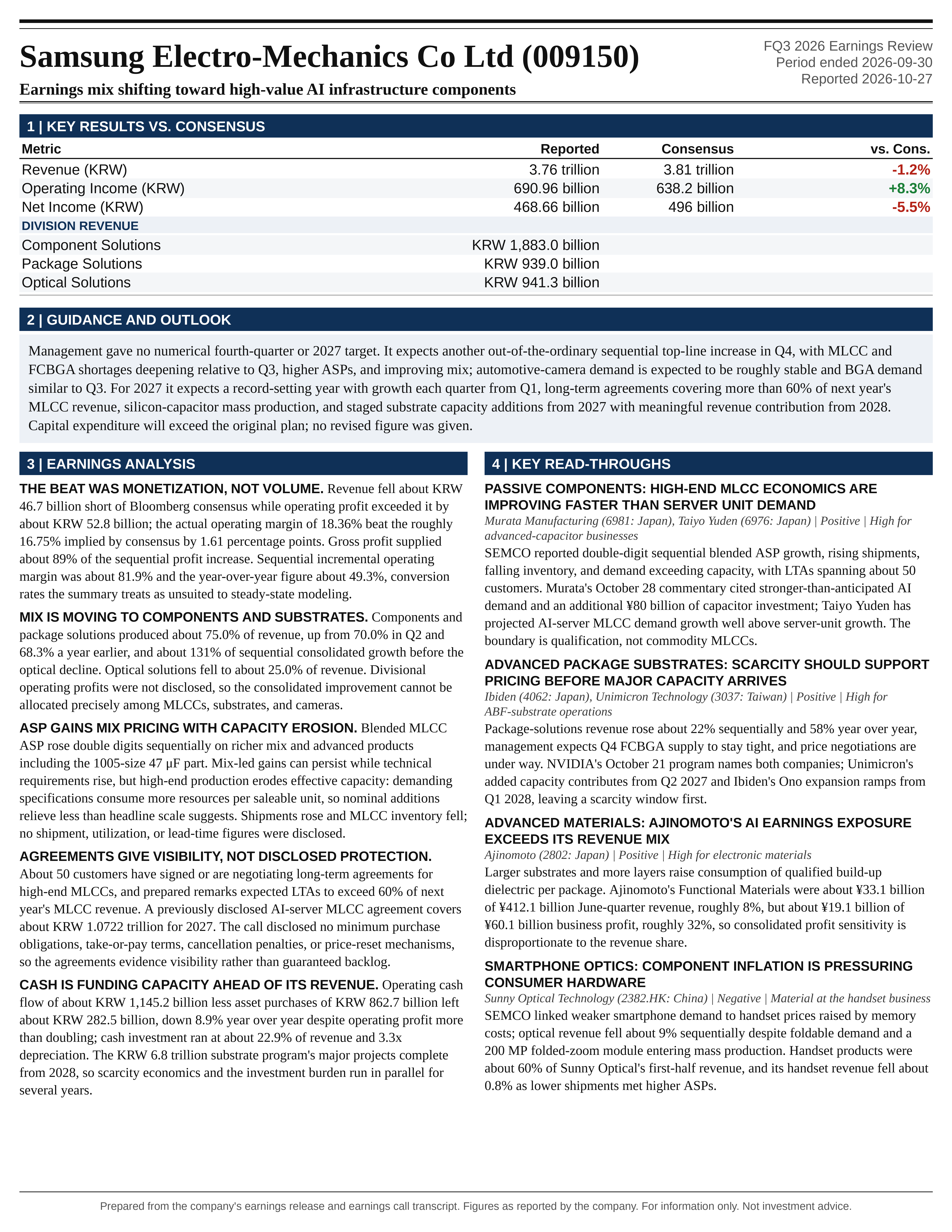
Samsung Electro-Mechanics delivered a substantial operating-profit beat and materially strengthened the evidence that its earnings mix is shifting toward high-value AI infrastructure components. The principal investment implication is positive for operating-earnings expectations, but more qualified for equity returns following the 9.7% share-price increase reported in the accompanying Bloomberg notice. The appropriate conclusion is to retain exposure rather than add indiscriminately: the operating trajectory is improving rapidly, while the durability of scarcity-driven margins, contractual protections, and returns on the expanding capital program remain less fully established.
Q3 revenue of KRW 3,763.3 billion increased 8.9% sequentially and 30.3% year over year. Operating profit of KRW 690.96 billion increased 56.9% sequentially and 165.5% year over year, exceeding Bloomberg consensus by 8.3%, despite revenue falling 1.2% below consensus. Operating margin reached 18.4%, compared with 12.7% in Q2 and 9.0% in Q3 2025. This was predominantly a profitability surprise rather than a revenue surprise. Net income attributable to shareholders of the parent increased 113.2% year over year to KRW 468.66 billion but missed consensus by 5.5%, reflecting the importance of separating operating performance from below-operating-line earnings.
The most consequential forward statement was management’s expectation that unusually strong sequential growth would continue through Q4 and into 2027. Management stated that “Q4 is expected to deliver another out-of-the-ordinary QoQ top-line growth,” supported by higher average selling prices, improving product mix, and increasing AI data-center exposure. The subsequent assertion that 2027 should be “a record-setting year for SEMCO, with significant growth achieved each quarter-after-quarter, starting from Q1” establishes an unusually demanding trajectory. These statements are qualitative guidance, not numerical revenue, margin, or earnings commitments.
The strategic case rests on overlapping advantages in high-capacitance MLCCs, advanced package substrates, and the integration of passive components within substrates. These capabilities address increasingly difficult power-delivery and packaging requirements rather than simply higher semiconductor shipment volumes. However, the associated businesses remain exposed to the same underlying AI infrastructure investment cycle. Product diversification within a data center is not equivalent to economic diversification away from hyperscaler capital expenditure.
The financial qualification is important. Operating cash generation improved sharply, but operating cash flow less cash purchases of tangible and intangible assets was approximately KRW 282.5 billion, below KRW 310.1 billion in Q3 2025. The company is converting stronger earnings into substantially greater investment rather than proportionately greater near-term cash available to shareholders. The investment debate has therefore shifted from whether AI demand is benefiting Samsung Electro-Mechanics to how much of the resulting profit uplift can persist after capacity additions, depreciation, competitive responses, and customer funding obligations are incorporated.
QUARTERLY PERFORMANCE AND THE QUALITY OF THE EARNINGS BEAT
The reported revenue shortfall against Bloomberg consensus was approximately KRW 46.7 billion, while operating profit exceeded consensus by KRW 52.8 billion. Actual operating margin of 18.36% exceeded the approximately 16.75% margin implied by consensus revenue and operating profit by 1.61 percentage points. This combination indicates that aggregate sales expectations were already demanding, but the company monetized its revenue base more effectively than anticipated. It does not establish whether the revenue shortfall arose from cameras, capacity constraints, currency, or another factor because a matched divisional consensus bridge was not disclosed.
The official earnings presentation provides a useful explanation of the sequential profit improvement. Gross profit increased by approximately KRW 223.4 billion, while selling, general and administrative expenses declined by approximately KRW 27.1 billion. These movements explain essentially all of the approximately KRW 250.6 billion sequential operating-profit increase, subject to rounding. Approximately 89% of the improvement came through gross profit and 11% through lower operating expenses. The earnings acceleration was therefore substantially rooted in the economics of products sold, although the expense decline also contributed.
Gross margin expanded from approximately 24.4% to 28.4% sequentially, while the SG&A ratio declined from approximately 11.7% to 10.0%. The gross-margin improvement is consistent with management’s discussion of richer product mix, higher blended ASPs, and constrained supply. The call did not provide enough detail to allocate that improvement precisely among like-for-like pricing, utilization, manufacturing yields, product mix, and currency. Similarly, the decline in absolute SG&A should not be treated as a permanently repeatable efficiency gain without further disclosure about expense timing.
Sequential incremental operating margin was approximately 81.9%, calculated as the change in operating profit divided by the change in revenue. The comparable year-over-year figure was approximately 49.3%. These unusually high conversion rates demonstrate powerful operating leverage during the quarter, but they are inappropriate steady-state modeling assumptions. Mix changes and lower operating expenses can temporarily generate exceptionally high incremental margins, particularly when revenue is migrating toward scarce, technically differentiated products. Future quarters will also absorb costs associated with new capacity, qualifications, depreciation, and business development.
The historical comparison strengthens the conclusion that this was more than an ordinary seasonal recovery. Revenue grew approximately 30% year over year, while operating margin more than doubled. Nevertheless, the quarter’s profitability should not automatically be characterized as fully structural. A defensible earnings model must distinguish the durable contribution from more sophisticated products and deeper customer integration from the potentially cyclical contribution of acute supply shortages.
The official presentation identifies KRW 468.7 billion as net income attributable to owners of the parent, versus approximately KRW 485.0 billion of consolidated continuing-operations income. The difference is principally relevant to the treatment of noncontrolling interests. The effective tax rate calculated from the disclosed pretax profit and income-tax expense was approximately 20.5%, compared with 24.3% in Q2 and 20.2% a year earlier. Calculating the tax rate by subtracting parent-attributable income directly from pretax profit would incorrectly incorporate noncontrolling interests.
Net nonoperating expense increased to approximately KRW 81.2 billion from KRW 7.1 billion in Q2, versus net nonoperating income of KRW 21.4 billion a year earlier. This materially diluted the operating-profit improvement before it reached shareholders. Management acknowledged unfavorable foreign-exchange effects, but the available disclosures do not establish that the entire nonoperating deterioration was caused by currency or that it will reverse. The consensus net-income miss cannot be allocated precisely among currency, financing, other nonoperating items, tax, and noncontrolling interests without corresponding consensus assumptions.
REVENUE MIX AND THE CHANGING ECONOMIC CENTER OF THE COMPANY
Components generated KRW 1,883.0 billion of revenue, package solutions KRW 939.0 billion, and optical solutions KRW 941.3 billion. Components and package solutions together represented approximately 75.0% of consolidated revenue, compared with 70.0% in Q2 and 68.3% in Q3 2025. Optical solutions declined to approximately 25.0% of revenue from 30.0% sequentially and 31.7% a year earlier. The consolidated revenue mix is consequently becoming less dependent on smartphone camera-module seasonality.
Components contributed approximately KRW 233.6 billion of sequential revenue growth and package solutions approximately KRW 167.4 billion. Optical solutions offset these increases by approximately KRW 94.9 billion. Components and packaging therefore generated approximately 131% of consolidated sequential growth before the camera decline. On a year-over-year basis, those businesses accounted for approximately 97% of incremental consolidated revenue.
This shift provides a credible explanation for the magnitude of consolidated margin expansion. However, divisional operating profits were not disclosed in the materials, so the precise profitability of MLCCs, FCBGA substrates, BGA substrates, and cameras cannot be reconstructed. It would be inappropriate to assign the entire consolidated improvement to a particular division or to infer specific divisional operating margins.
Revenue categories also require careful separation. Component revenue is not synonymous with MLCC revenue; the presentation shows capacitors accounting for approximately 92% of the division. Likewise, package solutions include both FCBGA and BGA products. An MLCC-specific ASP increase, a particular server-substrate volume target, or an AI application growth rate should not be applied mechanically to the entire associated division.
MLCC PERFORMANCE: STRONGER MONETIZATION, NOT SIMPLY MORE UNITS
Component revenue increased 14.2% sequentially and 36.3% year over year. Management described growth across industrial, IT, and automotive applications, with AI data-center products providing the most significant mix improvement. Within data centers, demand extended beyond accelerators to CPUs, network switches, optical modules, and power infrastructure. This breadth increases Samsung Electro-Mechanics’ potential content per deployed system and reduces dependence on any particular component location.
The central quarterly disclosure was that “Blended ASP in Q3 increased double digit on a quarter-on-quarter basis.” Management attributed this to a greater contribution from industrial and automotive applications and increased shipments of advanced products including 1005-size 47 μF, 0603-size 10 μF, and 1608-size 100 μF MLCCs. The wording supports improved realized revenue per unit, but not a conclusion that every product received a double-digit price increase. A blended ASP can rise substantially through product substitution even when prices for unchanged products move less.
This distinction matters for both forecasting and valuation. Mix-led ASP improvement can be durable when it follows sustained increases in technical requirements, but it can also consume more production resources per saleable unit. Pure pricing increases may generate stronger incremental margins but can be more vulnerable to customer negotiations and eventual supply normalization. The call suggests that both mechanisms are operating, but does not quantify their respective contributions.
Management reported higher shipments and lower MLCC inventory. This is directionally consistent with strong sell-through and constrained availability. However, no numerical shipment growth, inventory weeks, product-level utilization, or order-to-delivery lead times were supplied in the answer to the analyst’s operating-metrics question. The absence of these measures limits the ability to distinguish physical-volume acceleration from monetization and mix. It also prevents a reliable estimate of how much additional demand can be served before the Philippines facility ramps.
The company’s description of “capacity erosion caused by high-end MLCC production” is economically important. Effective capacity cannot be assessed solely by counting installed equipment or comparing nominal unit output. More demanding capacitance, size, voltage, temperature, and reliability specifications can reduce throughput or raise the production resources required per accepted device. Revenue can consequently grow substantially faster than unit shipments, while announced capacity additions provide less relief than their headline scale suggests.
LONG-TERM AGREEMENTS: IMPROVED VISIBILITY WITH UNDISCLOSED ECONOMIC PROTECTION
Management reported that approximately 50 customers had signed or were negotiating long-term agreements for high-end MLCCs. This compares with more than 10 signed customers disclosed around the Q2 results. The commercial pipeline has clearly broadened, but the comparison is not equivalent to a 5x increase in executed contracts. The current figure combines signed agreements and negotiations, while the earlier figure referred to completed agreements.
There is a related distinction within the current call. Prepared remarks indicated that LTAs were expected to represent “more than 60% of our next year MLCC revenue,” while the Q&A referred to “more than half.” These statements are not necessarily contradictory because more than 60% also satisfies the less precise formulation. However, neither statement establishes that more than 60% of 2027 revenue is already covered by fully executed, noncancelable purchase obligations. The most defensible interpretation is a management expectation for majority LTA-linked revenue, with a more ambitious prepared-remarks indication above 60%.
The operational benefits are credible. Better demand visibility can support capacity allocation, longer production runs, more efficient scheduling, and earlier participation in customers’ next-generation designs. Management specifically stated that agreements allow the company to “efficiently plan out our production for maximum productivity.” These benefits can support profitability even without exceptional contractual pricing.
The financial protections remain less clear. The call did not disclose minimum purchase obligations, take-or-pay provisions, cancellation penalties, deposits, customer termination rights, price-reset mechanisms, or the allocation of qualification risk. Agreements that reserve capacity but allow market-based pricing provide different protection from fixed-price purchase contracts. Customer forecasts also provide different protection from enforceable minimum volumes. The appropriate valuation response is improved visibility, not the treatment of expected LTA revenue as guaranteed backlog or a guaranteed earnings floor.
Earlier official announcements provide evidence that the transition is substantive rather than purely aspirational. Samsung Electro-Mechanics disclosed an approximately KRW 1.0722 trillion AI-server MLCC supply agreement covering 2027. That establishes a material commercial commitment, but it should not be added to a forecast that already includes the associated MLCC revenue. Nor should the amount be combined indiscriminately with contracts covering different products and delivery periods.
AI MLCC CONTENT: A COMPELLING DIRECTION WITH IMPORTANT TECHNICAL QUALIFICATIONS
Management’s most aggressive product forecast concerned the 1005-size 47 μF MLCC, which it said was being supplied to major new big-tech platforms and was expected to experience roughly 8x demand in 2027. Contemporaneous Seoul Economic Daily coverage described this as stronger than the prior quarter’s expectation of more than 7x. The change is directionally positive, but the open-ended earlier wording does not support a precise percentage revision. More importantly, the current transcript attaches the 8x forecast to a specific product, not to total MLCC revenue or component revenue.
Demand, available supply, shipments, and recognized revenue remain separate quantities. A product can experience an 8x increase in customer requirements without Samsung Electro-Mechanics being able to ship 8x as much. The revenue outcome also depends on qualification schedules, allocation decisions, realized pricing, and substitution into subsequent products. A rapidly expanding product category may additionally displace older MLCCs rather than representing entirely incremental demand.
Management’s “AI MLCC’s law” links increasing die counts and power consumption to a doubling of core-power capacitance requirements. The underlying direction is plausible: higher current requirements and more demanding transient behavior increase the importance of low-impedance power delivery close to the semiconductor. However, this is a management planning framework, not a universal physical law. Required capacitance depends on current transients, allowable voltage droop, regulator response, package inductance, operating voltage, and the partitioning of capacitance across the die, package, substrate, and board.
Nominal capacitance alone is also an incomplete measure of customer value. Effective capacitance under operating bias, temperature stability, equivalent series resistance, equivalent series inductance, mechanical reliability, and placement constraints can be decisive. This supports the company’s emphasis on technically differentiated products, but it also means that increasing capacitance requirements need not translate linearly into higher MLCC unit counts or revenue.
The optical-module opportunity broadens the thesis beyond accelerator packages. Management projected approximately 3x year-over-year MLCC revenue growth for high-speed optical modules in 2027 and stated that a 1.6 Tbps module requires capacitance comparable to a smartphone. The comparison illustrates increasing electrical content per communications module, not equivalent component revenue or profitability. Module volumes, product specifications, and starting revenue were not disclosed, so the 3x forecast cannot yet be translated into a material consolidated growth contribution.
The 800 V power-distribution transition provides another potentially valuable application. Management expects associated DC-DC converters to use MLCCs rated above 1 kV and sees an opportunity to leverage products already developed for automotive onboard chargers. Existing technology can reduce development risk and shorten commercialization timelines. However, matching nominal voltage specifications does not eliminate the need for application-specific reliability testing, qualification, and commercial adoption.
Automotive demand adds a further content driver through ADAS computing and the transition toward 48 V architectures. The reported qualification of a 100 V-class, 100 μF product is more tangible than a general market-growth assertion because it indicates progress toward customer volume. Nevertheless, qualification is not a disclosed revenue commitment, and automotive platform cycles generally develop over longer periods than near-term AI server demand.
SILICON CAPACITORS AND THE INTEGRATED POWER-DELIVERY OPPORTUNITY
Silicon capacitors represent a distinct 2027 growth opportunity rather than an explanation for Q3’s earnings acceleration. Management reiterated that mass production is planned for 2027 and discussed embedded and land-side configurations. The previously announced approximately KRW 1.5 trillion supply agreement covers 2027 and 2028. An equal allocation would imply approximately KRW 750 billion annually, but that is only an arithmetic reference point. The actual delivery schedule and revenue-recognition profile were not disclosed.
The strategic relevance is greater than the initial contract alone. Samsung Electro-Mechanics is extending from supplying discrete components into managing power integrity across multiple packaging layers. Silicon capacitors can address local power-delivery requirements where very low inductance and proximity to the semiconductor are particularly valuable. MLCCs can remain important elsewhere in the power-distribution network, making the technologies complementary in many configurations.
Substitution risk nevertheless remains. The distribution of value among discrete MLCCs, embedded capacitors, silicon capacitors, package structures, and voltage-regulation solutions can change as architectures evolve. The company’s participation across these categories provides a potential hedge against technological migration, but it does not guarantee that every category grows independently. Forecasts should avoid adding the full silicon-capacitor opportunity on top of an MLCC forecast that already assumes unchanged content at every power-delivery location.
Production execution is the main near-term uncertainty. A large contract establishes commercial relevance, but not mature yields, utilization, contribution margins, or cash returns. The 2027 launch could add meaningful revenue while initially diluting margins through startup costs. Conversely, successful ramping and additional customers could create a more defensible earnings stream than scarcity pricing alone.
PACKAGE SOLUTIONS: CONTENT GROWTH AND SUPPLY CONSTRAINTS REINFORCE EACH OTHER
Package-solutions revenue increased 21.7% sequentially and 58.3% year over year, substantially faster than consolidated revenue. Growth extended across server CPUs, AI accelerators, networking, automotive applications, memory substrates, and ARM-related products. This indicates that the business is benefiting from both stronger underlying demand and a more valuable product mix.
The key supply-side mechanism is greater manufacturing intensity per package. Larger substrates reduce the number of units that can be processed within a given manufacturing footprint, while higher layer counts and more demanding interconnect structures add process complexity. Warpage control and yield become increasingly important as dimensions and integration requirements rise. Consequently, industry unit capacity can appear adequate while capacity for qualified high-end substrates remains constrained.
Management stated that “we are in price talks to improve our profitability,” citing insufficient capacity and higher raw-material prices. This supports potential further margin improvement, but it is not confirmation that all requested increases have been implemented. It also distinguishes commercial repricing from mix-driven ASP growth. Raw-material pass-through can increase revenue without producing the same margin benefit as scarcity pricing.
The embedded-component opportunity is strategically significant. Bringing passive components inside the substrate can shorten power-delivery paths and reduce parasitic inductance, supporting power stability at high current densities. Samsung Electro-Mechanics’ ability to combine substrate manufacturing with internally developed passive components may improve design coordination and customer qualification. Management’s assertion that it is the only supplier offering this combination should remain an attributed company claim rather than an independently established monopoly position. Competitors can potentially address similar system requirements through partnerships or alternative architectures.
The near-term volume target is narrower than a headline reading might imply. Management plans to double Q4 supply of server CPU substrates using embedding and multi-core technologies. This does not mean total package-solutions revenue, total FCBGA volume, or all server-substrate shipments will double. The starting revenue base and associated margins were not provided. Nevertheless, expansion from existing mass production is a more credible near-term catalyst than an unqualified development program.
The 2027 roadmap extends these technologies into AI accelerators, network switches, and automotive applications. Longer-term discussion of embedding active components is strategically relevant but remains developmental. It should not be capitalized as a near-term earnings contribution without design wins, production timing, and manufacturing economics.
The customer relationship is partly corroborated outside the call. Samsung Electro-Mechanics and NVIDIA announced a substrate partnership on October 21, including existing Korean capacity, dedicated production expansion, and increasing allocations through 2028. This independently establishes NVIDIA exposure, but it does not identify every unnamed customer discussed during the call. It also means that the NVIDIA relationship was already public before the earnings release; the incremental earnings-call information concerns execution, demand intensity, pricing, and ramp timing rather than the initial existence of that relationship.
OPTICAL SOLUTIONS: PHYSICAL AI PROGRESS DOES NOT YET OFFSET SMARTPHONE EXPOSURE
Optical-solutions revenue declined 9.2% sequentially and increased only 2.9% year over year. The division was the principal offset to consolidated sequential growth. Strong foldable-phone demand and the start of mass production for a 200 MP folded-zoom module were insufficient to overcome weaker overseas smartphone-camera demand.
Management attributed part of the smartphone weakness to higher handset prices associated with increased memory costs. This creates an important cross-business tension. AI infrastructure demand can support Samsung Electro-Mechanics’ components and substrates while broader semiconductor-cost inflation pressures consumer-device affordability. The company is not uniformly advantaged by every consequence of the AI investment cycle.
Automotive cameras performed better, supported by next-generation EV platforms, higher-resolution all-weather cameras, and robotaxi applications. Q3 also marked the start of mass production of humanoid sensing modules. This is a meaningful execution milestone relative to the Q2 discussion of preparing new applications, but there was no disclosure of robotics revenue, unit volumes, content per robot, or profitability. Physical AI should therefore be treated as a developing growth option rather than a demonstrated driver of current consolidated earnings.
The call’s strongest camera-related opportunity is increasing technical differentiation through sensing precision, reliability, lens and actuator capabilities, and integrated modules. These attributes could support more attractive economics than commodity smartphone-camera assembly. However, automotive and robotics applications bring different qualification cycles and reliability obligations, and early production does not establish broad commercial adoption.
Management expects automotive-camera demand relevant to the company to be approximately stable sequentially in Q4. Near-term optical performance therefore still depends heavily on flagship-product preparations and smartphone demand. A new North American customer expected to onboard in 2027 adds potential diversification, but the customer and product were not identified. Assigning a specific company would exceed the disclosure.
GUIDANCE: WHAT CHANGED AND WHAT WAS ALREADY EXPECTED
The July 30 company release already anticipated strong Q3 AI, data-center, and automotive-component demand, increased production of advanced substrates, and additional MLCC supply agreements. Contemporaneous Q2 call coverage also described management as expecting record Q3 performance and continued improvement into 2027. The current record quarter therefore validates an existing direction rather than introducing the AI growth thesis for the first time.
What changed is the demonstrated profitability of that growth and the specificity of its continuation. The company moved from anticipating strong demand to reporting an 18.4% operating margin, double-digit sequential blended MLCC ASP growth, a much broader LTA pipeline, and an explicit expectation of further sequential revenue growth through the normally weaker Q4 period. Current guidance also extends the intended growth cadence to every quarter of 2027.
For Q4, the strongest signals concern MLCC and high-end FCBGA demand, pricing, and mix. The company expects shortages in these products to deepen relative to Q3. The camera and conventional BGA outlooks are more restrained: automotive-camera demand is expected to be approximately stable, while BGA demand overall is expected to resemble Q3 despite continuing AI-related growth. Consolidated strength is therefore expected to remain concentrated in the more technically demanding portions of the portfolio.
The language supports a stronger near-term earnings outlook, but no numerical Q4 revenue range, operating-margin target, profit forecast, or full-year 2027 target was supplied. The company also did not provide a quantified foreign-exchange assumption. Consequently, there is no defensible percentage calculation for an aggregate management-guidance increase. The Bloomberg operating-profit beat is a comparison with analyst consensus, not a quantified beat against a disclosed management forecast.
The statement about quarterly growth throughout 2027 deserves particular scrutiny. It implies that structural demand, mix, and supply additions are expected to overcome normal seasonal patterns. However, management did not specify a numerical growth rate or establish that every financial metric must increase each quarter. The statement should be treated as a strong directional commitment whose credibility will be tested by actual sequential delivery, not as a guaranteed quarterly earnings staircase.
CAPITAL EXPENDITURE AND THE TIMING OF SUPPLY RELIEF
Management explicitly indicated that capital expenditure would be higher than originally expected. The reasons included capacity expansion, supplementary investment, land and infrastructure requirements, silicon capacitors, and glass substrates. No revised annual amount was provided. The upward revision is therefore clear in direction but cannot be quantified from the call.
The approximately KRW 6.8 trillion substrate program is a multiyear investment commitment, not a disclosed 2026 cash-capex amount. The September announcement specified approximately KRW 4.27 trillion for Sejong and KRW 2.51 trillion for Vietnam. These commitments are large relative to the existing company, representing approximately 40% of Q3 assets and 65% of equity. The scale makes capital allocation and funding terms central to the investment thesis.
Project timing requires more precision than the broad call wording provides. The call described staged mass production beginning in 2027 and meaningful revenue contributions from 2028 across the expansion program. The September announcement specified Sejong mass production from September 2028 and targeted completion and operation of the Vietnam expansion by June 2030. The likely distinction is between earlier incremental capacity additions and later completion of major projects. The disclosures should not be collapsed into an assumption that the entire KRW 6.8 trillion program becomes productive in 2027.
This sequencing supports a near-term scarcity thesis while increasing medium-term execution risk. Major substrate additions arrive after the period in which management expects demand and ASPs to remain strong. However, capital is committed before those later revenues are realized. Delays, lower yields, changing customer architectures, or weaker utilization could therefore reduce returns even if the current demand environment remains favorable.
Customer funding support and volume commitments improve the investment proposition, but their economic form matters. Nonrepayable contributions, shared ownership, refundable advances, capacity-reservation payments, and future purchase credits create different exposures. Funding that must ultimately be credited against deliveries is not free capital and should not be counted both as a financing benefit and as unchanged future cash receipts. The call did not provide the information required to calculate Samsung Electro-Mechanics’ net capital at risk.
An illustrative return hurdle demonstrates why the revenue conversion matters. A 10% annual after-tax operating return on KRW 6.78 trillion of fully deployed gross investment would require approximately KRW 678 billion of annual after-tax operating profit. At an assumed 20% tax rate and 20% operating margin, that corresponds to approximately KRW 4.24 trillion of incremental annual revenue. This is not company guidance or a project IRR calculation. It excludes construction timing, working capital, maintenance investment, and customer contributions, but illustrates the scale of earnings required to justify the program economically.
Glass substrates targeted for full operation in 2028 add further strategic optionality and investment requirements. The call did not disclose customer commitments, revenue expectations, or returns for this business. It should remain separate from the more immediate MLCC and FCBGA earnings case rather than being used to justify current valuation through an unquantified future opportunity.
CASH GENERATION, LEVERAGE, AND EARNINGS CONVERSION
The quarterly cash-flow statement shows operating cash flow of approximately KRW 1,145.2 billion against cash purchases of tangible and intangible assets of KRW 862.7 billion. The resulting analytical cash-flow measure of KRW 282.5 billion improved from approximately negative KRW 21.4 billion in Q2 but declined 8.9% year over year. This is operating cash flow less those asset purchases, before dividends and other financing items, rather than a separately defined company free-cash-flow measure.
The contrast with operating-profit growth is substantial. Operating cash flow more than doubled year over year, but capital spending increased by approximately 308%. Cash investment represented approximately 22.9% of revenue and 3.3x quarterly depreciation. The company is therefore building capacity much faster than the current depreciation charge would suggest. This can support future growth, but it also creates a larger depreciation and utilization burden as projects enter service.
Lower inventory and relatively restrained receivables growth are encouraging. Consolidated inventory declined approximately KRW 206.5 billion sequentially, while receivables increased approximately KRW 31.6 billion despite higher revenue. These balances are consistent with favorable working-capital behavior, but balance-sheet movements are not identical to cash-flow contributions because currency and other adjustments can intervene. The current cash-conversion rate should not be annualized without the detailed working-capital and customer-advance bridge.
The leverage ratios reported on the call require a balanced interpretation. Gross debt increased, but cash increased more. On the presentation’s cash and debt definitions, the company held approximately KRW 687.4 billion of net cash, compared with KRW 320.0 billion in Q2. The increase in debt-to-equity to approximately 33% therefore does not by itself establish deteriorating net liquidity.
Nevertheless, a large portion of the quarterly cash increase was associated with financing inflows rather than retained free cash flow alone. The net-cash position is helpful but modest relative to the multiyear investment program. The relevant risk is less immediate solvency than the possibility that funding requirements, capital commitments, and future depreciation grow faster than durable operating cash generation.
COMPETITIVE IMPLICATIONS AND THE LIMITS OF SCARCITY
The call supports a favorable near-term view of technically qualified suppliers across high-end MLCCs and advanced substrates. It does not establish that all suppliers will benefit equally or that broad component shortages imply uniform pricing power. Qualification history, effective capacity, product architecture, yields, and customer relationships determine how much of the demand opportunity can be captured.
The NVIDIA announcement provides both corroboration and an important counterweight. NVIDIA described plans for approximately 2.5x aggregate substrate capacity over 3 years through multiple suppliers, including Samsung Electro-Mechanics, IBIDEN, and Unimicron. This supports the view that substrate availability is strategically important, while also showing that customers are actively creating redundancy and increasing future supply. Near-term shortages and medium-term capacity normalization can coexist.
Samsung Electro-Mechanics’ potential advantage is the combination of high-end passive components and advanced substrate capabilities. The risk is that customers use additional qualified suppliers and funded capacity to reduce dependence and constrain future economic rents. Customer co-investment can improve demand visibility while simultaneously increasing the customer’s influence over pricing and capacity allocation.
Commercial diversification also requires qualification. Approximately 50 signed or prospective MLCC customers is encouraging, but multiple semiconductor designers and module suppliers can ultimately depend on the same hyperscaler deployment plans. Exposure across accelerators, networks, power modules, and optical links remains positively correlated to AI infrastructure spending. The portfolio should not treat these revenue streams as independent risk factors.
ILLUSTRATIVE 2027 OPERATING SCENARIOS
The following scenarios are analytical sensitivities rather than company guidance, consensus forecasts, or price targets. The probabilities are judgmental, with medium confidence in continued operating growth but lower confidence in its magnitude. Q3 annualized revenue of approximately KRW 15.05 trillion and operating profit of KRW 2.76 trillion provide comparison points, not forecasts of full-year 2026 results.
The base case, assigned a 55% probability, assumes 2027 revenue of KRW 17.5 trillion and an operating margin of 21%, producing approximately KRW 3.68 trillion of operating profit. This requires continued high-end MLCC and substrate growth, successful initial silicon-capacitor commercialization, and further mix improvement, while allowing for startup expenses and a subdued camera business. Operating profit would be approximately 33% above the annualized Q3 level. The principal confirmation would be sustained sequential growth without a material deterioration in cash conversion or manufacturing execution.
The bull case, assigned a 25% probability, assumes revenue of KRW 19.5 trillion and a 24% operating margin, producing approximately KRW 4.68 trillion of operating profit. This requires strong pricing realization, continued supply constraints, successful high-value product ramps, and better-than-base-case capacity productivity. Operating profit would be approximately 69% above the annualized Q3 level. The outcome would be challenged by delayed qualifications, insufficient saleable output, or customer agreements that secure volumes while limiting price realization.
The bear case, assigned a 20% probability, assumes revenue of KRW 14.5 trillion and a 14.5% operating margin, producing approximately KRW 2.10 trillion of operating profit. This allows for weaker customer ordering, pricing normalization, delayed new-product revenue, and higher startup or depreciation costs. Operating profit would be approximately 24% below the annualized Q3 level. This scenario does not require the AI market to contract structurally; a pause in deployments or a mismatch between capacity commissioning and demand could be sufficient.
The scenarios demonstrate that margin durability matters as much as revenue growth. At the Q3 revenue scale, each 1 percentage point of operating margin represents approximately KRW 37.6 billion of quarterly operating profit, or KRW 150.5 billion on a simple annualized basis. A valuation framework that assumes peak scarcity margins persist indefinitely can consequently overstate value even if long-term revenue growth remains attractive.
INVESTMENT IMPLICATIONS, CATALYSTS, AND RISK DISCIPLINE
The operational assessment is favorable with medium-to-high confidence: the company is delivering measurable earnings growth from increasingly demanding AI infrastructure requirements, and the quarter validates several previously announced commercialization efforts. Confidence is lower in the exact duration of elevated margins and the shareholder returns from the investment program because contract economics, divisional profitability, and project-level returns remain incomplete.
The Bloomberg notice’s 9.7% share-price rise to KRW 1.32 million indicates that the operating beat and forward commentary received a substantial immediate valuation response. Its 30 buy recommendations, with 0 holds and 0 sells, indicate uniformly favorable analyst recommendations, not proof of actual investor positioning. The principal implication is a high expectations burden: merely meeting management’s increasingly confident narrative may not be sufficient to generate attractive incremental returns.
The recommendation is to hold rather than chase the earnings reaction. No new position is justified solely by the operating-profit beat without an updated valuation incorporating cash investment, customer funding, normalized margins, and the timing of major capacity additions. The materials do not establish a defensible target price or prospective equity return. Positive earnings revisions and an attractive entry valuation are separate conclusions.
For a portfolio electing to retain exposure, a conservative conditional framework would cap standalone risk at approximately 1% of NAV pending fuller cash-return visibility, particularly where other holdings already carry substantial AI infrastructure exposure. An illustrative 12% price-loss limit would imply approximately 0.12% of NAV at risk before gaps, currency movements, and trading costs. Applied to the notice’s KRW 1.32 million reference price, that corresponds to approximately KRW 1.16 million. This is a risk-management reference, not technical support or an estimate of intrinsic value.
The most immediate catalyst is Q4 delivery against the promised counter-seasonal growth, particularly whether higher MLCC ASPs and advanced-substrate shipments translate into sustained operating margins. Subsequent catalysts include conversion of prospective LTAs into executed agreements, the Philippines MLCC ramp, silicon-capacitor production in 2027, and broader commercialization of embedded substrates. The major substrate projects and glass-substrate ambitions belong primarily to the 2028-and-beyond assessment.
Fundamental reduction or exit triggers should include material contract deferrals or cancellations, sequential MLCC and FCBGA weakness inconsistent with the stated demand outlook, significant production delays, or declining margins while investment obligations continue to rise. A Q4 operating margin below approximately 17%, absent a clearly identified temporary explanation, would warrant a substantive thesis review. That threshold is an analytical risk trigger, not management guidance.
The central underwriting question is whether Samsung Electro-Mechanics is establishing durable returns from technically differentiated products or temporarily earning exceptional margins during a supply shortage. Q3 provides strong evidence for the former, but not enough to dismiss the latter. The strongest investment case combines successful product transitions, disciplined capacity deployment, enforceable customer commitments, and sustained cash generation. Revenue records and rising ASPs alone do not complete that case.
SOURCE BASIS AND LIMITATIONS
Financial comparisons use the supplied Q3 call and Bloomberg notice, supplemented by Samsung Electro-Mechanics’ October 28 earnings presentation. Prior-outlook comparisons use the July 30 company release and dated call coverage. Contract and investment context uses company announcements concerning silicon capacitors, MLCC supply agreements, the September substrate expansion, and the October 21 NVIDIA partnership, alongside NVIDIA’s announcement. The prior 7x demand expectation is supported by Seoul Economic Daily’s October 28 retrospective coverage rather than a fully accessible prior-call transcript. Forward statements remain management expectations; scenario figures, return hurdles, and portfolio risk parameters are analytical assumptions. Segment profitability, detailed contract protections, revised annual capex, and project returns remain undisclosed in the materials.
COMPANY EMPLOYEES ON THE CALL
• Dong Woo Lee, Executive Vice President and Head of the IR and Planning Team. • Sung Jin Kim, Chief Financial Officer. • Taegon Lee, Executive Vice President and Head of Strategic Marketing. • Kyu-Taeck Park, Vice President and Head of the Support Team, Component Division. • Pan Bae Kim, Executive Vice President and Head of the Support Team, Package Solution Division. • Hyun Jung Kim, Head of the Support Team, Optic Solution Division.
RESEARCH ANALYSTS ON THE CALL
• Hyunji Cho, DB Securities. • Kyung Hoon Park, SK Securities. • Junseo Park, Mirae Asset Securities. • Woon-ho Kim, IBK Investment and Securities.
Key Read-Throughs
KEY READ-THROUGHS FROM SAMSUNG ELECTRO-MECHANICS’ Q3 2026 EARNINGS CALL
Samsung Electro-Mechanics’ results indicate that AI infrastructure spending is increasingly benefiting suppliers of technically demanding power-delivery components and package substrates, not simply semiconductor manufacturers. Operating profit increased approximately 57% sequentially against revenue growth of approximately 9%, while management expects MLCC and FCBGA shortages to deepen in Q4 and persist into 2027. The strongest read-through is therefore a widening divergence between qualified suppliers that can monetize higher component content, manufacturing complexity, and constrained capacity, and downstream businesses that must absorb higher costs or fund supply expansion. The most actionable implications concern Japanese passive-component manufacturers, Taiwanese and Japanese substrate suppliers, advanced materials, and packaging equipment. The clearest negative transmission is into smartphone-related optics, where memory-cost inflation is already affecting demand. Magnitude assessments below refer to business and financial sensitivity, not predicted share-price returns. Country labels identify operating home markets.
PASSIVE COMPONENTS: HIGH-END MLCC ECONOMICS ARE IMPROVING FASTER THAN SERVER UNIT DEMAND (READ-THROUGH 1)
Affected companies: Murata Manufacturing (6981: Japan) and Taiyo Yuden (6976: Japan). Direction: positive. Magnitude: high for advanced-capacitor businesses and potentially material for consolidated earnings, although neither company should be assigned Samsung Electro-Mechanics’ growth rates or margins.
The supporting evidence is unusually strong: Samsung Electro-Mechanics reported double-digit sequential growth in blended MLCC ASP, increasing shipments, declining inventory, and demand exceeding capacity expansion. Management attributed additional supply pressure to “capacity erosion caused by high-end MLCC production.” Its 1005-size 47 μF product is expected to experience approximately 8x demand in 2027, while signed and prospective LTAs now involve approximately 50 customers.
The transmission mechanism is greater component value and manufacturing intensity per AI system. Higher capacitance, smaller dimensions, and stricter reliability requirements can consume more production resources per saleable device. Consequently, nominal capacity additions need not translate into equivalent growth in qualified output. Suppliers with established materials, layering, and manufacturing capabilities can benefit simultaneously from richer mix, stronger utilization, and improved pricing. This is more favorable than a conventional volume recovery in which additional output rapidly restores excess capacity.
Peer disclosures corroborate the mechanism. Murata’s October 28 management commentary identified stronger-than-anticipated AI demand and an additional ¥80 billion of capacitor investment. Taiyo Yuden’s 2026 annual report projected AI-server MLCC demand growth substantially above server-unit growth, explicitly linking the difference to component counts and higher-value specifications. Samsung Electro-Mechanics’ contribution is confirmation that these structural content trends are already translating into realized ASP improvement and continued supply tightness.
The nearest identifiable trading catalyst is Murata’s tentatively scheduled October 30 results announcement, particularly its pricing, capacity, and demand commentary. The longer-duration catalyst is successful conversion of 2027 AI-platform requirements into qualified shipments. The important boundary is product qualification: this is not a blanket positive for commodity MLCCs. Samsung Electro-Mechanics’ specific design wins cannot be transferred to competitors, and an 8x requirement for a particular product does not imply 8x industry revenue.
ADVANCED PACKAGE SUBSTRATES: SCARCITY SHOULD SUPPORT PRICING BEFORE MAJOR CAPACITY ARRIVES (READ-THROUGH 2)
Affected companies: Ibiden (4062: Japan) and Unimicron Technology (3037: Taiwan). Direction: positive for qualified high-end substrate revenue and profitability; more qualified for free cash flow. Magnitude: high for the relevant ABF-substrate operations, with consolidated sensitivity dependent on business mix.
Samsung Electro-Mechanics’ package-solutions revenue increased approximately 22% sequentially and 58% year over year. Management expects Q4 FCBGA supply to remain tight and stated that larger area and higher layer counts are creating shortages “not only [of] high-end substrates, but across all products in the substrate group.” It also disclosed price negotiations and said the announced expansion would still be insufficient to satisfy customer demand.
The mechanism extends beyond more accelerators. Larger packages reduce the number of units manufactured within a given production footprint, while additional layers increase processing requirements and execution risk. Qualified capacity is therefore consumed faster than unit-based comparisons suggest. High-end allocations can also constrain availability elsewhere in the substrate portfolio. For Ibiden and Unimicron, the resulting opportunity is improved revenue per unit of constrained manufacturing capacity, supported by customer qualification barriers and potentially stronger contractual visibility.
These exposures are independently established. NVIDIA’s October 21 announcement identified both companies in its substrate expansion program. Unimicron’s additional capacity was expected to begin contributing in Q2 2027, while Ibiden’s Ono expansion was expected to begin ramping in Q1 2028. The timing supports a period in which demand can remain strong before substantial new qualified output becomes available.
The near-term catalysts are Q4 pricing outcomes, product mix, and utilization disclosures. The longer-duration benefit depends on successful 2027–2028 ramps and customer allocations. The counterweight is that NVIDIA is deliberately expanding its supplier network, including Samsung Electro-Mechanics, and targeting substantially greater aggregate capacity. The call strengthens the near-term scarcity case, not the assumption of permanent scarcity margins. Customer-supported expansion also improves funding visibility without necessarily eliminating capex, depreciation, or utilization risk.
ADVANCED MATERIALS: AJINOMOTO’S AI EARNINGS EXPOSURE IS MUCH LARGER THAN ITS REVENUE MIX SUGGESTS (READ-THROUGH 3)
Affected company: Ajinomoto (2802: Japan). Direction: positive. Magnitude: high for electronic materials and material for consolidated profit sensitivity, despite the group’s predominantly food-related revenue base.
The relevant call evidence is the combination of larger-area substrates, additional layers, rising raw-material costs, and significant capacity investment. Samsung Electro-Mechanics also described expanding embedded-component substrates and increasingly demanding manufacturing requirements. These trends support consumption of qualified dielectric materials used in advanced build-up substrates.
Ajinomoto’s ABF is an interlayer insulating material used in these substrates. More build-up area and additional applicable dielectric layers can increase material consumption per package, even without equivalent growth in semiconductor unit shipments. More demanding electrical and thermal specifications also support opportunities in advanced material grades. The benefit is therefore linked to package architecture and production intensity, not merely aggregate chip volumes.
The less obvious implication concerns group-level earnings. Ajinomoto’s June-quarter disclosure showed Functional Materials revenue of approximately ¥33.1 billion against group revenue of ¥412.1 billion, or approximately 8%. Its Functional Materials business profit of ¥19.1 billion was equivalent to approximately 32% of consolidated business profit of ¥60.1 billion. The category includes ABF and other materials, and that comparison does not allocate central expenses to the business. Nevertheless, it demonstrates that a relatively small revenue category can exert disproportionate influence on consolidated profit.
Near-term catalysts are subsequent electronic-materials volume, product-grade mix, and profitability updates through the late-2026 reporting cycle. The 2027–2028 fundamental catalyst is higher substrate production combined with greater material intensity. This is primarily confirmation of an existing growth business, not evidence of a newly awarded Samsung Electro-Mechanics contract.
The analytical boundary is important: substrate ASP increases do not establish identical increases in ABF prices. Nor should announced substrate investment be translated directly into film revenue. The high-conviction conclusion is stronger demand for qualified advanced materials and meaningful earnings sensitivity within Ajinomoto, rather than an unsupported assumption about a particular price increase.
PACKAGING EQUIPMENT AND PROCESS CHEMISTRY: SUPPLIER INVESTMENT CAN MONETIZE BEFORE FINISHED SUBSTRATE OUTPUT (READ-THROUGH 4)
Affected company: MKS Inc. (MKSI: United States). Direction: positive. Magnitude: material for Electronics & Packaging demand, with a moderate consolidated impact because the category contains businesses beyond advanced substrates.
Samsung Electro-Mechanics stated that capex would exceed its original expectations, citing upfront infrastructure requirements, expansion of high-end FCBGA capacity, and additional customer requests beyond the announced approximately KRW 6.8 trillion program. Management described staged production additions from 2027 and meaningful revenue contributions from 2028. The September investment announcement was already public; the incremental information is higher spending expectations and continuing demand beyond the planned capacity.
MKS participates in electronics manufacturing through process equipment and chemistry, including technologies used in substrate and PCB production. Its exposure creates different timing from that of a substrate manufacturer. Equipment can generate revenue during installation and expansion, before the customer achieves full production utilization. Process chemistry subsequently benefits from manufacturing activity and, where applicable, greater processing intensity.
The call therefore supports a sustained investment cycle rather than merely a strong quarter of semiconductor shipments. Higher layer counts and more demanding interconnect structures can increase the importance of process capability and yield control. MKS’s June-quarter Electronics & Packaging revenue was approximately $381 million, roughly 31% of group revenue, establishing a meaningful exposure rather than a peripheral thematic association.
Near-term catalysts are equipment orders, backlog conversion, and customer installation schedules during late 2026 and 2027. The longer-duration opportunity is recurring process demand as new facilities reach production. This does not establish that MKS has won equipment allocations for Samsung Electro-Mechanics’ specific projects, and some orders associated with previously announced investments may already have been placed.
The cross-portfolio implication is that equipment and process suppliers can benefit while substrate manufacturers experience substantial cash-investment burdens. However, equipment delivery is not proof that qualified substrate capacity is immediately available. Installation, yield improvement, and customer qualification remain separate steps.
SMARTPHONE OPTICS: AI-RELATED COMPONENT INFLATION IS PRESSURING CONSUMER HARDWARE (READ-THROUGH 5)
Affected company: Sunny Optical Technology (2382.HK: China). Direction: negative for handset-optics volumes and utilization. Magnitude: material at the handset business, but moderated at group level by automotive, XR, and other optical applications.
Samsung Electro-Mechanics explicitly linked weaker smartphone demand to higher handset prices associated with increased memory costs. Its optical-solutions revenue declined approximately 9% sequentially despite stronger foldable-phone demand and the start of mass production for a 200 MP folded-zoom module. This is direct evidence that premium product launches and better camera specifications did not fully offset demand weakness in its customer mix.
The transmission mechanism is an adverse allocation of the handset bill of materials. Higher memory costs force manufacturers to choose among raising retail prices, accepting lower margins, reducing other specifications, or changing procurement volumes. For camera suppliers, weaker device demand can reduce shipments and factory utilization, while budget pressure can restrain camera-content upgrades outside premium models.
Sunny Optical’s own first-half disclosure establishes the relevance. Handset products represented approximately 60% of group revenue, and their revenue declined approximately 0.8% as lower camera-module shipments were largely offset by higher ASPs. Samsung Electro-Mechanics’ Q3 commentary extends the evidence of demand pressure beyond that already reported period. It is not a prediction of Sunny’s completed first-half results.
The nearest trading catalysts are Sunny’s October–December shipment disclosures and subsequent commentary on customer orders, high-end mix, and handset profitability. The longer-duration issue is whether premium imaging upgrades can continue offsetting weaker mass-market volumes while memory remains expensive.
This is not a high-conviction forecast of falling consolidated Sunny earnings. Its first-half group revenue increased, supported by non-handset businesses, and Samsung Electro-Mechanics’ customer mix is not identical. The actionable negative is narrower: an indiscriminate consumer-optics recovery thesis is weakened. AI infrastructure beneficiaries and handset-component suppliers should not be treated as participants in the same uniformly favorable electronics cycle.
DATA-CENTER OPTICS: PASSIVE-COMPONENT DEMAND CORROBORATES THE HIGHER-SPEED INTERCONNECT TRANSITION (READ-THROUGH 6)
Affected company: Coherent (COHR: United States). Direction: positive. Magnitude: high strategic relevance to data-center optics, but only moderate incremental information because Coherent had already disclosed a strong optical-growth trajectory.
Samsung Electro-Mechanics expects approximately 3x year-over-year growth in MLCC revenue associated with high-speed optical modules in 2027. Management stated that a 1.6 Tbps module requires MLCC capacitance comparable to a smartphone. This is an independent component-level indication that faster optical links are becoming more electrically demanding and commercially important within AI infrastructure.
Coherent has verified exposure through its 1.6T transceiver portfolio and associated optical technologies. The mechanism is rising bandwidth requirements, increasing deployment of high-speed links, and product transitions toward higher-performance modules. A passive-component supplier seeing greater optical-module demand provides corroboration from a different point in the supply chain rather than another forecast from an optical vendor.
The near-term catalysts are subsequent disclosures of 1.6T shipments, customer qualifications, manufacturing capacity, and product mix over the next reporting cycles. The longer-duration benefit is the increasing optical content of larger AI systems and the expansion of high-speed interconnection beyond a narrow set of initial deployments.
The denominator constraint is essential. Samsung Electro-Mechanics’ projected 3x optical-related MLCC revenue does not imply 3x optical-module units or 3x Coherent revenue. It can reflect more capacitance per module, higher-value MLCCs, customer share, and module-volume growth simultaneously. It also does not establish which laser technology, transceiver architecture, or supplier gains share.
The high-conviction read-through is continued importance of the high-speed optical transition, not a numerical earnings upgrade derived from the MLCC forecast. Power integrity and component availability can still limit finished-module shipments, so strong demand should not be confused with unrestricted supply.
DATA-CENTER POWER: 800 V ADOPTION SUPPORTS ARCHITECTURE-LEVEL SUPPLIERS, NOT JUST MORE LEGACY POWER UNITS (READ-THROUGH 7)
Affected company: Delta Electronics (2308: Taiwan). Direction: positive. Magnitude: high strategic relevance to AI power infrastructure, with a moderate near-term consolidated impact because deployment and qualification timing remain important.
Samsung Electro-Mechanics stated that more data centers are adopting 800 V power systems and expects associated DC-DC converters to require MLCCs rated above 1 kV. It also described growing demand for high-reliability components across AI power infrastructure. This is evidence of downstream component preparation for a change in power architecture, rather than simply rising demand for existing power supplies.
Delta has directly relevant products. Its 2026 portfolio includes 800 VDC distribution solutions and a 90 kW shelf converting 800 VDC to 54 VDC, alongside protection and cooling technologies. The transmission mechanism is demand for redesigned conversion, distribution, protection, and control systems as AI installations move toward higher power density.
Higher distribution voltage reduces current for a given power level, helping address conductor requirements and resistive losses. It also changes conversion and protection requirements. Suppliers with system-level engineering capabilities and established platform relationships can participate across multiple parts of that redesign rather than compete solely on commodity power-supply pricing.
Near-term catalysts are customer qualifications, production-readiness milestones, and orders associated with next-generation AI platforms in late 2026 and 2027. The larger fundamental opportunity develops as deployments scale through 2027 and beyond. Samsung Electro-Mechanics’ commentary corroborates an architecture Delta had already presented; it is not a new Delta contract announcement.
The important qualification is substitution. More efficient architectures can remove some conversion stages or displace legacy products, so all existing power-equipment markets should not be assumed to grow additively. The strongest positive exposure is to suppliers positioned for the new topology. The call alone does not establish a winner among alternative power-semiconductor technologies or justify a precise increase in Delta’s content per rack.
AI ACCELERATOR PLATFORMS: SECURING SUPPLY REQUIRES MORE CUSTOMER CAPITAL AND DOES NOT REMOVE DELIVERY RISK (READ-THROUGH 8)
Affected company: NVIDIA (NVDA: United States). Direction: negative for upfront cash commitments and supply flexibility, but positive for longer-term supply assurance. Magnitude: strategically high; the incremental financial effect cannot be quantified from this call.
Samsung Electro-Mechanics described customer-supported substrate investment, LTAs covering increasingly important products, and demand exceeding even the planned expansion. Management stated that “even this large-scale capacity expansion won’t be enough to fully satisfy the customer’s demand.” It also expects MLCC and FCBGA shortages to deepen in Q4 and continue into 2027.
The mechanism is that essential components increasingly require advance commercial commitments and manufacturing investment rather than ordinary short-cycle procurement. For an accelerator platform, qualified substrates and power-delivery components are necessary complements to leading-edge silicon and memory. Securing more of a single input does not ensure that all inputs arrive together or that complete systems can ship.
The relationship is established rather than inferred from the transcript’s unnamed customers. NVIDIA and Samsung Electro-Mechanics announced their substrate partnership before the call. NVIDIA also disclosed a multibillion-dollar capacity-reservation advance supporting Ibiden and a capacity-reservation arrangement with Unimicron. These arrangements demonstrate that supply assurance can require customer capital well ahead of finished-product revenue.
The near-term implication is greater importance of advances, purchase commitments, inventory, and cash conversion in NVIDIA’s financial disclosures. This is not evidence of a new quarterly cash-flow downgrade: the identified agreements were already announced, and Samsung Electro-Mechanics did not disclose an incremental NVIDIA payment. Nor does the call establish an impending NVIDIA shipment miss.
The longer-duration benefit is greater capacity and supplier redundancy. The corresponding negative is that an asset-light manufacturing model does not eliminate capital exposure when customers help fund the production ecosystem. Upfront funding can reduce the risk of future shortages while increasing the amount of cash committed before delivery. Across portfolios, stronger supplier pricing and investment commitments should therefore not be treated as an unqualified positive for every downstream AI beneficiary.
Report record
- Sector
- Information Technology
- Industry
- Electronic Components
- Fiscal period end
- September 30, 2026
- Report date
- October 27, 2026
- Analysis
- 5964 words
- Read-throughs
- 2693 words
- Content fingerprint (PDF)
0c3ba40fb33c- Content fingerprint (analysis)
4e71b451f6be- Content fingerprint (read-throughs)
120ab2eab005
Prepared from the company's earnings release and earnings call transcript. Figures as reported by the company. For information only. Not investment advice.
More from Samsung Electro-Mechanics Co Ltd
No other reports yet.
All Samsung Electro-Mechanics Co Ltd reports
More in Information Technology
Constructive on the business but more selective on the stock
AI adoption accelerates, but weaker margins and cash conversion leave the financial inflection unproven
All Information Technology reports
Follow @AtlasPeakRes on X for new earnings reports as they publish.