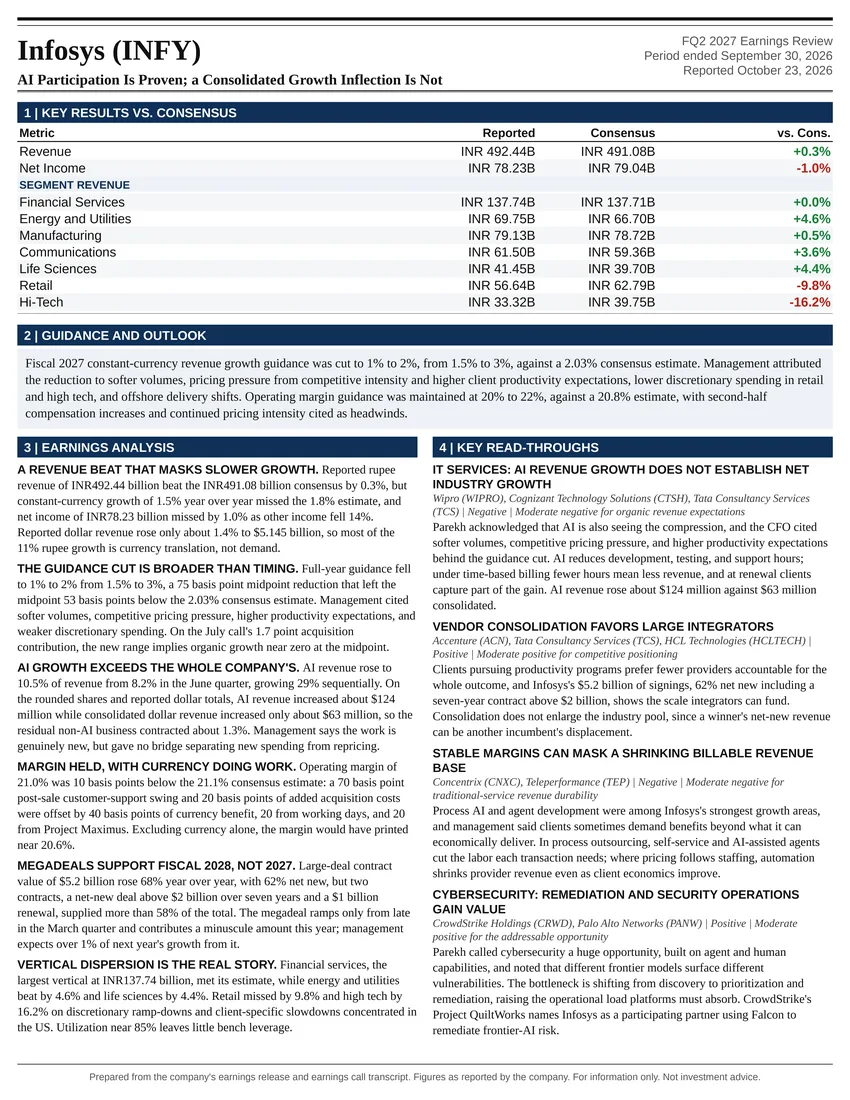
AI Participation Is Proven; a Consolidated Growth Inflection Is Not
Earnings Reports
CrowdStrike Holdings FQ2 2027 Earnings Report
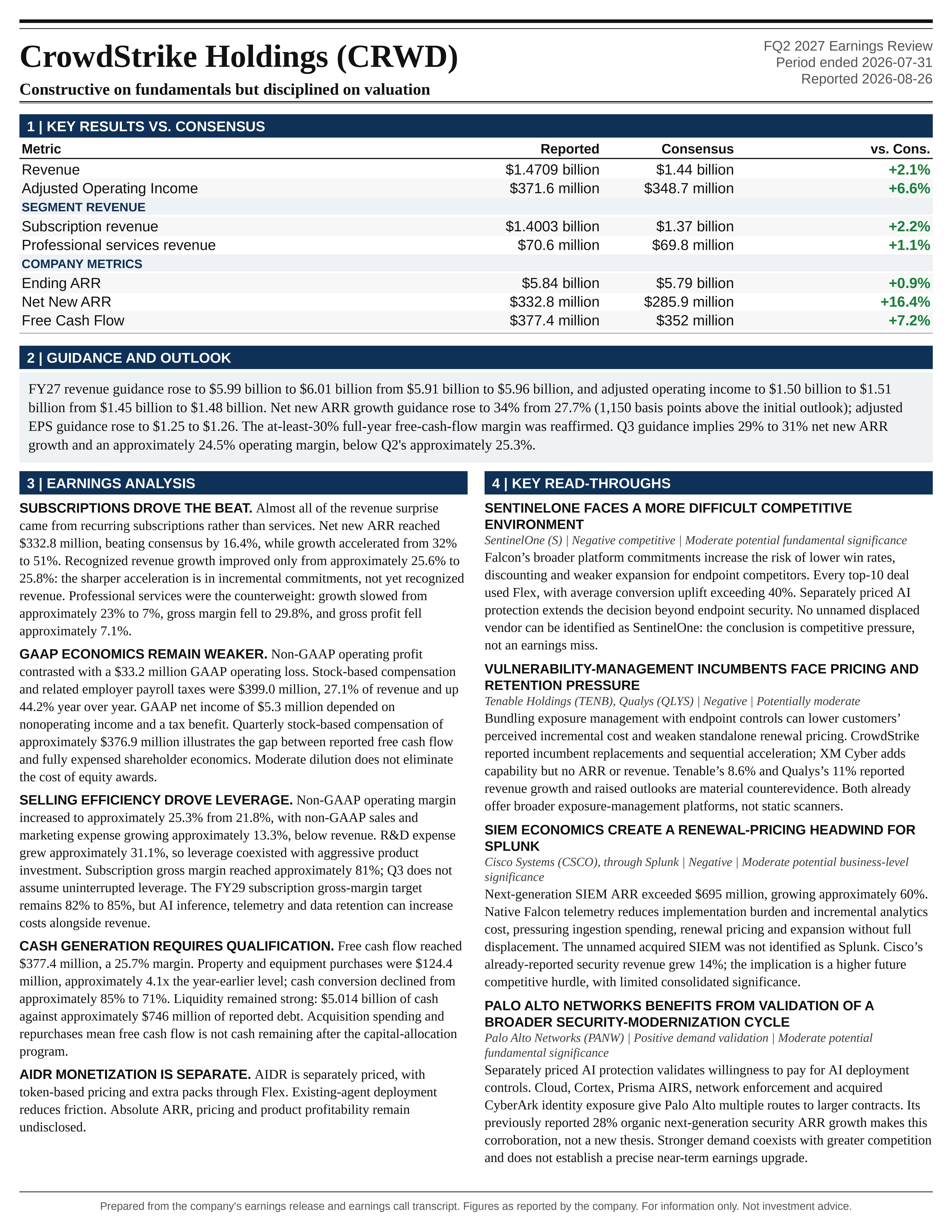
CrowdStrike Holdings (CRWD) FQ2 2027 earnings: Constructive on fundamentals but disciplined on valuation. Full earnings analysis, key read-throughs, and the one-page exhibit from Atlas Peak Research.
CrowdStrike Holdings (CRWD)
Sector: Information Technology · FQ2 2027 · Period end July 31, 2026 · Reported August 26, 2026
CrowdStrike’s Q2 FY27 results materially strengthened the operating thesis that AI adoption is expanding cybersecurity demand while accelerating consolidation onto the Falcon platform.
Download the one-page report (PDF)
View one-page exhibit
Download analysis (.md)
Download read-throughs (.md)
Post to X
One-Page Exhibit
Earnings Analysis
EXECUTIVE CALL SUMMARY: CrowdStrike Holdings Inc. (08/26/26)
CrowdStrike’s Q2 FY27 results materially strengthened the operating thesis that AI adoption is expanding cybersecurity demand while accelerating consolidation onto the Falcon platform. The appropriate investment stance is constructive on fundamentals but disciplined on valuation: retain risk-controlled exposure rather than automatically chase the reported 12% after-hours appreciation. The quarter demonstrated genuine acceleration in incremental recurring revenue, improving sales efficiency, and substantial non-GAAP operating leverage. It did not establish that the exceptionally strong 51% growth in quarterly net new ARR is sustainable, that Falcon Flex growth represents entirely incremental customer spending, or that reported free cash flow translates into comparably strong economics after equity compensation.
The most important result was $332.8 million of net new annual recurring revenue, exceeding the supplied Bloomberg consensus by $46.9 million, or 16.4%. Ending ARR reached approximately $5.84 billion, revenue increased 25.8% to $1.471 billion, and non-GAAP operating income increased 45.8% to $371.6 million. Management increased FY27 net new ARR growth guidance to 34%, versus 27.7% following Q1 and 22.5% initially. Crucially, the annual increase exceeded the amount required merely to incorporate Q2 outperformance. Nevertheless, the incremental upgrade to the remaining fiscal year was appreciably smaller than the headline annual increase: approximately $16 million of the approximately $64 million increase in annual ending ARR guidance represents an improvement beyond the completed quarter’s beat against prior guidance.
The call’s most consequential product disclosure concerned AI Detection and Response, or AIDR. George Kurtz explicitly stated that “it is separate and incremental. It’s another module, and it’s priced separately.” This establishes that AI security is being monetized as an additional paid entitlement rather than solely being embedded into existing endpoint products. AIDR ending ARR nearly tripled sequentially, and management confirmed token-based pricing with additional token packs available through Falcon Flex. These disclosures strengthen the case for a monetization model that can expand beyond employee and endpoint counts. However, absolute AIDR ARR, customer penetration, effective pricing, consumption conversion, and product-level profitability remain undisclosed.
The principal qualification is earnings quality. The accompanying earnings release shows a $33.2 million GAAP operating loss despite $371.6 million of non-GAAP operating profit. Stock-based compensation and related employer payroll taxes were $399.0 million, equivalent to 27.1% of revenue and up 44.2% year over year. Positive GAAP net income of $5.3 million depended on nonoperating income and a tax benefit rather than positive GAAP operating earnings. Free cash flow of $377.4 million was strong, but approximately $376.9 million of quarterly stock-based compensation, derived from the issuer’s cash-flow statements, illustrates the considerable difference between cash generation and fully expensed shareholder economics.
All comparisons below are anchored to information available with the 08/26/26 call, including the accompanying issuer release, the 06/03/26 Q1 release, and the supplied Bloomberg consensus notice. Subsequent operating outcomes are not assumed. Share and per-share comparisons are adjusted for the 4-for-1 stock split.
QUARTERLY PERFORMANCE AND THE QUALITY OF THE BEAT
Revenue of $1.4709 billion exceeded the supplied $1.44 billion consensus by approximately $30.9 million, or 2.1%. Subscription revenue of $1.4003 billion increased 27.0%, compared with total revenue growth of 25.8%, and exceeded the $1.37 billion subscription consensus by approximately $30.3 million. Professional services revenue of $70.6 million increased 7.0% and exceeded consensus by only approximately $0.8 million. Almost all of the revenue surprise therefore came from recurring subscriptions rather than services activity.
The historical comparison supports acceleration, but its magnitude differs materially by metric. Total revenue growth increased from approximately 25.6% in Q1 to 25.8% in Q2, a sequential acceleration of approximately 26 basis points. Both quarters round to 26% growth. By contrast, net new ARR growth accelerated from 32% to 51%, while the absolute quarterly addition increased approximately 30% from Q1’s $255.8 million. The sharper acceleration is therefore in incremental recurring commitments, not yet in recognized revenue. This distinction matters because subscription revenue recognizes the economic benefit of newly signed business over time.
Ending ARR growth increased from approximately 24% in Q1 to more than 25% in Q2. Management described this as the 4th consecutive quarter of acceleration, while revenue growth accelerated for the 5th consecutive quarter. The combination of stronger incremental ARR and accelerating recognized revenue is more compelling than either measure alone. Nevertheless, ARR is an annualized contractual operating measure, not GAAP revenue, cash collections, or a direct measure of deployed software consumption.
Non-GAAP operating income of $371.6 million exceeded the $348.7 million consensus by $22.9 million, or 6.6%. Free cash flow of $377.4 million exceeded the $352 million consensus by $25.4 million, or 7.2%. Profit and cash-flow outperformance were therefore proportionately larger than the revenue beat. The company did not need to sacrifice reported non-GAAP profitability to deliver stronger growth.
Revenue remained geographically diversified, with approximately 65% from the US and 35% from international markets. Management reported broad-based strength across customer sizes and geographies and a 5th consecutive quarter of international revenue growth acceleration. This reduces the likelihood that the entire quarter was driven by a narrow geographic pocket. However, regional growth rates, constant-currency growth, and regional profitability were not provided, preventing a precise separation of demand acceleration from currency or mix effects.
Professional services provide a useful counterweight to the uniformly strong demand narrative. Services revenue growth slowed from approximately 23% in Q1 to 7% in Q2, despite management describing high demand for incident response and AI-readiness engagements. Non-GAAP services gross margin declined from approximately 34.4% a year earlier to 29.8%, and services gross profit fell approximately 7.1%. Services may still generate valuable subscription opportunities, but the financial evidence does not show a comparable acceleration in services monetization or profitability.
GUIDANCE: A GENUINE FORWARD UPGRADE, BUT NOT A STRAIGHT-LINE EXTRAPOLATION
FY27 ending ARR guidance increased to $6.6030 billion to $6.6119 billion from $6.5317 billion to $6.5555 billion in the Q1 release. The midpoint increased approximately $63.9 million to $6.6075 billion. Management now expects approximately $1.355 billion of FY27 net new ARR, representing approximately 34% growth. The growth outlook has increased by 630 basis points since Q1 and 1,150 basis points since the initial outlook, equivalent to approximately $116 million of additional annual net new ARR versus the initial forecast.
Burt Podbere stated, “The magnitude of this increase reflects more than our Q2 outperformance.” The guidance arithmetic supports that statement, but it also clarifies its scale. Q2 ending ARR exceeded the prior quarterly guidance midpoint by approximately $47.8 million. Subtracting that completed-quarter outperformance from the approximately $63.9 million annual increase leaves approximately $16.1 million of additional expected ARR generation during H2. Approximately 75% of the annual increase reflects already delivered outperformance, while approximately 25% represents a stronger remaining-year outlook.
The revenue revision contains a more balanced split between realized and prospective improvement. FY27 revenue guidance increased to $5.9911 billion to $6.0111 billion from $5.9147 billion to $5.9587 billion. The midpoint increased $64.4 million, or approximately 1.1%, to $6.0011 billion. Q2 revenue exceeded the prior quarterly midpoint by $31.9 million. The remaining approximately $32.5 million represents a mechanical increase in the revenue outlook beyond Q2, assuming no other perimeter or accounting changes.
FY27 non-GAAP operating income guidance increased to $1.4972 billion to $1.5084 billion from $1.4523 billion to $1.4803 billion. The midpoint increased $36.5 million, or approximately 2.5%, to $1.5028 billion. Approximately $24.3 million of that increase reflects Q2’s operating-profit beat against prior guidance, leaving approximately $12.2 million of additional expected operating profit during H2. The revised annual operating margin is approximately 25.0%, versus approximately 24.7% previously.
The EPS comparison requires explicit stock-split adjustment. The prior FY27 EPS range of $4.88 to $4.96 becomes $1.22 to $1.24 after the 4-for-1 split. The revised range of $1.25 to $1.26 therefore represents a midpoint increase of approximately 2.0%. The assumed non-GAAP tax rate remains 21%. The annual diluted share assumption increased from the split-adjusted equivalent of approximately 1.036 billion to 1.044 billion, absorbing part of the improvement in forecast net income.
Against the supplied consensus, the new annual revenue midpoint is approximately 1.0% higher, ending ARR is approximately 1.0% higher, non-GAAP operating income is approximately 2.2% higher, and EPS is approximately 2.0% higher. This is a broad positive revision, but the magnitude of the near-term estimate increase is materially smaller than the reported 12% initial stock reaction. The market response consequently incorporates a reassessment of durability, terminal opportunity, or valuation rather than merely the arithmetic increase in FY27 earnings.
Q3 guidance is strong but embeds moderation from Q2’s exceptional incremental growth. Ending ARR is expected to reach $6.1844 billion to $6.1884 billion, corresponding to net new ARR of approximately $343 million to $347 million and growth of 29% to 31%. The midpoint represents approximately 3.7% sequential growth in net new ARR, but a substantial slowdown from Q2’s 51% year-over-year growth. Q3 revenue guidance of $1.5232 billion to $1.5292 billion implies approximately 23% to 24% growth, below Q2’s 25.8%.
The Q3 consensus comparison also requires a consistent opening ARR base. The approximately $66 million excess of Q3 ending ARR guidance over the supplied consensus should not be treated entirely as a new Q3 bookings surprise. Approximately $51 million of that difference was already embedded in Q2’s ending ARR beat versus consensus. Using the rounded consensus figures, the previously implied Q3 net new ARR expectation was approximately $330 million, compared with management’s new midpoint of approximately $345 million. This suggests an incremental Q3 improvement of approximately $15 million, not $66 million.
Q3 non-GAAP operating income guidance of $372.7 million to $375.9 million implies an approximately 24.5% operating margin at the midpoint. That is below Q2’s approximately 25.3% despite sequential revenue growth. EPS guidance of $0.31 is approximately unchanged sequentially and in line with the supplied consensus. The forecast therefore does not assume that Q2’s operating leverage continues uninterrupted into Q3.
The implied Q4 requirements remain meaningful. Subtracting Q3 ending ARR guidance from the annual midpoint produces approximately $421 million of Q4 net new ARR, approximately 22% above Q3’s midpoint. Using reported H1 results and Q3 guidance, the annual outlook also implies approximately $1.618 billion of Q4 revenue and $431 million of non-GAAP operating income, corresponding to an approximately 26.6% operating margin. These are mechanical implications, not separately issued Q4 guidance. The full-year outlook still requires a strong fiscal close rather than merely maintaining Q3’s expected absolute performance.
FALCON FLEX: COMMERCIAL ACCELERATION WITH IMPORTANT COHORT LIMITATIONS
Falcon Flex was the clearest commercial driver of the quarter. Ending ARR from accounts using Flex exceeded $2.29 billion, increasing 101% year over year and representing approximately 39% of company ARR. More than 935 Flex accounts were added during Q2, exceeding the additions in the preceding 3 quarters combined. Every deal in the top 10 by deal value used Flex. The evidence indicates that Flex has become a central enterprise contracting mechanism rather than a peripheral purchasing option.
The investment significance is the reduction of procurement friction across a broad product portfolio. A customer can establish a larger commercial commitment and deploy additional Falcon capabilities without conducting a separate procurement exercise for each expansion. When enterprise AI deployments require endpoint, identity, cloud, data, and monitoring controls simultaneously, that purchasing structure can reduce the time between recognizing a security requirement and activating paid protection.
Management reported an average ARR uplift exceeding 40% when existing standard-subscription customers converted to Flex. Customers completing their initial re-Flex during Q2 generated an additional average ARR expansion of 25%. Customers that had re-Flexed at least 2 times had average ARR 53% above their initial Flex subscription. These are attractive expansion indicators, but they refer to different cohorts and different starting points. They cannot be added together or applied sequentially to a representative company-wide customer.
The disclosure that more than 630 customers had re-Flexed at least once, approximately 6x the year-earlier level, provides evidence that some customers are expanding beyond initial commitments. The average initial re-Flex occurred approximately 8 months after the original Flex agreement. However, that average describes customers that actually re-Flexed, not the entire Flex population. It does not establish that the typical new Flex customer will expand after 8 months. The total eligible cohort, nonexpanding cohort, consumption distribution, and renewal outcomes were not disclosed.
The 101% growth in ARR associated with Flex accounts is not equivalent to 101% organic growth within a fixed customer cohort. When an existing customer migrates to Flex, its existing ARR becomes part of the Flex-account measure. The measure can therefore expand through reclassification of previously existing business as well as genuine incremental spending. The reported conversion uplift and re-Flex statistics are important precisely because they offer evidence of expansion beyond that classification effect.
New-customer adoption strengthens the quality of the Flex story. Management attributed 34% of Q2 net new ARR to new-logo Flex business, implying approximately $113 million of contribution using the reported quarterly total. This indicates that Flex is supporting competitive acquisition rather than only repackaging the installed base. The remaining 66% should not be interpreted entirely as existing-customer expansion because it also includes other new-logo activity and the effects of contraction and churn.
The unresolved issue is the relationship between contracted commitments and actual product utilization. Longer, larger agreements can improve visibility and customer lifetime value, but they can also bring future purchasing decisions forward. Sustainable economics require customers to deploy the products, realize measurable value, and renew or expand at acceptable effective pricing. The call did not disclose unused commitments, deployment-adjusted ARR, contract-duration changes, discounting, or renewal performance for mature Flex cohorts.
Platform adoption metrics provide a more measured picture than the headline Flex growth. Customers using at least 6 modules remained at 51%, and those using at least 7 remained at 35%, unchanged from Q1. Adoption of at least 8 modules increased from 25% to 26%. This is continued penetration, but not an abrupt increase in breadth across the entire customer population. These metrics also exclude Falcon Go customers, limiting their usefulness for evaluating the full SMB customer base.
AIDR: THE MOST IMPORTANT NEW MONETIZATION DISCLOSURE
AIDR’s nearly 3x sequential ARR growth is potentially the most important long-duration signal in the call. The near-term financial significance cannot be quantified because the starting ARR base was not disclosed. Nevertheless, management’s clarification that AIDR is separately priced materially reduces the risk that AI security is merely an unmonetized feature enhancement within existing subscriptions.
The distribution advantage is significant. AIDR can be activated through the existing Falcon agent and a license entitlement, avoiding the deployment burden associated with an additional endpoint agent. That lowers implementation friction and provides CrowdStrike with access to an installed customer base already using its telemetry and enforcement architecture. In principle, this can support attractive incremental acquisition economics, although no product-level sales-cost or margin data were supplied.
The functional distinction from traditional endpoint security is also important. Conventional endpoint detection focuses heavily on malicious execution, exploitation, and suspicious behavior. AI-agent security must additionally address legitimate software using legitimate credentials in unintended ways, including excessive data access, unauthorized external transmission, inappropriate tool execution, and policy violations. This creates a plausible additional control requirement rather than simply a renamed malware-detection category.
Kurtz confirmed, “we actually have token-based pricing as part of AIDR.” Customers receive an allowance and can purchase additional token packs if usage exceeds that allowance. Falcon Flex provides the commercial mechanism for expansion. This structure introduces a potential growth driver linked to monitored AI activity rather than only the number of employees or protected devices.
The economic sensitivity is nevertheless not a simple proportional relationship between industry AI-token growth and CrowdStrike revenue. Revenue depends on the population of activity being monitored, the definition of billable tokens, included allowances, effective pricing, discounts, and the timing of additional purchases. The call did not disclose how input, output, cached, local, or tool-related activity is metered. It also did not establish whether incremental tokens generate the same gross margin as core subscriptions.
The pricing structure contains a useful tension. AIDR can help customers reduce unnecessary AI usage and monitor token costs, making the product relevant to CIO budgets as well as security budgets. However, successful optimization can reduce the token volume available for consumption-based monetization. The long-term opportunity therefore depends on protection value, broader adoption, and willingness to pay, not simply maximizing raw token consumption.
Management’s assertion that “the AIDR business can be bigger than the EDR business” should be treated as a strategic hypothesis rather than a forecast. The cited estimate of approximately 90 agents per person was not supported with an adoption timeline, pricing framework, or independently established methodology. Agent counts are not economically equivalent to paid security units. A single entitlement may cover multiple agents, while enterprise architectures may centralize policy enforcement at gateways or identity layers.
The bank example reinforces willingness to buy AI protection but does not establish AIDR’s standalone deal size. The disclosed 8-figure Flex transaction included AIDR within a broader commercial relationship. It cannot be interpreted as an 8-figure AIDR contract. This distinction is particularly important when evaluating early-stage product materiality from large platform-deal anecdotes.
The next meaningful evidence would be absolute AIDR ARR, paid customer counts, adoption among the largest existing customers, token-pack expansion, realized pricing, and mature-cohort renewal behavior. Without those disclosures, AIDR deserves meaningful strategic option value but not an unconstrained contribution to near-term revenue forecasts.
ENDPOINT: AI IS REFRESHING THE DISTRIBUTION ADVANTAGE
The endpoint business accelerated for the 4th consecutive quarter, challenging the view that endpoint protection is necessarily a mature, structurally decelerating market. Management attributed demand to AI consumption on employee devices, replacement of legacy antivirus, competitive displacement, and cross-selling. The call did not quantify the contribution from each source.
The strategic argument is that the endpoint remains an important execution and data-access location even when the underlying model operates in a remote cloud. CrowdStrike’s established presence can provide visibility into the applications, processes, identities, and outbound connections involved in AI use. This creates an installed-base advantage for discovering and securing shadow AI.
Management reported more than 400% growth in Claude usage and more than 100% growth in custom-agent usage within sampled customer environments over recent months. These observations support rapidly expanding activity but should not be interpreted as market-wide growth rates. The sample size, customer composition, measurement period, and usage definition were not disclosed.
The large financial-services displacement across more than 100 entities and hundreds of thousands of endpoints supports continued competitive relevance. However, management did not provide separate endpoint ARR, endpoint growth rates, seat growth, price changes, or premium-service mix. The evidence supports renewed endpoint momentum but does not identify whether the largest contributor was market expansion, share gains, pricing, or product mix.
There is also an architectural limit to the endpoint-centric thesis. Some agent activity occurs in cloud services, SaaS applications, API workflows, and environments where endpoint telemetry is incomplete. CrowdStrike’s broader cloud, identity, gateway, and data capabilities are therefore essential to its AI-security strategy. Endpoint presence is an advantage, not proof of comprehensive visibility across every agent interaction.
NEXT-GENERATION SIEM, CLOUD, AND IDENTITY
Next-generation SIEM ending ARR exceeded $695 million, with approximately 60% year-over-year growth cited in Q&A. This is the fastest-growing of the 3 larger adjacent categories discussed. The product benefits from access to telemetry already generated within Falcon, reducing initial integration work and allowing customers to activate security analytics without first constructing an entirely new data foundation.
The important competitive mechanism is the combination of deployment speed, telemetry economics, and platform integration. Customers can begin with native Falcon data and then add external sources. Management indicated that external data sources are expanding rapidly, which matters because durable SIEM displacement requires usefulness beyond the vendor’s own endpoint data.
The major power-provider win demonstrates the ability to replace an incumbent system in a demanding enterprise environment. However, long-term displacement depends on third-party integrations, historical-data migration, detection engineering, investigation workflows, retention requirements, and operational reliability. An easier initial deployment does not eliminate those requirements. Product-level gross margin and the economics of external data ingestion were not disclosed.
AgentWorks adds a potential expansion mechanism by allowing customers to build and operate security agents within the platform. If adoption becomes embedded in daily security operations, it could increase switching costs and the value of the broader data layer. The call did not disclose separate AgentWorks revenue, attach rates, or consumption economics, so it should not be counted as an independently quantified growth engine.
Cloud security ending ARR exceeded $905 million, growing more than 29%. The frontier-lab and large technology-company wins are important because they place CrowdStrike within expanding AI infrastructure rather than solely within employee-device budgets. The cited advantages included runtime protection, development-pipeline integration, and compatibility with internal tools.
The claim that static posture assessments are insufficient against rapidly executing threats is directionally persuasive, but runtime protection and posture management are complementary rather than mutually exclusive. Continuous runtime enforcement addresses active behavior, while configuration, entitlement, and exposure controls address conditions that enable compromise. The strongest platform thesis is coordinated protection across those layers, not the disappearance of posture-management requirements.
Identity ending ARR exceeded $585 million, growing approximately 34% in prepared remarks, versus approximately 33% cited in Q&A. This small discrepancy does not alter the investment interpretation but argues against false precision. Identity is particularly relevant to agents because non-human software can inherit access to sensitive systems and execute continuously. Authorization decisions must increasingly consider context and risk rather than merely whether credentials are valid.
Falcon Shield ARR growth exceeding 185% and privileged-access ARR growth exceeding 35x indicate rapid adoption of newer capabilities. Their absolute bases were not disclosed. These growth rates demonstrate momentum but cannot establish financial materiality. SGNL’s reported handling of more than 30 million unique access decisions at a customer provides evidence of technical activity at scale, not a direct revenue measure.
The individual disclosed ARR amounts for cloud, identity, and next-generation SIEM total at least approximately $2.185 billion. The CFO referred to the combined businesses as approximately $2.1 billion, growing 39%. The difference may reflect abbreviated speech, scope, or transcription, but it is unresolved. The broad conclusion is clear: these businesses are substantial and collectively growing faster than the company. A precise additive product-mix model should not be constructed without consistent definitions and confirmation that the categories do not overlap.
EXPOSURE MANAGEMENT AND THE PARTNER ECOSYSTEM
Exposure management benefits from a credible operational bottleneck. AI can accelerate vulnerability discovery and exploit development faster than enterprises can safely test and deploy patches. Kurtz described the constraint as having “hit the sound barrier of actually rolling out a patch.” The resulting opportunity is to prioritize exposures based on exploitability, business importance, attack paths, and available compensating controls.
This does not mean patching becomes unnecessary. The investment thesis is that prioritization and containment become more valuable when remediation capacity is scarce. CrowdStrike’s ability to combine asset visibility, endpoint protection status, identity context, and attack-path analysis could improve those decisions. Management reported sequential acceleration and competitive replacements, but exposure-management ARR and growth rates were not disclosed.
The planned purchase of XM Cyber’s technology assets should be evaluated as a capability investment, not acquired revenue growth. Podbere explicitly stated that the transaction “will not bring any ARR or revenue to CrowdStrike.” No ARR or revenue from the transaction is included in FY27 guidance. That prevents the acquisition from explaining the raised sales outlook, but it does not make the transaction economically costless. Integration expense, purchase consideration, development spending, and eventual monetization remain relevant.
Project QuiltWorks had more than 25 partners collaborating on nearly $400 million of total contract value pipeline. This is strategically useful evidence of partner engagement, particularly when assessments identify exposures that can lead to Falcon adoption. It is not $400 million of ARR, recognized revenue, or committed bookings. Contract duration, conversion probability, timing, and overlap with other reported pipeline measures were not disclosed.
The nearly 50% growth cited for the GSI business supports partner-led implementation capacity, especially for SIEM and exposure-management projects. The exact financial denominator was not identified, limiting direct model use. Kroll’s migration across approximately 450,000 endpoints and subsequent commitment exceeding 3x its previous spending provide stronger evidence of actual commercial expansion. Accenture’s selection of CrowdStrike for its SMB-focused Edge business creates another distribution route, although no revenue contribution was quantified.
Cloud marketplaces processed more than $600 million of deal value during Q2, growing more than 30%. Microsoft Marketplace expands the range of procurement relationships through which customers can purchase Falcon. This can improve access and shorten purchasing cycles, but it does not necessarily represent entirely new security budgets. Marketplace deal value, Flex commitments, and partner-generated opportunities can describe overlapping transactions and should not be added together.
The competitive implication is positive for the overall security-modernization budget but uneven across vendors. Platform providers may benefit from broader demand, while displaced point products can lose share within an expanding market. The call does not identify the unnamed vendors in its competitive-win examples, so specific competitor revenue losses cannot be inferred. The supplied notice’s positive peer reactions reflect thematic read-through, not evidence that every competitor benefits equally.
OPERATING LEVERAGE: REAL, BUT CONCENTRATED IN SALES EFFICIENCY
Non-GAAP operating margin increased to approximately 25.3% from 21.8% a year earlier, an improvement of approximately 346 basis points. Incremental operating profit represented approximately 38.6% of incremental revenue. Subscription gross margin reached approximately 81%, up approximately 90 basis points, while total gross margin approached 79%.
The detailed expense bridge shows that sales and marketing efficiency was the dominant contributor. Non-GAAP sales and marketing expense increased approximately 13.3%, materially below revenue growth, and declined approximately 310 basis points as a percentage of revenue. Non-GAAP research and development expense increased approximately 31.1%, faster than revenue, increasing its revenue share by approximately 78 basis points. The company is therefore generating operating leverage while continuing to increase product investment aggressively.
Management attributed productivity improvements partly to internal automation and AI. The financial outcome is consistent with improved efficiency, but the call did not quantify AI-related savings, labor productivity, customer-acquisition costs, or payback periods. The evidence supports better reported selling efficiency; it does not permit a precise allocation of that improvement to AI, Flex, channel mix, contract structure, or workforce changes.
Sales efficiency must also be assessed alongside commission capitalization. Cash outlays recorded as deferred contract acquisition costs were approximately $205.7 million in Q2, derived from H1 less Q1, while amortization of those costs was approximately $108.2 million. This is consistent with substantial current selling activity whose expense recognition extends over future periods. It is not evidence of improper accounting, but it means current sales expense alone is an incomplete measure of current customer-acquisition investment.
The FY29 subscription gross-margin target remains 82% to 85%, versus approximately 81% currently. There is therefore approximately 100 to 400 basis points of potential subscription-margin expansion if the target is achieved. The path is not assured: AI inference, telemetry volume, data retention, cloud infrastructure, and implementation requirements can increase costs alongside revenue.
GAAP PROFITABILITY AND EQUITY COMPENSATION
The distinction between non-GAAP and GAAP profitability is central to the investment assessment. Q2 non-GAAP operating profit of $371.6 million contrasts with a GAAP operating loss of $33.2 million, a difference of $404.9 million. Stock-based compensation and related employer payroll taxes of $399.0 million account for almost all of that difference before other adjustments and offsets.
Those compensation-related costs increased approximately 44.2% year over year, faster than revenue growth. Their share of revenue increased materially. Consequently, strong non-GAAP operating leverage coexisted with substantial growth in compensation expense excluded from the preferred profitability measure.
The positive GAAP net-income result should not be mistaken for positive operating economics. The $33.2 million operating loss was offset by $43.9 million of interest income, less interest expense and other items, followed by a tax benefit. GAAP net income attributable to CrowdStrike was only $5.3 million, approximately 0.4% of revenue. The 3rd consecutive quarter of positive GAAP net income is a milestone, but the operating business remained loss-making after all recognized operating expenses.
Year-over-year GAAP improvement also benefited from unusual-item comparisons. Q2 included approximately $14.5 million of net recoveries associated with the July 19 incident, versus approximately $35.7 million of incident-related costs a year earlier. The prior-year quarter also included approximately $38.4 million of strategic-plan charges that did not recur. Removing only these incident and strategic-plan effects produces an illustrative operating loss of approximately $47.8 million currently, versus approximately $31.4 million previously. This is not the company’s non-GAAP measure or a complete normalization, but it shows that improvement in the reported GAAP loss does not independently establish stronger fully expensed recurring profitability.
Dilution was more moderate than compensation expense growth. Non-GAAP diluted weighted-average shares increased approximately 1.9% year over year to 1.0445 billion. That is constructive, but it does not eliminate the economic cost of equity awards. Share issuance, vesting schedules, repurchases, and award valuation occur on different timelines. H1 repurchases of approximately $175.6 million also consumed cash that is not deducted in reported free cash flow.
CASH FLOW, CAPITAL INTENSITY, AND THE FULL-YEAR CASH HURDLE
Operating cash flow increased 59.3% to $530.3 million, substantially faster than revenue. Free cash flow increased 33.1% to $377.4 million, producing a 25.7% margin versus management’s 24.5% expectation. Cash conversion was strong, but the divergence between operating cash flow and free cash flow reflects a significant increase in investment requirements.
The issuer’s reconciliation deducts $124.4 million of property and equipment purchases, $26.5 million of capitalized internal-use software and development costs, and approximately $1.9 million of net deferred-compensation investment purchases. Property and equipment purchases were approximately 4.1x the year-earlier level. Operating-cash-flow conversion into free cash flow consequently declined from approximately 85% to 71%.
This increase in capital spending deserves monitoring because the investment narrative emphasizes scalable software economics. The release does not provide enough detail to determine whether the increase is temporary infrastructure investment, sustained capacity expansion, or a structural change in capital intensity. Rising gross margins indicate that current infrastructure economics remain favorable, but cash investment must be assessed separately from P&L margins.
Working-capital movements also varied materially by quarter. H1 included a $324.2 million cash benefit from receivables, but Q1 alone generated a $428.8 million benefit. Q2 therefore absorbed approximately $104.7 million through receivables. Conversely, Q2 generated approximately $120.0 million from deferred revenue after a Q1 outflow. The strong Q2 cash result cannot be explained simply as another quarter of receivable liquidation.
Stock-based compensation remains a major cash-flow consideration. H1 stock-based compensation was $674.6 million, approximately 60% of operating cash flow. Q2 stock-based compensation, derived by subtracting Q1 from H1, was approximately $376.9 million. A simple sensitivity subtracting that accounting expense from Q2 reported free cash flow leaves approximately $0.5 million. This is not a company-reported metric, an estimate of actual cash compensation, or a fully tax-adjusted owner-earnings calculation. It demonstrates why the 25.7% cash margin should not be treated as equivalent to a margin after the economic cost of employee equity.
The full-year free-cash-flow commitment remains at least 30% of revenue, implying at least approximately $1.800 billion at the revenue midpoint. H1 generated $845.9 million, a 29.6% margin. Q3’s 27.5% margin expectation implies approximately $419.7 million of free cash flow. Meeting the annual minimum would then require approximately $534.8 million in Q4, or approximately 33.0% of mechanically implied Q4 revenue. That is an achievable-looking but meaningful fiscal-close requirement, not an automatic consequence of the Q2 beat.
Liquidity remains strong. Cash and cash equivalents were $5.014 billion, compared with approximately $746 million of reported debt, implying roughly $4.27 billion of cash net of that debt before leases and other obligations. However, cash remained below the $5.230 billion fiscal-year opening balance despite substantial H1 free cash flow. Approximately $881 million of acquisition cash payments and $176 million of share repurchases help explain the difference. Reported free cash flow therefore should not be interpreted as cash remaining after the full acquisition and capital-allocation program.
DURABILITY, COMPETITION, AND THE LIMITS OF THE AI NARRATIVE
Management’s central assertion was that the “Mythos moment” has become a durable spending catalyst. Kurtz emphasized growth “not measured by meetings or calls, but measured by ARR.” The financial results support the existence of stronger commercial demand. They do not isolate how much of that demand reflects incremental AI-security budgets versus consolidation, competitive displacement, contract expansion, purchasing acceleration, or improving comparisons.
The demand mechanism is credible. AI agents expand the number of identities, permissions, execution environments, data flows, and automated actions requiring control. Security can become a prerequisite for moving agents from restricted testing into production. CrowdStrike’s ability to sell across multiple control domains makes it well positioned to participate in that spending.
The competitive moat is less conclusively established. Kurtz stated that “we are net data creators,” emphasizing proprietary endpoint and threat telemetry. Continuously generated operational data can improve detection, model training, and response. However, data volume alone does not establish superior protection. Label quality, coverage, latency, false positives, enforcement authority, and the ability to interpret legitimate but harmful agent behavior remain critical.
Frontier-model providers and hyperscalers are both partners and potential competitors. Their integration can expand CrowdStrike’s reach, but they also control important execution, identity, and model interfaces. Customers may prefer independent cross-platform protection, while model providers may embed effective safeguards directly into their environments. The quarter demonstrates current customer willingness to pay CrowdStrike; it does not resolve the eventual division of security spending between independent platforms and infrastructure providers.
Reliability risk also becomes more significant as platform breadth increases. Consolidation can reduce operating complexity and improve response, but it increases dependence on a common control layer. The July 19 incident remains relevant to assessing deployment safety, customer trust, operational concentration, and potential legal exposure. Improved retention and strong new-logo performance are encouraging evidence, but the call did not establish that all incident-related economic consequences have ended.
Several important disclosures remain absent. Management reported improved net and gross retention without providing absolute rates. Its published gross-retention definition focuses on ARR lost from customers that cease being customers, while net retention incorporates expansion and contraction. Improved gross retention therefore should not be interpreted as complete evidence that spending reductions within retained accounts have disappeared.
The supplied Bloomberg Intelligence commentary also referenced accelerating remaining-performance-obligation growth. That is supportive qualitative context, but the supplied call and notice do not provide the relevant balances, current versus long-term split, or contract-duration bridge. Longer agreements can improve total backlog without proportionately improving near-term revenue. The RPO observation cannot be used as a quantified independent confirmation of underlying consumption growth.
VALUATION AND THE MARKET RESPONSE
The quarter supports higher estimates and a lower probability of a near-term growth disappointment. It does not automatically justify an unrestricted valuation increase. Annual revenue guidance rose approximately 1.1%, annual operating-profit guidance approximately 2.5%, and annual EPS guidance approximately 2.0%. The reported 12% after-hours share appreciation therefore reflects a larger reassessment of future opportunity than of immediate earnings.
The supplied Stephens price target of $230 provides a useful valuation reference, not a verified event-time share price or an independently endorsed target. Using the annual diluted-share assumption of approximately 1.044 billion as a rough share-count proxy implies approximately $240 billion of equity value at that price. Deducting approximately $4.27 billion of cash net of reported debt produces an indicative enterprise value of approximately $236 billion. This corresponds to approximately 39x FY27 revenue guidance and approximately 36x year-end ARR guidance.
At the same $230 reference price, the multiple of FY27 non-GAAP EPS guidance is approximately 183x. The equity-value multiple of the minimum implied full-year free cash flow is approximately 133x, equivalent to a yield of approximately 0.75% at that cash-flow floor. These are illustrative calculations because weighted-average shares are not an exact period-end fully diluted share count. Nevertheless, they show that substantial long-duration growth and favorable competitive outcomes are embedded in a valuation near the cited target.
Multiple sensitivity remains substantial even if execution stays strong. A 25% increase in revenue combined with a 20% contraction in the revenue multiple leaves enterprise value approximately unchanged. This is the central distinction between a strong business result and an attractive new investment. Sustained operating growth can be offset by even a moderate reduction in the premium assigned to distant cash flows.
The ARR mathematics also impose an important hurdle on more aggressive growth expectations. If FY28 net new ARR grows another 34% from the revised FY27 midpoint, FY28 ending ARR growth would be approximately 27.5%, not 34%. Achieving 30% ending ARR growth from the expected FY27 ending base would require approximately $1.98 billion of FY28 net new ARR, approximately 46% growth over FY27’s revised net new ARR midpoint. A return to 30% company ARR growth therefore requires another meaningful acceleration in incremental production.
SCENARIO FRAMEWORK AND INVESTMENT IMPLICATIONS
A base case assigned an illustrative 50% probability assumes that AI-driven modernization remains durable, Flex expansion continues, and incremental ARR growth normalizes below Q2’s exceptional rate. FY27 finishes near or modestly above the revised outlook. FY28 net new ARR increases approximately 20% to 30%, reaching approximately $1.63 billion to $1.76 billion and supporting roughly 25% to 27% ending ARR growth. Revenue growth remains in the low-to-mid-20% range, non-GAAP operating margin improves gradually toward 26% to 28%, and free-cash-flow margin remains around or above 30%. This supports continued business compounding but does not guarantee strong stock returns from an elevated starting multiple.
A bull case assigned an illustrative 25% probability assumes that AIDR becomes financially material, token-pack expansion produces meaningful incremental revenue, endpoint displacement remains strong, and SIEM and identity gains compound across the installed base. FY28 net new ARR growth reaches approximately 40% to 50%, producing roughly $1.90 billion to $2.03 billion of additions and approximately 29% to 31% ending ARR growth. Revenue growth approaches the upper-20% range, operating margin approaches 28% to 30%, and free-cash-flow margin reaches approximately 32% to 34%. This outcome would require evidence that current demand is not merely accelerated procurement and that AI-security monetization is substantial in absolute dollars.
A bear case assigned an illustrative 25% probability assumes that part of the Flex surge reflects accelerated commitments, AIDR remains relatively small, token economics become more competitive, or platform deployment trails contracted spending. FY28 net new ARR grows approximately 0% to 10%, producing approximately $1.35 billion to $1.49 billion of additions and roughly 21% to 23% ending ARR growth. Revenue growth moderates toward approximately 18% to 22%, while operating margin stagnates near 24% to 25% and free-cash-flow margin falls below 30%. Under a simultaneous 30% to 40% revenue-multiple contraction, this level of continued revenue growth could still produce an enterprise-value decline of approximately 15% to 30%.
These probabilities are analytical judgments, not management guidance or statistically estimated outcomes. The largest uncertainties are absolute AIDR monetization, mature Flex renewal economics, the persistence of net new ARR growth, and the valuation assigned to those outcomes. The bull case depends on evidence beyond the current quarter; the bear case does not require revenue contraction or a collapse in cybersecurity demand.
The resulting action is HOLD existing, appropriately sized exposure and remain selective on additional purchases. The quarter argues against a short thesis based solely on endpoint saturation or the assumption that AI eliminates independent security vendors. Conversely, it does not justify adding risk solely because AI-related product activity is growing rapidly. Incremental capital should require an explicit valuation framework with adequate upside after accounting for dilution, acquisition spending, and multiple compression.
For an illustrative diversified portfolio, a 0.5% to 1.0% NAV exposure would limit reliance on an unproven AIDR valuation contribution. A 15% price decline from entry would represent approximately 7.5 to 15 basis points of portfolio loss before gaps or slippage; a 30% stress decline would represent approximately 15 to 30 basis points. A 10% decline should trigger review, with a 15% loss serving as a predefined risk-exit threshold unless a formally re-underwritten thesis supports retention. Actual sizing and absolute entry levels require verified market pricing and portfolio exposures, neither of which is established by the supplied call materials.
Portfolio diversification benefits should not be overstated. Cybersecurity demand may be more resilient than discretionary enterprise software spending, and AI-security growth may offset some software-disruption concerns. Nevertheless, CrowdStrike remains exposed to common high-multiple software, growth, momentum, and interest-rate factors. Existing exposure to AI infrastructure or other premium cybersecurity platforms can increase rather than reduce correlated drawdown risk.
CATALYSTS AND THESIS-INVALIDATION CONDITIONS
At the time of the call, the nearest identified catalyst was the 09/02/26 investor briefing at Fal.Con. The investment-relevant information would be measurable product adoption, absolute AIDR economics, pricing structure, customer deployment evidence, and any quantified long-term model updates. Product announcements alone would not resolve the principal monetization uncertainties.
The next quarterly release, covering the period ending 10/31/26, should test delivery against approximately $345 million of net new ARR, approximately $1.526 billion of revenue, and the 27.5% free-cash-flow margin expectation. It should also clarify whether the record pipeline converts without unusual discounting, contract extension, or a deterioration in deployment economics. The fiscal-year close on 01/31/27 must then support approximately $421 million of implied Q4 net new ARR and the remaining annual cash-flow requirement.
The bullish thesis would weaken materially if net new ARR falls below the guided range without a clearly identifiable timing explanation, if mature Flex cohorts renew below their committed economics, if AIDR growth remains percentage-heavy but financially immaterial, or if retention reverses. Persistent stock-based compensation above revenue growth, further increases in capital intensity, and failure to achieve the 30% annual free-cash-flow margin would weaken the quality-of-growth case even if reported ARR remains strong.
The strongest positive confirmation would be sustained ARR outperformance accompanied by improving absolute retention, broader paid AIDR adoption, clear evidence of consumed Flex commitments, and continued margin expansion without increasing dependence on equity compensation. Q2 established a strong operating foundation. The remaining investment question is whether that foundation can support the duration and quality of growth already required by a premium valuation.
COMPANY EMPLOYEES ON THE CALL
• George Kurtz, Founder and Chief Executive Officer. • Burt Podbere, Chief Financial Officer. • Andrew Nowinski, Vice President of Investor Relations and Strategic Finance.
RESEARCH ANALYSTS ON THE CALL
• Saket Kalia, Barclays. • Brian Essex, J.P. Morgan. • Gabriela Borges, Goldman Sachs. • Matthew Hedberg, RBC Capital Markets. • Fatima Boolani, Citi. • Meta Marshall, Morgan Stanley. • Adam Tindle, Raymond James. • Roger Boyd, UBS. • Rob Owens, Piper Sandler. • Mike Cikos, Needham & Company. • Patrick Colville, Scotiabank. • Joseph Gallo, Jefferies. • Todd Weller, Stephens.
Key Read-Throughs
KEY READ-THROUGHS FROM CROWDSTRIKE’S Q2 FY27 EARNINGS CALL
CrowdStrike’s results support a stronger cybersecurity spending environment, but the most actionable implication is greater dispersion between companies that capture platform consolidation and those whose products become displaced or repriced within larger agreements. Net new ARR growth of 51%, separately monetized AI protection, and accelerating partner activity indicate that AI-related security demand is translating into commercial commitments. However, Falcon Flex’s influence means that stronger platform spending can coexist with weaker economics for competing vendors. The highest-conviction implications concern endpoint competition, vulnerability management, security analytics, identity, cloud procurement, and security implementation services. Anonymous customer wins do not support company-specific earnings upgrades for banks, automakers, utilities, semiconductor suppliers, or data-center operators. The analysis uses the information available at the 08/26/26 call; catalyst timing is expressed relative to that event. Countries identify corporate domicile.
CYBERSECURITY: ENDPOINT AND EXPOSURE MANAGEMENT
SENTINELONE FACES A MORE DIFFICULT COMPETITIVE ENVIRONMENT EVEN AS SECURITY DEMAND IMPROVES (READ-THROUGH 1)
Affected company: SentinelOne (S: US). Directional impact: negative competitive read-through, with moderate potential fundamental significance and elevated sensitivity around customer expansion and enterprise bookings. This is not evidence of an immediate earnings miss.
The supporting evidence is CrowdStrike’s 4th consecutive quarter of endpoint acceleration, record new-logo ARR, and multiple replacements of competing next-generation endpoint products. A large financial-services customer selected Falcon across more than 100 entities and hundreds of thousands of endpoints. A European automotive manufacturer replaced endpoint, SIEM, and vulnerability-management products through a broader Flex agreement. CrowdStrike also reported that Kroll had migrated a majority of its customers across approximately 450,000 endpoints and subsequently increased its spending by more than 3x.
The transmission mechanism is broader than a contest over endpoint detection accuracy. CrowdStrike can combine endpoint replacement with additional cloud, identity, SIEM, and AI-security entitlements under a common commercial commitment. All of its top 10 deals by value used Flex, while customers converting to Flex generated average ARR uplift exceeding 40%. This increases the risk that an endpoint competitor must defend its position against the economics of an entire platform rather than against the price of a comparable endpoint product. Potential consequences include lower competitive win rates, greater discounting, reduced expansion opportunities, and higher selling costs.
AIDR strengthens that distribution advantage. Kurtz stated that “it is separate and incremental. It’s another module, and it’s priced separately,” while emphasizing deployment through the existing Falcon agent. Customers already considering endpoint replacement can consequently evaluate CrowdStrike as both an endpoint vendor and an AI-security supplier, increasing the strategic scope of the purchasing decision.
The important qualification is that none of the unnamed displaced vendors can be identified as SentinelOne from this transcript. Kroll’s migration should not be presented as a confirmed SentinelOne loss. SentinelOne’s previously reported Q1 results also showed 23% ARR growth and emerging solutions reaching approximately 50% of company ARR, demonstrating that it is not merely an endpoint-only vendor without adjacent capabilities. The high-conviction conclusion is increased competitive pressure, not technological obsolescence.
The near-term catalyst is SentinelOne’s next earnings update, particularly enterprise net new ARR, large-customer expansion, competitive commentary, and the relationship between bookings growth and sales efficiency. Over approximately 12 to 24 months, the more consequential question is whether broader platform commitments restrict SentinelOne’s ability to increase spending within shared customer accounts. The supplied notice’s 4.3% positive SentinelOne reaction therefore represents sector-demand optimism that should be distinguished from company-specific competitive fundamentals.
VULNERABILITY-MANAGEMENT INCUMBENTS FACE PRICING AND RETENTION PRESSURE, NOT THE DISAPPEARANCE OF THEIR MARKET (READ-THROUGH 2)
Affected companies: Tenable Holdings (TENB: US) and Qualys (QLYS: US). Directional impact: negative incremental competitive pressure; potentially moderate at the company level because exposure management is central to their businesses. The evidence does not support an immediate revenue contraction forecast.
CrowdStrike reported sequential acceleration in exposure management and described replacements of incumbent vulnerability-management products at a European automotive manufacturer and a global religious organization. Kurtz framed the underlying operational problem as having “hit the sound barrier of actually rolling out a patch.” Customers need to prioritize exposures and contain attacks because vulnerability discovery and exploitation can advance faster than organizations can safely remediate every issue.
The transmission mechanism is a change in the purchasing criteria for vulnerability-management budgets. Asset discovery and vulnerability enumeration remain necessary, but customers increasingly need those findings connected to business importance, identity privileges, attack paths, and active protection. CrowdStrike can offer that context alongside deployed endpoint controls and bundle exposure management into a larger Flex commitment. The economic risk for incumbents is that customers perceive a lower incremental cost of adopting the platform vendor’s product, weakening standalone renewal pricing and expansion opportunities.
The proposed acquisition of XM Cyber’s technology assets increases the strategic significance of this push. Management explicitly stated that the transaction “will not bring any ARR or revenue to CrowdStrike.” This is therefore a capability investment in attack-path visualization and offensive simulation, not acquired revenue being presented as organic demand. The longer-duration threat is a stronger competing product assembled around CrowdStrike’s installed distribution base.
The counterevidence is material. Tenable had already reported 8.6% Q2 revenue growth and raised its annual outlook, while Qualys had reported 11% growth and raised annual revenue guidance. Both already offer broader exposure-management platforms. Qualys specifically highlighted Enterprise TruRisk Management, remediation, and early QFlex engagement. Categorizing these companies as static scanners that cannot adapt would be inaccurate.
The actionable conclusion is that a growing exposure-management market does not guarantee improving pricing or market share for every incumbent. Near-term confirmation would appear in subsequent renewal commentary, net expansion, platform bookings, and discounting rather than in already reported quarters. Over approximately 12 to 24 months, sustained platform displacement would pressure revenue durability and the premium assigned to incumbent cash flows. The transcript establishes credible competitive pressure but does not identify which vendor lost the cited accounts.
SECURITY OPERATIONS AND ANALYTICS
CROWDSTRIKE’S SIEM ECONOMICS CREATE A RENEWAL-PRICING HEADWIND FOR SPLUNK (READ-THROUGH 3)
Affected company: Cisco Systems (CSCO: US), through Splunk. Directional impact: negative for competitive positioning and pricing within security analytics; moderate potential business-level significance but limited immediate significance to Cisco’s consolidated earnings.
CrowdStrike disclosed next-generation SIEM ARR exceeding $695 million, with approximately 60% year-over-year growth cited in Q&A. A major US power provider replaced a “legacy acquired” SIEM, while the European automotive customer also replaced a legacy SIEM within its Flex agreement. Kurtz emphasized that native Falcon telemetry is already present in the platform and described the product as “very disruptive from a price point.”
The precise mechanism is a reduction in the incremental cost and implementation burden of moving security analytics onto the incumbent endpoint platform. Customers can activate analytics against existing Falcon telemetry and then connect additional sources. This can weaken the pricing umbrella around traditional SIEM contracts, particularly when customers compare the total cost of ingestion, storage, detection engineering, investigation, and operating personnel rather than individual software-license prices.
The impact can occur before an incumbent loses an entire customer. A customer can move selected workloads, reduce paid ingestion, negotiate lower renewal pricing, or redirect expansion spending to the competing platform. For Splunk, the relevant risk is therefore weaker net expansion or more expensive retention, not only outright displacement.
The call does not identify the unnamed acquired SIEM as Splunk. Moreover, Cisco’s 08/12/26 results already showed security revenue growing 14% to approximately $2.23 billion. CrowdStrike’s report therefore does not establish that Cisco’s security business was contracting or that its reported quarter should have been weaker. It increases the competitive hurdle for future security-analytics expansion.
The near-term catalysts are subsequent Cisco commentary on security orders, subscription expansion, competitive wins, and renewal economics. CrowdStrike’s 09/02/26 investor briefing was also an opportunity for further disclosure on SIEM penetration and external-data adoption. The longer-duration shift is toward security platforms using proprietary telemetry and integrated workflows to reduce customers’ total operating costs. That shift can compress incumbent pricing even while aggregate security-data volumes continue to grow.
CYBERSECURITY: INTEGRATED PLATFORMS AND IDENTITY
PALO ALTO NETWORKS BENEFITS FROM VALIDATION OF A BROADER SECURITY-MODERNIZATION CYCLE (READ-THROUGH 4)
Affected company: Palo Alto Networks (PANW: US). Directional impact: positive demand validation, with moderate potential fundamental significance across several product families. The call supports the spending environment more strongly than it supports a precise near-term earnings upgrade.
CrowdStrike raised FY27 net new ARR growth guidance from 27.7% to 34%, citing a record Q3 pipeline and broad-based demand. Its cloud-security ARR exceeded $905 million, identity ARR exceeded $585 million, and next-generation SIEM ARR exceeded $695 million. Kurtz explained that customers want to deploy more AI but face “security compliance, privacy, data protection-type issues.”
The transmission mechanism is the conversion of security from a discretionary modernization project into a prerequisite for AI deployment. Palo Alto has exposure through cloud protection, Cortex security operations, Prisma AIRS, network enforcement, and the acquired CyberArk identity business. Increased demand for coordinated controls across those domains can raise contract scope and cross-selling opportunities even when CrowdStrike wins some individual competitive evaluations.
Separately priced AIDR is particularly relevant. It provides evidence that customers will pay for AI-specific protection rather than insist that every new AI control be included free in existing subscriptions. That supports the commercial premise behind Palo Alto’s AI-security offerings. The read-through concerns willingness to pay for a category, not an assumption that Palo Alto receives CrowdStrike’s pricing, growth rate, or margins.
This is corroboration rather than a wholly new thesis. Palo Alto’s 06/02/26 call had already reported 28% organic next-generation security ARR growth and XSIAM ARR exceeding $600 million. Its headline growth also included acquisitions, making direct comparison with CrowdStrike inappropriate without perimeter adjustments. CyberArk exposure belongs within Palo Alto Networks; it should not be represented as a separate current public-equity position.
The near-term catalyst, as of the CrowdStrike call, was Palo Alto’s scheduled 09/01/26 earnings release. The most relevant evidence would be organic bookings, AI-security monetization, cloud and Cortex expansion, and acquisition-adjusted growth. Over approximately 12 to 36 months, the structural benefit is a larger share of enterprise security spending directed toward integrated platforms. CrowdStrike’s success is therefore positive for Palo Alto’s addressable demand while simultaneously increasing competitive intensity.
AGENT DEPLOYMENT EXPANDS PAID IDENTITY REQUIREMENTS BEYOND EMPLOYEE COUNTS (READ-THROUGH 5)
Affected companies: SailPoint (SAIL: US) and Okta (OKTA: US). Directional impact: positive structural demand, with potentially moderate longer-duration significance and limited quantifiable near-term incremental revenue from this call alone.
CrowdStrike reported approximately 34% identity ARR growth, Falcon Shield ARR growth exceeding 185%, and privileged-access ARR growth exceeding 35x from an undisclosed base. A large financial institution added identity protection after a board-mandated AI-security audit. In another example, SGNL handled more than 30 million unique access decisions. Kurtz stated that productive agents require access to enterprise data and that “you have to have an identity control plane.”
The transmission mechanism is the proliferation of identities and permissions that cannot be governed adequately through employee provisioning alone. Agents need ownership, access authorization, credential management, policy enforcement, and lifecycle controls. Enterprise customers consequently face additional governance and security requirements even if employee headcount is flat. This reduces the relevance of a purely seat-based framework for assessing the identity market’s potential growth.
SailPoint has a direct product exposure rather than merely thematic adjacency. Its Agentic Fabric became generally available on 08/04/26 in dedicated commercial suites. CrowdStrike’s audit-driven customer example supports the urgency of identifying and governing non-human access, while the scale of access decisions illustrates why manual review alone is insufficient. The positive implication is greater relevance and potential expansion spending for identity governance, not a claim that every access decision creates a separately billable unit.
Okta’s same-day results already showed 14% growth in current remaining performance obligations and identified identity governance as a contributor to new-product momentum. CrowdStrike therefore corroborates a demand trend that Okta had itself disclosed; it does not predict that completed quarter. The supplied notice’s approximately 20% Okta share appreciation also limits the case that this was an undiscovered immediate trading catalyst.
The important qualification is competition. CrowdStrike’s SGNL and privileged-access capabilities expand its reach into identity controls, while Palo Alto’s CyberArk business addresses overlapping requirements. Market expansion is highly credible, but the allocation of that spending is unsettled. Agent counts, access decisions, and customer experiments should not be translated mechanically into revenue.
Near-term catalysts are paid-agent product adoption, identity-governance bookings, and the next customer-expansion disclosures, including SailPoint’s scheduled 09/09/26 results as viewed from the call date. The longer-duration shift is more important: identity demand increasingly follows the number and complexity of machine-to-application relationships rather than only the number of human employees.
CLOUD PLATFORMS AND ENTERPRISE SOFTWARE PROCUREMENT
MICROSOFT’S CLOUD COMMITMENTS CAN FINANCE A SECURITY COMPETITOR (READ-THROUGH 6)
Affected company: Microsoft (MSFT: US). Directional impact: negative for the exclusivity of Microsoft’s security-bundling advantage, positive for Azure’s procurement relevance, and small or indeterminate for consolidated earnings.
CrowdStrike reported more than $600 million of quarterly deal value through AWS, Google, and Microsoft marketplaces, growing more than 30%. Early Microsoft Marketplace transactions included a new Australian healthcare customer and an expanded US manufacturing relationship, both through 7-figure Flex agreements. These are actual commercial examples rather than merely the announcement of a distribution agreement.
The important contractual detail predates the call: the 02/18/26 joint announcement established that Falcon purchases can count against customers’ Microsoft Azure Consumption Commitments. Customers can therefore satisfy an existing Microsoft spending commitment while purchasing an independent security platform.
The transmission mechanism is a reduction in the procurement disadvantage faced by Microsoft’s security competitors. An enterprise with committed Azure spending no longer necessarily needs a wholly separate budget authorization to adopt Falcon. That can make CrowdStrike more competitive against Microsoft-native endpoint, cloud-security, and security-analytics products, particularly where procurement simplicity previously supported the bundled offering.
This is not evidence that the named customers displaced Microsoft Defender or Sentinel. The competitive implication is that Azure purchasing commitments no longer imply equivalent loyalty to Microsoft’s security stack. Cloud-platform retention and security-product attach rates must therefore be assessed separately.
The positive offset is that Microsoft remains central to purchasing, billing, and the broader enterprise cloud relationship. The same distinction applies to Amazon (AMZN: US) and Alphabet (GOOGL: US): their marketplaces can distribute valuable third-party security products without their own security suites winning the workload. However, the $600 million figure is software deal value, potentially spanning multiple years, not incremental cloud revenue or disclosed marketplace fees. No material hyperscaler EPS revision follows directly.
Near-term confirmation would come from marketplace-originated wins, co-selling activity, and native-security competitive commentary rather than a single quarter of aggregate Azure growth. Over approximately 12 to 24 months, the structural implication is greater separation between control of the procurement channel and ownership of the software economics. A portfolio long Microsoft for Azure demand should not assume that this automatically provides equivalent exposure to independent-security displacement.
IT SERVICES AND MANAGED SECURITY
ACCENTURE HAS A DIRECT ROUTE TO AI-SECURITY IMPLEMENTATION SPENDING, BUT THE BENEFIT IS SELECTIVE (READ-THROUGH 7)
Affected company: Accenture (ACN: Ireland). Directional impact: positive for security consulting, implementation, and managed services; moderate potential significance within security practices but modest initially at the consolidated company level.
CrowdStrike reported nearly 50% growth in its GSI business, primarily associated with next-generation SIEM transformation and vulnerability-management requirements. Project QuiltWorks partners were collaborating on nearly $400 million of total contract value pipeline. Most importantly, the call identified a specific relationship: “Accenture standardized on CrowdStrike for its new SMB-focused Accenture Edge business launched in June.”
Accenture’s own launch announcement describes Edge primarily as a mid-market offering. The geographic and customer implication is therefore an extension of standardized security and AI-modernization services beyond the largest global enterprises, not simply a push into very small businesses.
The transmission mechanism is that software consolidation does not eliminate implementation work. Replacing SIEM, endpoint, identity, or vulnerability products creates requirements for migration, policy design, data integration, detection engineering, operating-model changes, and ongoing management. Moving agents from isolated trials into production adds authorization, governance, and compliance work. Those activities generate services demand around the platform sale.
The most useful non-consensus distinction is between security-enabling work and generic discretionary consulting. A project that is necessary to permit production AI deployment can have greater urgency than a conventional efficiency assessment. CrowdStrike’s statement that customers are constrained by compliance, privacy, and data protection supports this prioritization. Its partner-led assessment model also creates a route from initial advisory work to implementation and recurring managed services.
The call does not justify applying CrowdStrike’s nearly 50% GSI growth rate to Accenture. The denominator was not specified, and the $400 million pipeline belongs to a coalition of more than 25 partners, with no disclosed allocation to Accenture. Kroll’s spending expansion reinforces the managed-security opportunity but should not be converted into an assumed benefit for an unrelated listed service provider.
There is also a margin qualification. Automated security agents and standardized deployment tools may reduce labor required per engagement. The stronger opportunity is ownership of implementation outcomes and recurring managed services, not necessarily a proportional increase in billable personnel. Winning more projects does not automatically produce an equivalent increase in services margins.
The near-term catalysts are security bookings, Edge customer wins, conversion of assessment work into implementation contracts, and recurring managed-services awards over the following 1 to 3 quarters. The longer-duration shift is a more important role for implementation partners in enabling production AI. This supports selective exposure to documented security partners rather than a blanket conclusion that the entire IT-services sector benefits equally from AI adoption.
Report record
- Sector
- Information Technology
- Industry
- Software
- Fiscal period end
- July 31, 2026
- Report date
- August 26, 2026
- Analysis
- 7026 words
- Read-throughs
- 2885 words
- Content fingerprint (PDF)
28d9fcf9297b- Content fingerprint (analysis)
e1b2a933dfec- Content fingerprint (read-throughs)
afca5138afc3
Prepared from the company's earnings release and earnings call transcript. Figures as reported by the company. For information only. Not investment advice.
More from CrowdStrike Holdings
No other reports yet.
All CrowdStrike Holdings reports
More in Information Technology
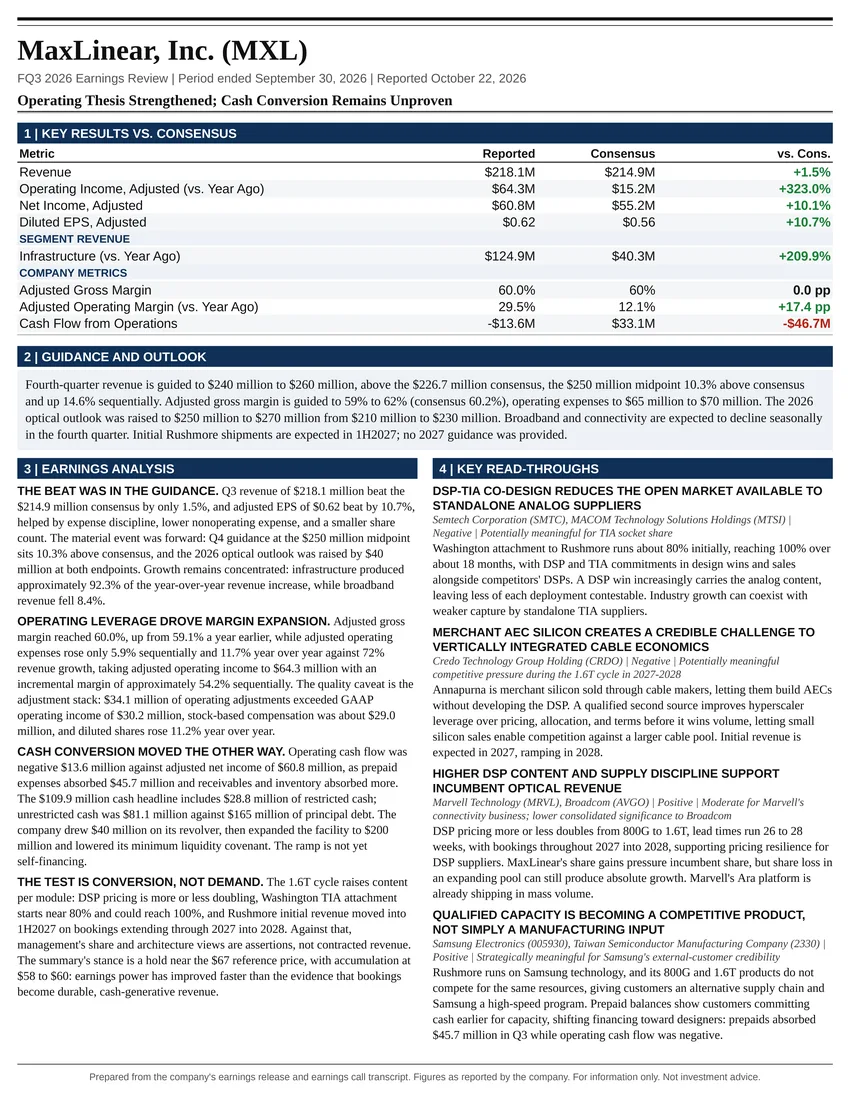
Operating Thesis Strengthened; Cash Conversion Remains Unproven
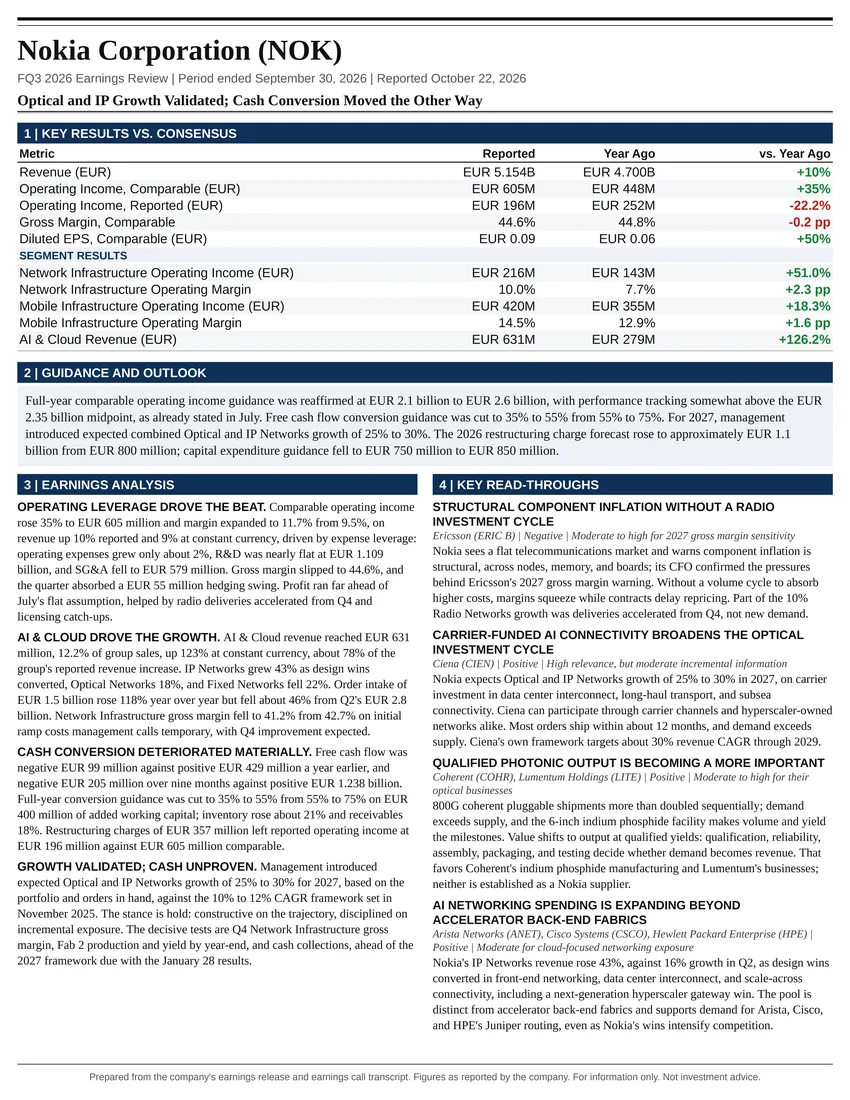
Optical and IP Growth Validated; Cash Conversion Moved the Other Way
All Information Technology reports
Follow @AtlasPeakRes on X for new earnings reports as they publish.