A Larger and More Profitable Equipment Franchise, Not Yet a Cash-Generative Platform
Earnings Reports
Hexcel Corporation FQ3 2026 Earnings Report
Hexcel Corporation (HXL) FQ3 2026 earnings: A Tax-Supported Beat Is Not Yet an Earnings Upgrade. Full earnings analysis, key read-throughs, and the one-page exhibit from Atlas Peak Research.
Hexcel Corporation (HXL)
Sector: Industrials · FQ3 2026 · Period end September 30, 2026 · Reported October 21, 2026
Hexcel’s Q3 2026 call supports a cautiously constructive medium-term operating outlook, but not an unqualified earnings-upgrade thesis.
Download the one-page report (PDF)
View one-page exhibit
Download analysis (.md)
Download read-throughs (.md)
Post to X
One-Page Exhibit
Earnings Analysis
EXECUTIVE CALL SUMMARY: Hexcel Corporation (10/22/26)
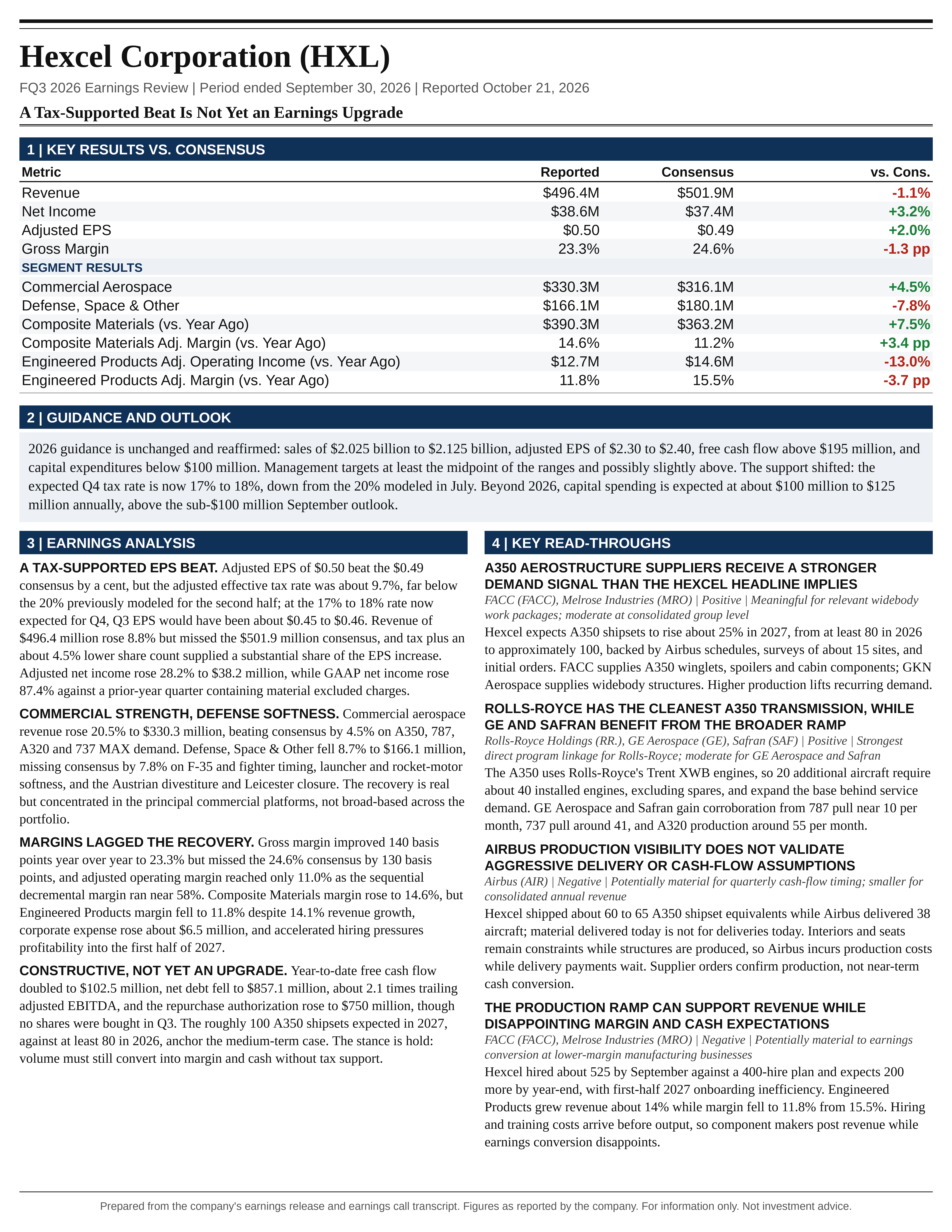
Hexcel’s Q3 2026 call supports a cautiously constructive medium-term operating outlook, but not an unqualified earnings-upgrade thesis. The appropriate investment stance is HOLD pending stronger evidence that accelerating commercial aerospace demand can translate into sustained margin expansion after hiring, training, and production-line restart costs. The most consequential positive development was management’s expectation of approximately 100 A350 shipsets in 2027, compared with at least 80 in 2026. The principal negative was the deterioration in near-term earnings quality: a favorable tax adjustment supported a modest EPS beat despite weaker-than-expected revenue and gross margin. Reaffirmed annual EPS guidance therefore carries less operating reassurance than the unchanged headline suggests.
Revenue increased 8.8% to $496.4 million, but missed Bloomberg consensus of $501.9 million by 1.1%. Commercial aerospace revenue exceeded expectations, while Defense, Space & Other materially underperformed. Adjusted EPS of $0.50 exceeded consensus by $0.01, but the adjusted effective tax rate was approximately 9.7%, substantially below the 20% assumption used for 2H 2026 on the previous earnings call. At the 17%-18% tax rate now expected for Q4, Q3 adjusted EPS would have been approximately $0.45-$0.46. That normalization is not a replacement for reported earnings, but it demonstrates that the headline EPS beat did not establish operating outperformance.
The call strengthened the long-term earnings opportunity while increasing uncertainty around its timing. Management retained its approximately 18% operating-margin objective and introduced a more explicit opportunity to approach 20% through pricing, productivity, and overhead efficiency. However, accelerated hiring is expected to pressure profitability into 1H 2027, and the company did not quantify the associated expense burden. Capital-spending commentary also became less favorable relative to the September investor-conference outlook: the prospective range is now approximately $100 million-$125 million annually rather than less than $100 million.
The central investment question is therefore not whether demand is recovering. Commercial aerospace growth, purchase orders, and production preparations provide substantial evidence that it is. The question is whether the recovery can generate sufficient operating profit and cash flow to justify the valuation without relying on unusually low taxes, continued share-count reduction, or immediate realization of an aspirational 20% margin. Bloomberg’s earnings notice reported an 11% postmarket decline following the October 21 release. That reaction is consistent with concerns about earnings quality and execution, although it should not be treated as a verified closing-price reaction to the subsequent call.
QUARTERLY PERFORMANCE AND EARNINGS QUALITY
Commercial aerospace revenue increased to $330.3 million from $274.2 million, representing 20.5% reported growth and 21.0% constant-currency growth. The distinction matters because management’s approximately 21% characterization should not be interpreted as a disclosed unit-volume growth rate. Pricing and program mix also affect revenue. Commercial aerospace represented 66.5% of consolidated sales, compared with 60.1% in Q3 2025, making Hexcel increasingly dependent on the commercial production recovery.
Defense, Space & Other revenue declined to $166.1 million from $182.0 million, a decrease of 8.7%. Commercial aerospace added $56.1 million of revenue, while Defense, Space & Other subtracted $15.9 million, producing consolidated growth of $40.2 million. The commercial recovery was therefore strong enough to overcome a meaningful offset elsewhere, but the quarter did not demonstrate broad-based acceleration across the portfolio.
Relative to Bloomberg consensus, commercial aerospace revenue exceeded the $316.1 million estimate by $14.2 million, or 4.5%. Defense, Space & Other missed the $180.1 million estimate by $14.0 million, or 7.8%. These market-level consensus estimates sum to $496.2 million rather than the $501.9 million consolidated consensus. They cannot be combined into an exact consolidated surprise bridge because independently aggregated consensus figures can reflect different contributing analyst populations.
Gross margin increased 140 basis points year over year to 23.3%, but was 130 basis points below the 24.6% consensus estimate. At actual quarterly revenue, that margin shortfall represents approximately $6.5 million of gross profit. Gross profit increased to $115.5 million from $99.9 million, but adjusted operating income increased by only $9.6 million, to $54.4 million, as SG&A and R&D absorbed part of the improvement.
Adjusted operating margin increased to 11.0% from 9.8%, and the year-over-year incremental operating margin was approximately 23.9%. That was materially below the approximately 49% incremental margin achieved in Q2 and below management’s medium-term discussion of incrementals in the 30% range. The year-to-date incremental margin remained much stronger at approximately 41.1%, demonstrating that Q3 was a deterioration within an improving annual trend rather than evidence that operating leverage had disappeared altogether.
The sequential comparison is more concerning than the year-over-year comparison. Revenue declined 6.2% from Q2’s $529.3 million, while adjusted operating income declined 26.1% from $73.6 million. The resulting sequential decremental margin was approximately 58%. Gross margin fell from 26.1% to 23.3%, and adjusted operating margin fell from 13.9% to 11.0%. Seasonal revenue weakness was broadly comparable with the prior year, when revenue declined approximately 6.9% between Q2 and Q3, but the 2026 margin decline was substantially larger. Seasonality explains part of the quarter, but does not fully explain the magnitude of the profitability deterioration.
The tax benefit is critical to interpreting the EPS result. Adjusted pretax income was approximately $42.3 million, compared with $35.6 million in Q3 2025. Adjusted net income increased 28.2% to $38.2 million, while adjusted EPS increased 35.1% to $0.50. Diluted weighted-average shares declined approximately 4.5%, to 76.7 million from 80.3 million. An approximate bridge attributes $0.07 of the EPS increase to higher adjusted pretax earnings, $0.035 to the lower effective tax rate, and $0.022 to the lower share count. Tax and denominator effects therefore accounted for a substantial portion of the EPS improvement.
GAAP earnings growth was even stronger, with net income increasing 87.4% and diluted EPS increasing 92.3%. Those comparisons overstate the underlying operating recovery because Q3 2025 contained material charges excluded from adjusted earnings. Adjusted operating income growth of 21.4% and adjusted pretax income growth of approximately 18.8% provide more representative measures of the recurring improvement.
SEGMENT ECONOMICS AND CORPORATE COSTS
Composite Materials provided the principal operating improvement. External revenue increased to $390.3 million from $363.2 million, and adjusted operating income increased to approximately $60.7 million from $42.7 million. Adjusted segment margin increased to 14.6% from 11.2%. This supports the argument that higher commercial aerospace demand and better pricing are generating meaningful benefits within the core materials business.
Engineered Products moved in the opposite direction. External revenue increased approximately 14.1% to $106.1 million, but adjusted operating income declined to $12.7 million from $14.6 million. Adjusted operating margin fell to 11.8% from 15.5%. The deterioration also persisted sequentially, compared with a 15.0% margin in Q2 2026. Revenue growth accompanied by lower absolute profit indicates that mix, labor efficiency, production preparation, or other operating costs outweighed volume benefits. The call did not provide a sufficiently detailed bridge to determine their respective contributions.
Corporate costs were another material constraint. Adjusted unallocated corporate expense increased to approximately $19.0 million from $12.5 million in Q3 2025. The approximately $6.5 million increase, together with the $1.9 million decline in Engineered Products profit, absorbed nearly half of the $18.0 million improvement in Composite Materials profit. The consolidated margin issue was therefore not confined to manufacturing-line restart costs.
An analyst specifically questioned the approximately $17 million year-to-date increase in corporate expense. Management responded principally by discussing consolidated SG&A as a percentage of sales and its eventual target of 6.5%-7.0%. That response did not establish a near-term corporate-expense run rate or identify how much of the increase was temporary. This remains an important modeling gap because unallocated corporate expense and consolidated SG&A are related, but not interchangeable, measures.
Reported segment margins also require careful interpretation. Segment sales include intersegment activity, while the approximately 79% and 21% business-mix figures refer to external revenue. Corporate expenses are not allocated to the operating segments. Weighting the segment margins by external revenue shares will therefore not reproduce consolidated operating margin.
2026 GUIDANCE: UNCHANGED HEADLINES, DIFFERENT UNDERLYING SUPPORT
The authoritative revenue guidance is $2.025 billion-$2.125 billion, as stated in Hexcel’s October 21 earnings release. The transcript’s reference to an upper bound of $2.150 billion conflicts with the written release and should not be treated as an increase. Bloomberg’s rounded $2.03 billion-$2.13 billion range is consistent with the written guidance. Adjusted EPS guidance remains $2.30-$2.40, free cash flow remains greater than $195 million, and 2026 capital expenditures remain below $100 million.
The guidance history is important. Hexcel initially guided to revenue of $2.0 billion-$2.1 billion and adjusted EPS of $2.10-$2.30. The July release increased both revenue bounds by $25 million and raised the EPS midpoint from $2.20 to $2.35. Q3 preserved those increases but did not extend them. Free-cash-flow and capital-spending guidance remained unchanged throughout these revisions.
At the current midpoint, 2026 revenue would increase approximately 9.6% from 2025’s $1.8939 billion, while adjusted EPS would increase approximately 33.5% from $1.76. This is a meaningful recovery from 2025, when revenue declined 0.5% and adjusted EPS declined 13.3%. However, the 2026 EPS midpoint is only approximately 15.8% above the $2.03 earned in 2024. The strong year-over-year percentage partly reflects a depressed comparison period.
Management’s most constructive near-term statement was: “To close the year, we are still targeting at least mid-range of our guidance and possibly slightly above that.” With $1.5272 billion of revenue and $1.75 of adjusted EPS already recorded, the formal ranges imply Q4 revenue of $497.8 million-$597.8 million and adjusted EPS of approximately $0.55-$0.65. The midpoint implies $547.8 million of revenue, up 10.4% sequentially and 11.5% year over year.
The expected commercial-defense mix makes the Q4 requirement more tangible. Applying management’s approximate 65%-35% mix to midpoint revenue implies commercial aerospace sales of roughly $356.1 million and Defense, Space & Other sales of approximately $191.7 million. Commercial aerospace would need to increase approximately 7.8% sequentially and 18.9% year over year. Defense, Space & Other would need to recover approximately 15.4% sequentially, but would be essentially unchanged from Q4 2025’s $191.8 million. The annual outlook therefore requires a meaningful sequential defense recovery, not an extraordinary year-over-year expansion.
The tax assumptions changed more favorably than the EPS range. On the July call, management modeled a 20% tax rate for 2H 2026. On the October call, Jamie Coogan indicated a Q4 rate of 17%-18% and a full-year rate slightly above 16%. Combined with Q3’s approximately 9.7% adjusted rate, the revised tax profile provides materially greater earnings support than previously assumed. Holding pretax earnings constant, the Q3 benefit relative to a 20% rate was approximately $0.057 per share, with the lower Q4 rate potentially adding roughly another $0.02 under midpoint earnings assumptions.
Consequently, maintaining the same annual EPS range despite the tax improvement is not equivalent to reaffirming the same underlying operating outlook. The comparison suggests that tax benefits are absorbing some combination of weaker operating performance, additional investment, or forecast conservatism. The precise offset cannot be determined without an updated operating-profit bridge. Management’s statement that full-year operating margin should be “about 13%” is useful directionally, but is too rounded to resolve that question.
A350: THE PRIMARY 2027 EARNINGS DRIVER
The approximately 100-shipset A350 outlook is the most important quantified forward indicator from the call. Relative to an 80-shipset 2026 baseline, it implies approximately 25% growth. The percentage is not fixed because 2026 guidance is for at least 80 shipsets; stronger actual 2026 shipments would reduce the subsequent growth rate.
Management supported the 2027 expectation with several inputs: Airbus’s published production ambitions, its multiyear production schedule, surveys of approximately 15 receiving locations, and initial purchase orders covering January and February. This is stronger evidence than an extrapolation from aircraft backlog alone. It is nevertheless materially different from having firm purchase orders covering the entire 2027 forecast.
Gentile’s statement, “We manage the business based on production demand and purchase orders we receive, not reported OEM aircraft deliveries,” correctly identifies the relevant near-term operating variable. Hexcel ships material substantially upstream of completed-aircraft delivery. Management described a lead time of at least approximately 6 months, meaning material shipped late in 2026 can support aircraft delivered well into 2027.
The gap between Hexcel’s estimated 60-65 A350 shipset equivalents supplied through September and Airbus’s 38 aircraft delivered over the same period should therefore not be interpreted automatically as excess inventory. Materials are distributed across multiple component suppliers and production stages. Aircraft can also be structurally complete but await interiors or seats. The difference between the 2 figures is not a valid measurement of channel inventory without opening balances, work-in-process positions, and supplier-level consumption data.
However, upstream positioning does not eliminate inventory risk. It can delay the transmission of downstream disruption into Hexcel’s orders. If Airbus cannot clear aircraft awaiting completion, working capital, physical storage, or production planning can eventually force an adjustment further upstream. The relevant test is whether material consumption, component production, final assembly, and deliveries continue converging, not whether any individual monthly delivery figure matches Hexcel’s shipment rate.
Management was unusually confident, stating that “we will not see destocking next year.” The justification was that demand indications strengthened throughout 2026, unlike the deterioration experienced during the prior cycle. That distinction is meaningful, but the assertion remains a forecast rather than a demonstrated outcome. Management’s recollection of earlier indications near 98 aircraft, subsequent reductions, and eventual 2025 Airbus deliveries of 57 highlights the scale of historical scheduling uncertainty. Those numbers should not be treated as a like-for-like waterfall of Hexcel shipset guidance because they refer to different measures and stages of planning.
The revenue implications are substantial. At the approximately $4.5 million-$5.0 million A350 shipset value discussed at the September investor conference, an additional 20 shipsets represents roughly $90 million-$100 million of annual revenue. That is equivalent to approximately 4.3%-4.8% of the 2026 consolidated revenue midpoint and could account for a substantial portion of a low-double-digit 2027 growth outcome. These are content-based estimates, not disclosed program revenue forecasts, and actual realization will depend on timing, configuration, and pricing.
At an illustrative 35%-40% incremental operating margin, the additional A350 revenue would contribute approximately $32 million-$40 million of operating profit. Using an 18% tax rate and 76.7 million diluted shares, the EPS contribution would be approximately $0.34-$0.43 before changes elsewhere. Conversely, a 10-shipset shortfall against the 100-shipset assumption could reduce revenue by approximately $45 million-$50 million and EPS by roughly $0.17-$0.21 under the same framework. The downside could be larger if already-hired labor remains underutilized.
Management did not validate the analyst’s characterization of A350 content as uniquely margin-rich or provide program-level profitability. It confirmed improved fixed-cost absorption as volumes rise. That supports positive operating leverage, but does not justify assuming unusually high program-specific incrementals without further evidence.
The call also clarified the timing of Airbus’s 12-aircraft monthly objective. Management does not expect a full-year equivalent at that rate in 2028 and referenced approximately 132 aircraft in 2029, using an 11-month production convention. The economically relevant progression is therefore a ramp toward the target, not 144 annual shipsets beginning immediately in 2028. This clarification limits overly aggressive near-term volume extrapolations.
OTHER COMMERCIAL AEROSPACE PROGRAMS
Demand commentary was favorable across the other principal platforms. Management described A320 production around 55 aircraft per month, 787 material pull reaching approximately 10 per month during the quarter, and 737 pull around 41 per month. The stated annual expectations remained approximately 90-100 787 shipsets and around 500 737 shipsets, with potential upside.
These indicators support continued growth, but the unit economics differ significantly from the A350. Additional narrowbody units do not generate the same revenue contribution as an additional A350. Aggregate aircraft delivery growth is therefore an incomplete proxy for Hexcel’s growth; program mix and material content are essential.
Other commercial aerospace revenue grew only 1.3% in Q3, compared with 3.7% in Q2 and 6.4% year to date. The recovery is increasingly concentrated in the principal Airbus and Boeing platforms rather than uniformly distributed across regional and business aviation. Management reported no observed demand or operational impact from the Spanish labor disruption or events in France. That is reassuring for the quarter, but does not establish immunity to future disruption.
DEFENSE AND SPACE: SELECTIVE OPPORTUNITY, INCOMPLETE RECOVERY EVIDENCE
The Defense, Space & Other decline combines portfolio changes with genuine operating softness. The Austrian industrial business was divested on September 30, 2025, and industrial operations at Leicester were wound down during 2026. Those exits reduce reported revenue without necessarily indicating weaker retained-business demand. However, the company did not provide a dollar bridge separating divestitures and closures from F-35 timing, Rafale seasonality, and lower launcher and rocket-motor sales. The retained portfolio’s organic performance cannot therefore be quantified reliably.
The Austrian divestiture begins to anniversary in Q4 2026. Reported growth should become less burdened by that comparison even if underlying demand does not accelerate. Any apparent Q4 improvement must therefore be evaluated against both the easier perimeter comparison and the need for actual recovery in affected programs.
The F-35 announcement discussed during the call is constructive for visibility, but management’s shorthand description was more definitive than the underlying agreement. Lockheed Martin’s October 22 announcement describes a framework covering 850 U.S. aircraft over 10 years, international orders across Lots 21-30, and a continued production rate of 156 aircraft annually. It explicitly conditions final contract terms, pricing, and schedules on multiyear authority and associated appropriations.
The framework should not be treated as a fully funded, unconditional 10-year supplier order or as evidence of a production-rate increase above 156. Its principal benefit is potentially greater duration and predictability. It may also introduce pressure for supplier efficiencies and volume discounts. Gentile acknowledged the limited information available: “Don’t know what the conditions are and how those will flow down.” For Hexcel, the agreement strengthens the case that Q3 weakness is not necessarily structural, but does not establish the timing or profitability of a subsequent recovery.
Rotorcraft provides a more tangible long-duration opportunity. Management cited CH-53K content of approximately $2.5 million-$3.5 million per aircraft and an eventual production rate of approximately 24 annually. At that rate, the stated content implies roughly $60 million-$84 million of annual program revenue, before timing and configuration differences. This is total potential program revenue at the cited rate, not incremental revenue from the current base. The Marine Corps program is also distinct from the Army aviation budget pressures raised during the call.
Black Hawk exposure provides a different economic profile. Shipset content is lower, at approximately $200,000-$500,000, but Hexcel supplies blade spars and participates in replacement demand as well as new production. The large installed base and stated orders through 2032 support durability. However, the call did not quantify aftermarket revenue or profitability, so the business should not be assigned the economics of a separately disclosed high-margin aftermarket franchise.
The MV-75 remains prospective rather than a near-term earnings driver. Management described discussions with Textron about material packages and explicitly stated that the program does not materially affect the next few years. Similarly, the 6th-generation fighter opportunities at Boeing offer substantial potential, but development involvement and historical material-system incumbency do not constitute finalized production awards. Hexcel’s fiber role alongside Syensqo resin also differs from the more vertically integrated material-system position on the A350.
Space presents the most important challenge to the broad secular-growth narrative. Hexcel’s exposure depends on composite content and customer share, not merely the total number of launches. Management stated that SpaceX has limited composite content in its launch systems, while other, more composite-intensive launch providers have experienced delays. If those competitors recover, Hexcel can benefit. If launch-market share continues shifting toward less composite-intensive architectures, strong industry growth may translate into comparatively weak Hexcel growth.
The characterization of launcher softness as temporary is therefore plausible but not fully demonstrated. Timing delays and unfavorable customer mix can coexist. The call provided neither a quantified backlog conversion schedule nor a firm recovery date across the affected launcher and rocket-motor programs.
HIRING, MARGIN EXPANSION, AND THE PATH TO 18%-20%
Hiring accelerated materially beyond the original plan. Hexcel began 2026 expecting approximately 400 hires, had reached approximately 525 by September, and expected roughly another 200 by year-end. That implies around 725 hires, approximately 81% above the initial target. The increase is consistent with stronger demand expectations, but also represents a substantial commitment of expense ahead of realized production.
The direction of hiring was not entirely new. On the July call, management had already indicated that it would exceed the original plan, and by the September investor conference it reported reaching approximately 400 hires. The October update increased the magnitude of the commitment and extended the expected inefficiency period into 1H 2027.
Coogan described the operating sequence clearly: labor is hired, training and startup inefficiencies occur, and subsequent volume provides absorption and productivity benefits. That is economically credible for specialized manufacturing. However, the analyst’s suggestion of approximately $50 million of excess costs was not confirmed. Gross hiring also does not necessarily equal net headcount growth, and neither disclosed wages nor onboarding timing supports a reliable independent estimate of the annual cost burden.
The near-term margin path should not be modeled as uniformly improving each quarter. Coogan warned of “a little bit of first half inefficiency from the hiring we did in the fourth quarter and third quarter timeframe.” That is more specific than the CEO’s broader reference to a straight-line margin progression from 2027. The practical implication is that a favorable full-year margin outcome may still require stronger improvement in 2H 2027.
The long-term revenue framework must be anchored correctly. Management’s approximately $500 million commercial aerospace opportunity is measured against fiscal 2025 sales, with approximately $200 million of additional opportunities across defense, space, regional jets, and business jets. Adding the full $700 million to 2025 revenue of $1.8939 billion produces approximately $2.594 billion, not an additional $700 million on top of the 2026 guidance midpoint. At that midpoint, roughly $181 million of the recovery would already have been realized.
The remaining increase from the 2026 midpoint to approximately $2.594 billion is about 25%, equivalent to approximately 7.7% annual growth over 3 years. The framework supports a meaningful multiyear expansion, but does not mechanically require sustained double-digit consolidated growth through the end of the decade. It also does not establish that every component of the $200 million opportunity is contracted.
At approximately $2.594 billion of revenue, an 18% operating margin implies roughly $467 million of operating profit. A 20% margin implies approximately $519 million. The additional 200 basis points are therefore worth approximately $52 million of annual operating profit, or approximately $0.55 per share at an 18% tax rate and an unchanged diluted share count. That is a material opportunity, but remains dependent on actions that have not yet been quantified.
The September investor-conference discussion provides useful context for the margin bridge. Management indicated that returning to the pre-pandemic revenue level of approximately $2.35 billion would produce only about 16% operating margin because of unrecovered inflation, while higher revenue near $2.6 billion would restore approximately 18%. The October initiative seeks to recover more of that inflation-related shortfall and potentially move beyond 18%. It should not be interpreted as evidence that the entire 200-basis-point opportunity is already secured.
Coogan identified the principal lever as “price realization on our LTA renegotiations and making sure that we capture value for the product and technologies we’re providing to our customers.” Pricing can have attractive incremental economics, but timing is constrained by contract maturities. At the September conference, management stated that the major Airbus agreements represented approximately 40% of revenue and extended through the end of 2030. Near-term pricing progress must therefore depend substantially on other renewing contracts, existing contractual mechanisms, and productivity rather than an immediate comprehensive reset of Airbus pricing.
The SG&A target provides another important component. Reducing SG&A from approximately 9% of sales to 6.5%-7.0% would contribute 200-250 basis points of consolidated margin improvement. At approximately $2.594 billion of revenue, that target corresponds to annual SG&A of roughly $169 million-$182 million, compared with approximately $180 million when annualizing Q3’s expense. The objective is therefore broadly consistent with holding nominal overhead near the current quarterly run rate while revenue grows, although year-to-date spending suggests that disciplined execution will still be required.
The gross-margin requirement remains substantial. With SG&A at 6.5%-7.0% and R&D near 3.25%, an 18% operating margin would require gross margin of approximately 27.8%-28.3%, absent material other operating items. A 20% operating margin would require roughly 29.8%-30.3%. These compare with 23.3% in Q3 and 26.1% in Q2. Overhead leverage alone is insufficient; manufacturing absorption, yield, mix, and price realization must also improve.
CAPITAL EXPENDITURE AND CASH GENERATION
The longer-term capital-spending commentary was a meaningful change. At the September conference, management described capital expenditures below $100 million for several years and associated that profile with approximately $1 billion of cumulative free cash flow during 2026-2029. On the Q3 call, Gentile instead described approximately $100 million-$125 million annually over the next few years, including completion of previously initiated carbon-fiber and PAN precursor capacity in Decatur.
The formal 2026 capital-spending forecast remains below $100 million, so the change concerns subsequent periods rather than the current annual guide. Nevertheless, $125 million instead of $100 million would reduce annual free cash flow by $25 million, all else equal. That amount equals approximately 12.8% of the current $195 million free-cash-flow floor. Stronger operating earnings could offset it, but the earlier cumulative cash-generation narrative should not be carried forward without revisiting the investment assumptions.
The distinction between existing capacity and zero investment is important. Hexcel appears to have sufficient installed or previously initiated capacity to support the currently contemplated commercial ramp without a major new greenfield expansion. That does not eliminate spending to complete unfinished lines, restore equipment, qualify capacity, or support maintenance and productivity. The business can remain relatively capital efficient during the recovery while still requiring more cash investment than earlier commentary implied.
Year-to-date operating cash flow increased to $171.1 million from $105.0 million, and free cash flow increased to $102.5 million from $49.9 million. The correct reconciliation uses $68.6 million of cash capital expenditures, not the $61.2 million accrual-basis figure discussed during the call. Free cash flow is operating cash flow less cash capital spending and is measured before dividends and share repurchases.
The quarterly cash comparison is less favorable than the year-to-date headline. Subtracting the first-half figures shows Q3 operating cash flow of approximately $74.4 million, compared with $110.2 million in Q3 2025. Q3 free cash flow was approximately $50.7 million, compared with $96.5 million. Current-quarter free cash flow therefore declined approximately 47.5% despite its strong year-to-date increase.
Working-capital timing explains much of that divergence. Q3 2026 used approximately $5.9 million of working capital, whereas Q3 2025 released approximately $60.7 million. The prior-year quarter benefited from unusually strong cash recovery after a substantial first-half outflow. Current-quarter free cash flow still exceeded adjusted net income, so the comparison does not establish poor underlying cash conversion. It does show why the year-to-date doubling should not be described as a doubling of quarterly cash generation.
Year-to-date working capital consumed $78.1 million, including a $35.5 million inventory cash outflow. Inventory growth is consistent with preparation for higher production, but also increases exposure if customer schedules weaken. Deferred tax and stock-based compensation adjustments contributed to operating cash flow as well, reinforcing the need to distinguish cash conversion from recurring operating profitability.
Achieving more than $195 million of annual free cash flow requires more than $92.5 million in Q4. That is substantially above Q3, but below the approximately $107.3 million generated in Q4 2025. The target is therefore demanding in sequential terms without requiring a record year-end cash quarter. At the EPS midpoint and a roughly unchanged share count, it would imply annual free-cash-flow conversion above 100% of adjusted net income.
BALANCE SHEET AND SHARE REPURCHASES
Net debt declined to $857.1 million from $897.2 million at June 30 and $922.0 million at year-end 2025. Against approximately $401 million of trailing adjusted EBITDA, leverage was approximately 2.1 times. The company is close to its 1.5-2.0 times target range. At unchanged EBITDA, reaching 2.0 times would require approximately $55 million of additional net-debt reduction; EBITDA growth would reduce that requirement.
The balance sheet does not indicate an immediate funding problem. Expected Q4 cash generation should provide a credible route back into the target range, subject to working-capital execution and shareholder distributions. However, net debt remained materially above September 2025’s $667.4 million following the accelerated repurchase. Interest expense increased to $12.1 million from $9.2 million in the quarter, absorbing part of the operating improvement.
The $400 million refinancing completed earlier in 2026 improved the maturity profile but increased the coupon from 3.95% to 4.9%. The approximately $3.8 million annualized interest difference illustrates that balance-sheet normalization does not automatically translate into sharply lower financing costs.
The authorization increased to a total of $750 million from approximately $380.6 million remaining. The incremental authorization was therefore about $369.4 million, not $750 million of newly committed spending. No shares were repurchased during Q3, and management said repurchases would be evaluated after leverage returned to the target range.
The authorization is a source of flexibility, not a forecast of near-term execution. It is equivalent to approximately 3.8 times the annual free-cash-flow floor before dividends. The $0.18 quarterly dividend represents roughly $55 million of annual cash distributions at the current share base, leaving approximately $140 million from a $195 million free-cash-flow year before other financing requirements. Funding the full authorization rapidly would require considerably stronger cash generation or renewed leverage.
Repurchases can enhance EPS, but valuation discipline remains essential. The lower share count already supported the Q3 comparison. As the late-2025 accelerated repurchase enters the comparison base, that benefit will diminish unless additional repurchases occur. Organic operating growth will therefore become more important to sustaining EPS momentum.
COMPETITIVE POSITION, INPUT COSTS, AND INNOVATION
The competitive position remains attractive, particularly on established aerospace programs. Qualification involves the material system, the manufacturing process, structural performance, and aircraft certification. Gentile summarized the switching barrier directly: “It’s very difficult to change a material system, certainly for any primary or secondary structure.” These barriers support continuity of supply and create opportunities to capture value at contract renewal.
They do not eliminate competitive risk. Toray’s interest in A350 participation is particularly relevant around the 2030 contract cycle and any requirement for additional capacity above the currently supported production rate. Airbus may weigh supplier diversification, pricing leverage, and industrial resilience alongside qualification costs. Hexcel’s prospective capital commitments should therefore be evaluated together with contract duration, share protection, and returns on incremental investment.
Chinese high-performance fiber development is a longer-term competitive consideration rather than evidence of immediate substitution. Management stated that the referenced products were not qualified on current Airbus or Boeing programs and distinguished technical capability from qualification and industrialization. That distinction is appropriate. Current-program protection is materially stronger than certainty about the competitive environment for future aircraft.
Innovation spending supports the longer-term opportunity but carries a present earnings cost. Q3 R&D increased to $16.2 million from $14.0 million, while year-to-date spending increased to $51.3 million from $42.1 million. Next-generation single-aisle aircraft, higher-rate manufacturing, and new defense and space applications justify investment, but should not be assigned near-term revenue without awards and production schedules.
The NCAMP-qualified honeycomb and related material developments can reduce evaluation barriers for prospective customers. They do not replace aircraft-specific qualification or establish production revenue. Their value is improved accessibility and potential adoption rather than an immediately measurable earnings contribution.
Input-cost risk appears manageable but not eliminated. Acrylonitrile represents only a low-single-digit percentage of revenue, and the company uses propylene hedges over an approximately 8-quarter horizon as a partial economic offset. The protection reduces near-term volatility, but does not perfectly hedge acrylonitrile pricing, energy, logistics, labor, or other chemicals. Persistent inflation can enter the cost base as contracts and hedges roll.
Foreign exchange reduced Q3 operating margin by approximately 30 basis points, compared with approximately 90 basis points in Q2. That narrowing of the year-over-year headwind makes it harder to attribute the sequential margin deterioration primarily to currency. Higher oil prices also have different effects over different horizons: they increase the economic appeal of lighter aircraft, but can raise manufacturing costs and pressure airline finances before generating incremental composite demand.
ILLUSTRATIVE 2027 SCENARIOS
The following scenarios are analytical assumptions rather than company guidance or verified consensus. Each uses the 2026 revenue midpoint of $2.075 billion and approximately $270 million of operating profit, consistent with management’s rounded 13% margin commentary. Diluted shares are held at 76.7 million to avoid embedding an unannounced repurchase schedule. The probability assignments are judgmental.
The base case, assigned 55% probability, assumes revenue of approximately $2.30 billion, representing 10.8% growth. A350 shipments approach 100, other commercial platforms continue expanding, and Defense, Space & Other stabilizes. A 32% incremental operating margin produces approximately $342 million of operating profit and a 14.9% operating margin. With $45 million of interest expense and an 18% tax rate, adjusted EPS would be approximately $3.17. This assumes that volume absorption outweighs onboarding costs over the full year without requiring an immediate return to peak profitability.
The bull case, assigned 25% probability, assumes revenue of approximately $2.40 billion, representing 15.7% growth, with stronger commercial demand and a clearer defense and space recovery. A 38% incremental operating margin produces approximately $393 million of operating profit and a 16.4% margin. With $43 million of interest expense and a 17% tax rate, adjusted EPS would be approximately $3.79. Even this scenario does not require the eventual 18%-20% margin objective to be achieved in 2027.
The bear case, assigned 20% probability, assumes revenue of approximately $2.10 billion, representing only 1.2% growth. A350 demand falls materially short of the 100-shipset expectation, other programs fail to compensate, and labor added ahead of demand remains insufficiently utilized. A 12.0% operating margin produces approximately $252 million of operating profit. With $50 million of interest expense and a 20% tax rate, adjusted EPS would be approximately $2.11, below the 2026 guidance midpoint.
Probability-weighted EPS across these scenarios is approximately $3.11. That is not a price target or an expected stock return. It demonstrates that the operating recovery can support meaningful earnings growth, while the downside case remains credible because fixed-cost commitments have increased before the full demand ramp has been realized.
VALUATION, PORTFOLIO IMPLICATIONS, AND RISK DISCIPLINE
The principal valuation risk is paying for both earnings recovery and peak-margin realization before either is sufficiently established. At the illustrative base-case EPS of approximately $3.17, each 1.0 times change in the earnings multiple changes equity value by approximately $3.17 per share. A 5.0 times multiple contraction would remove roughly $16 per share, potentially offsetting a significant portion of the value created by higher earnings.
The reported 11% postmarket decline is not sufficient evidence that the shares became inexpensive. A verified contemporaneous share price is not established here. An illustrative entry discipline would require approximately 20 times or less normalized 2027 base-case earnings, equivalent to roughly $63 per share under the stated assumptions, together with improving operating evidence. At that price, the $195 million current-year free-cash-flow floor would represent approximately a 4% equity free-cash-flow yield. These are underwriting thresholds, not a claimed market price or an independently established fair-value estimate.
For a diversified equity portfolio, any new position would be better treated as a small aerospace-production recovery exposure than as a defensive aerospace-and-defense holding. An illustrative initial allocation of 0.5%-1.0% of net asset value, with a 15% price-loss review or exit threshold, would imply a planned portfolio loss of approximately 7.5-15 basis points before gap risk. A stop does not guarantee the loss limit during an earnings or customer-production shock.
The relevant investment horizon is approximately 12-24 months, sufficient to observe the 2027 A350 ramp and the expected conversion of hiring costs into productivity. Actual portfolio fit cannot be quantified without position data. Economically, the exposure overlaps with commercial aircraft production, widebody suppliers, aerospace working-capital cycles, and growth-sensitive valuation factors. The defense and space business does not currently provide a reliable countercyclical offset.
The thesis would require reassessment if the 100-shipset A350 expectation is materially reduced, supplier schedules weaken after hiring is completed, Engineered Products profitability remains depressed despite higher sales, or corporate costs continue expanding faster than revenue. Persistent cash underperformance despite favorable tax rates would also challenge the claim that existing capacity is creating a capital-efficient growth phase. A valuation that already capitalizes 20% margins without discounting execution and contract-renewal risk would weaken the case for continued ownership even if operations improve.
CATALYSTS AND DECISION FRAMEWORK
The immediate catalyst is Q4 delivery against the annual forecast, particularly revenue near or above the $547.8 million midpoint requirement and free cash flow above $92.5 million. The composition matters: a recovery supported by commercial demand, defense normalization, and cash collections would be more valuable than EPS delivery primarily through tax benefits.
The next major catalyst is formal 2027 guidance with the full-year 2026 results, expected in early 2027. Revenue growth, operating margin, tax rate, capital expenditures, and the timing of training-cost absorption will determine whether the approximately 100 A350 shipsets translate into the earnings improvement implied by the operating scenarios. Management’s refusal to endorse the analyst’s low-double-digit revenue growth and low-30% incremental-margin framework should be respected; those figures are not company guidance.
During 1H 2027, the key evidence will be conversion of demand indications into sustained purchase orders and production, together with stabilization of hiring costs. During 2H 2027, the central test will be whether incremental margins improve as training inefficiencies recede. Details of the CFO-led margin initiative will also be important, particularly quantified price realization, corporate-cost targets, yield improvements, implementation costs, and contract-renewal timing.
The final assessment is that Hexcel’s commercial recovery is credible and its A350 exposure offers substantial earnings leverage. The quarter nevertheless revealed a weaker operating result than the EPS headline implied, greater near-term labor commitments, and a modestly higher prospective capital burden. The strongest investment case rests on demonstrated conversion of volume into profit and cash, not on extrapolating a favorable tax quarter or treating 20% margins as already secured.
COMPANY EMPLOYEES ON THE CALL
• Thomas C. Gentile III, Chairman, Chief Executive Officer and President. • Jamie Coogan, Executive Vice President and Chief Financial Officer. • Kurt Goddard, Vice President, Investor Relations.
RESEARCH ANALYSTS ON THE CALL
• Michael Ciarmoli, Guggenheim Securities. • Gavin Parsons, UBS. • Scott Mikus, Melius Research. • Richard Safran, Seaport Research Partners, identified as Seaport Global Securities in the participant roster. • David Strauss, Wells Fargo. • Jason Holcomb, Morgan Stanley. • Noah Poponak, Goldman Sachs. • Ronald Epstein, Bank of America. • Pete Skibitski, Alembic Global. • Gautam Khanna, TD Cowen. • Myles Walton, Wolfe Research. • Sheila Kahyaoglu, Jefferies. • Ken Herbert, RBC Capital Markets. The operator announced his line, but no question or substantive remarks appear in the transcript.
Key Read-Throughs
KEY READ-THROUGHS FROM HEXCEL’S Q3 2026 EARNINGS CALL
Hexcel’s October 22 call provides stronger evidence of an aerospace production recovery than its consolidated revenue miss initially suggests. Commercial aerospace sales increased 20.5%, exceeded expectations, and were supported by rising demand across all 4 principal aircraft platforms. The more differentiated implications concern where that recovery generates value: upstream materials and established component suppliers can benefit before aircraft deliveries accelerate, while airframers remain exposed to completion bottlenecks and suppliers incur labor and working-capital costs before realizing operating leverage. Defense signals are similarly selective: mature fighter and helicopter programs retain substantial duration, but launcher weakness demonstrates that expanding government budgets and space activity do not translate uniformly into supplier revenue. The highest-conviction implications favor established program positions and qualification barriers, while challenging assumptions of immediate margin expansion, unrestricted cash conversion, and broad-based space-sector participation. Magnitudes below refer to operating exposure, not predicted share-price changes.
COMMERCIAL AEROSPACE AND AEROSTRUCTURES
AIRBUS PRODUCTION VISIBILITY DOES NOT VALIDATE AGGRESSIVE DELIVERY OR CASH-FLOW ASSUMPTIONS (READ-THROUGH 1)
Affected company: Airbus (AIR: Netherlands). Direction: negative for aggressive near-term cash-conversion assumptions and premature recognition of peak production. Magnitude: potentially material for quarterly cash-flow timing and A350-specific forecasts, but smaller for consolidated annual revenue.
Hexcel expects approximately 100 A350 shipsets in 2027, compared with at least 80 in 2026. However, management explicitly separated upstream shipments from completed-aircraft deliveries: “The material we’re delivering today is not for deliveries today.” Hexcel estimated that approximately 60-65 shipset equivalents had entered the supply chain through September, while Airbus had delivered 38 aircraft. That difference is not itself a measure of excess inventory because it compares different production stages and includes normal lead times.
The more important evidence is management’s explanation that interiors and seats remain constraints, while aircraft structures can continue being produced. The transmission mechanism is a potential separation between supplier revenue recognition and Airbus cash collection. Airbus can incur costs for engines, structures, and systems while final delivery payments remain deferred until aircraft are completed and accepted. Strong supplier orders therefore support production confidence without independently validating stronger near-term Airbus free cash flow.
Management also clarified that reaching 12 A350 aircraft per month during 2028 does not mean operating at that rate throughout 2028. Gentile referenced approximately 132 aircraft in 2029, using an 11-month production convention. That is below a simplistic 144-aircraft annualization and later than assuming a full-rate 2028 contribution. This is a negative read-through for overly aggressive models, not evidence that Airbus has formally reduced its target.
The near-term catalysts are Airbus delivery conversion, completion of aircraft awaiting interiors, and working-capital performance. The longer-duration A350 demand outlook remains favorable. The actionable distinction is between improving production visibility and improving cash realization.
A350 AEROSTRUCTURE SUPPLIERS RECEIVE A STRONGER DEMAND SIGNAL THAN THE HEXCEL HEADLINE IMPLIES (READ-THROUGH 2)
Affected companies: FACC (FACC: Austria) and Melrose Industries (MRO: United Kingdom), through GKN Aerospace. Direction: positive. Magnitude: meaningful for relevant widebody work packages; moderate at consolidated group level because neither company’s entire business follows A350 production.
The strongest evidence is the approximately 25% increase from an 80-shipset A350 baseline to approximately 100 shipsets in 2027. Hexcel supported that expectation with Airbus production schedules, surveys of approximately 15 receiving locations, and initial January-February purchase orders. Gentile emphasized that demand indications had strengthened during 2026 rather than deteriorated as they had during the preceding downturn.
FACC supplies A350 components including winglets, spoilers, engine-related structures, and cabin components. GKN Aerospace supplies structures across the A350 and other major widebody platforms. Higher aircraft production consequently increases recurring demand for established work packages without requiring either supplier to win a new aircraft program. The economic mechanism is additional component shipments followed by improved utilization of engineering, tooling, and manufacturing capacity.
The geographic transmission is important. A U.S.-listed materials supplier is providing corroborating demand evidence for European aerospace manufacturing, particularly Austrian and U.K. exposures. This is more useful than treating Hexcel’s consolidated revenue miss as evidence of weakening global commercial aircraft demand. Commercial aerospace revenue actually exceeded Bloomberg consensus by approximately $14 million; the weakness was concentrated elsewhere.
The near-term trading catalyst is confirmation of stronger order schedules in supplier updates and 2027 guidance. The fundamental benefit unfolds during 2027-2029 as production advances toward higher sustained rates. The 25% figure applies to Hexcel’s expected A350 shipsets, not automatically to FACC or Melrose revenue, and customer inventory positions can shift shipment timing across suppliers.
THE PRODUCTION RAMP CAN SUPPORT REVENUE WHILE DISAPPOINTING MARGIN AND CASH EXPECTATIONS (READ-THROUGH 3)
Affected companies: FACC (FACC: Austria) and Melrose Industries (MRO: United Kingdom). Direction: negative for assumptions of immediate, uniform operating leverage. Magnitude: potentially material to earnings conversion at lower-margin manufacturing businesses, even when revenue forecasts remain intact.
Hexcel had hired approximately 525 employees through September against an original annual plan of 400 and expected approximately another 200 hires before year-end. Coogan warned of “a little bit of first half inefficiency” in 2027 from onboarding employees hired during 2H 2026. The company’s Engineered Products business provides a particularly relevant example: external revenue increased approximately 14%, but adjusted operating margin fell to 11.8% from 15.5%.
The transmission mechanism is expense arriving ahead of productive output. Hiring, training, qualification, startup scrap, and additional work in process consume resources before higher production rates generate sufficient absorption. Downstream component manufacturers face the same economic sequencing, although the magnitude depends on their own staffing, automation, contracts, and capacity.
FACC’s August presentation reported a 4.8% EBIT margin on €526.3 million of 1H revenue. At that revenue base, a hypothetical 100-basis-point margin variance equals approximately €5.3 million, or about 21% of reported EBIT. This is a sensitivity, not a forecast of deterioration. FACC’s own profitability was improving, so Hexcel’s experience does not justify mechanically cutting its estimates.
Cash-flow extrapolation also requires discrimination. Hexcel largely expects to grow into previously installed capacity, whereas FACC has announced a €120 million investment in a new aerostructures plant. That is a project commitment, not an annual expenditure figure, but it demonstrates why Hexcel’s capital-efficiency narrative cannot be applied uniformly across the supply chain.
The near-term risk window is Q4 2026 through 1H 2027. The key catalysts are supplier disclosures on hiring, production efficiency, inventory, and investment spending. The longer-term revenue opportunity remains positive; the negative read-through concerns the timing and quality of earnings conversion.
AIRCRAFT ENGINES
ROLLS-ROYCE HAS THE CLEANEST A350 TRANSMISSION, WHILE GE AND SAFRAN BENEFIT FROM THE BROADER RAMP (READ-THROUGH 4)
Affected companies: Rolls-Royce Holdings (RR.: United Kingdom), GE Aerospace (GE: United States), and Safran (SAF: France). Direction: positive. Magnitude: strongest direct program linkage for Rolls-Royce; moderate incremental demand confirmation for GE Aerospace and Safran.
The A350 forecast is particularly relevant to Rolls-Royce because the aircraft uses the Trent XWB engine family. An additional 20 aircraft ultimately require approximately 40 installed engines, excluding spares. This is a physical relationship, not a prediction that Rolls-Royce will deliver exactly 40 additional engines during calendar 2027: Hexcel’s material shipments occur earlier in the production process, and engine deliveries follow a different schedule.
The transmission extends beyond initial equipment. Additional aircraft entering service expand the installed engine base, flight-hour exposure, and eventual maintenance requirements. The most durable benefit is therefore the creation of future service demand, not simply additional original-equipment revenue. Service cash receipts can develop with utilization, while major maintenance activity follows later.
GE Aerospace and Safran receive corroboration from Hexcel’s comments that 787 material pull reached approximately 10 aircraft per month during the quarter, 737 pull was approximately 41 per month, and A320 production was around 55 per month. GE participates in the 787 through GEnx, while GE and Safran participate through CFM in the 737 MAX and a substantial portion of A320neo production. Unlike the A350’s engine relationship, these exposures require attention to engine selection and market share.
The near-term catalysts are engine delivery guidance, supply-chain throughput, and customer production schedules. The longer-duration benefit is a larger serviceable fleet. Original-equipment economics and service economics should not be conflated: stronger engine shipments do not automatically produce proportionate immediate profit, and Hexcel’s call provides no direct evidence of a near-term aftermarket growth acceleration.
ADVANCED MATERIALS AND SPECIALTY CHEMICALS
QUALIFIED AEROSPACE MATERIALS OFFER A BETTER READ-THROUGH THAN A GENERIC CARBON-FIBER OR CHEMICALS RECOVERY (READ-THROUGH 5)
Affected companies: Toray Industries (3402: Japan) and Syensqo (SYENS: Belgium). Direction: positive for established aerospace materials franchises. Magnitude: meaningful within aerospace operations; moderate and dependent on business mix at consolidated group level.
Hexcel’s commercial aerospace sales increased 20.5%, with growth across the A350, 787, A320neo, and 737 MAX. The 787 material-pull indication is particularly relevant to Toray’s established carbon-fiber prepreg position on that aircraft. It provides a more immediate commercial opportunity than the prospective A350 market-share entry discussed by an analyst, which management characterized as difficult because of qualification and certification requirements.
Syensqo benefits through a different part of the materials stack: resins, composites, adhesives, and associated aerospace applications. Its March Boeing agreement covered commercial and defense programs, and the accompanying company announcement identified aerospace as approximately 20% of group net sales. As a simple exposure sensitivity, 10% aerospace growth would contribute approximately 2 percentage points to consolidated revenue growth if the remainder of the portfolio were unchanged. Hexcel’s growth rate should not be imposed directly on Syensqo, but the end-market relevance is substantial.
The longer-duration positive is qualification-based pricing power. Gentile stated that changing an established structural material system is “very difficult,” while Coogan identified “price realization on our LTA renegotiations” as a central margin lever. Those characteristics favor incumbent suppliers with qualified materials and industrial-scale consistency over producers of technically capable but unqualified fiber.
This is not evidence of an immediate sector-wide price increase. Contract renewals determine timing, and Hexcel’s margin ambitions do not establish Toray’s or Syensqo’s pricing outcomes. The counterpart is a modest longer-term cost headwind for Airbus (AIR: Netherlands) and Boeing (BA: United States), unless aircraft pricing or productivity offsets higher supplier costs.
The near-term catalysts are aerospace order growth and capacity utilization. The structural shift is gradual recovery of value through contract renewal and production scale. The call does not support a broad commodity-chemical inflation trade: management described acrylonitrile as only a low-single-digit percentage of revenue and emphasized hedges and substantial downstream value added.
DEFENSE AIRCRAFT AND ROTORCRAFT
F-35 VISIBILITY SUPPORTS PROGRAM DURATION, NOT AN IMMEDIATE PRODUCTION-RATE UPGRADE (READ-THROUGH 6)
Affected companies: Lockheed Martin (LMT: United States), BAE Systems (BA.: United Kingdom), and Northrop Grumman (NOC: United States). Direction: positive for production continuity and supplier planning. Magnitude: most significant for Lockheed Martin; meaningful within the partners’ F-35 activities but diluted across their broader portfolios.
Hexcel attributed its weak F-35 quarter to timing and customer schedule changes rather than a deterioration in program demand. Gentile cited the newly announced multiyear arrangement at 156 aircraft annually as evidence supporting that distinction. The transmission mechanism is greater confidence in recurring airframe, structure, systems, and material requirements across the established production network.
The important limitation is contractual status. Lockheed Martin’s October 22 announcement describes a framework covering 850 U.S. aircraft over 10 years, international orders, modifications, and sustainment. Final terms, pricing, and schedules remain subject to multiyear authority and appropriations. Gentile acknowledged that uncertainty: “Don’t know what the conditions are and how those will flow down.”
The positive implication is longer production visibility and potentially more efficient procurement, workforce planning, and supplier investment. It is not evidence that annual output will rise above 156 or that the full framework should immediately enter funded backlog. It also does not guarantee higher margins: multiyear procurement is intended partly to secure efficiency savings and volume discounts.
The near-term catalysts are authorization, appropriations, definitive awards, and supplier contract terms. The longer-duration benefit is reduced uncertainty around the persistence of the production base. Hexcel’s commentary is confirmatory rather than a new F-35 award announcement, and its weak material quarter should not be extrapolated into a corresponding quarterly revenue decline at each prime contractor.
ARMY AVIATION BUDGET CONCERNS SHOULD NOT BE APPLIED INDISCRIMINATELY TO SIKORSKY (READ-THROUGH 7)
Affected company: Lockheed Martin (LMT: United States), through Sikorsky. Direction: positive relative to a broad helicopter-budget bearish interpretation. Magnitude: meaningful for the rotorcraft portfolio, but smaller at consolidated Lockheed Martin level.
An analyst raised pressure on the fiscal 2027 Army aviation request. Gentile responded that Hexcel’s largest rotorcraft program, CH-53K, serves the Marines rather than the Army. He cited a 200-aircraft program of record, an intended production rate of approximately 24 annually, and foreign military sales. Hexcel’s stated content of $2.5 million-$3.5 million per aircraft also demonstrates that the heavy-lift program is economically important to its supply chain.
The transmission mechanism is differentiated budget exposure. CH-53K production depends on Marine Corps requirements and its own procurement trajectory rather than the specific Army budget pressure discussed. That does not make the program immune to defense-budget changes, but it weakens the case for treating every helicopter supplier as having the same fiscal risk.
Black Hawk adds a separate source of persistence. Management cited firm orders through 2032 and replacement demand for blade spars from aircraft already in service. For Sikorsky, an established installed base, modernization, and international demand can extend activity even as the Army develops successor capabilities.
The near-term catalysts are funded CH-53K and Black Hawk orders and execution against production schedules. The longer-duration implication is that mature rotorcraft can retain value well into the transition to newer platforms. Hexcel’s statement that MV-75 material opportunities remain several years away also argues against assuming immediate displacement of incumbent production; it does not imply that Textron’s development revenue is absent.
NEXT-GENERATION FIGHTERS FAVOR INCUMBENT MATERIAL SYSTEMS, WITH SYENSQO A LESS OBVIOUS BENEFICIARY (READ-THROUGH 8)
Affected companies: Syensqo (SYENS: Belgium) and Boeing (BA: United States). Direction: positive over a longer horizon. Magnitude: potentially substantial within relevant programs, but insufficiently disclosed to quantify a consolidated earnings contribution.
Discussing Boeing’s next-generation fighter opportunities, Gentile stated that demonstrators had used established military material systems incorporating Hexcel carbon fiber and Syensqo resin. This is more specific than a generic assertion that future aircraft will contain more composites. It identifies a technical foundation already associated with development activity.
For Syensqo, the transmission is potential continuation of a qualified resin position as demonstrators progress into production designs. Existing performance data, process knowledge, and qualification history can reduce adoption risk relative to introducing a completely new material system. Requirements for range and low observability reinforce demand for lightweight structural solutions, although composites alone do not determine stealth performance.
For Boeing, access to established material systems can reduce part of the materials-development burden. That is favorable for industrialization, but does not remove aircraft-development, manufacturing, or contract-execution risks. Boeing’s awards are not new information created by the Hexcel call; the incremental insight concerns the potential continuity of the underlying materials supply chain.
The critical distinction is between technical positioning and an awarded production contract. Management said it would work with Boeing as the programs were finalized, rather than announcing secured production volumes. The near-term catalyst is supplier selection or material-system confirmation. The fundamental opportunity develops over several years and should not be treated as a meaningful 2027 earnings contribution without further disclosure.
SPACE LAUNCH AND SOLID-ROCKET PROPULSION
LAUNCH-MARKET GROWTH DOES NOT GUARANTEE GROWTH FOR THE EXISTING COMPOSITE-INTENSIVE SUPPLY CHAIN (READ-THROUGH 9)
Affected companies: Boeing (BA: United States) and Lockheed Martin (LMT: United States), through United Launch Alliance; Northrop Grumman (NOC: United States), through relevant launch-propulsion exposure. Direction: negative for the pace of recovery in affected launch activities. Magnitude: potentially meaningful within individual launch programs, but low at the diversified parent-company level.
Hexcel reported softness in U.S. launchers and rocket motors and emphasized that the dominant launch provider does not necessarily consume the most of its material. Gentile stated that SpaceX “do[es] not use much composite today on their launching systems,” while other composite-intensive providers had experienced pauses. Hexcel’s September conference commentary had specifically identified ULA and Blue Origin as affected providers.
The mechanism is customer and architecture mix. A rising aggregate launch count can coexist with weak demand for particular composite structures and propulsion components if activity shifts toward a different provider or vehicle architecture. For ULA, a slower launch cadence can delay revenue realization and utilization benefits. For Northrop Grumman, which supplies GEM 63XL boosters for Vulcan, prolonged schedule disruption can affect the timing of downstream demand, although booster production and launch timing are not identical.
The call does not identify Northrop Grumman as the source of Hexcel’s decline or quantify any effect on its earnings. The supported conclusion is a program-specific demand-timing risk, not a broad downgrade to Northrop Grumman or the defense-propulsion industry.
The near-term catalysts are sustained flight operations, resolution of technical issues, and replenishment orders rather than aggregate industry launch statistics. The longer-duration risk is that customer share and material intensity prevent legacy suppliers from capturing the full economic benefit of space-market expansion. This negative read-through should not be extended to tactical missile propulsion, where budgets, customers, consumption rates, and production constraints are materially different.
Report record
- Sector
- Industrials
- Fiscal period end
- September 30, 2026
- Report date
- October 21, 2026
- Analysis
- 6411 words
- Read-throughs
- 2815 words
- Content fingerprint (PDF)
3b1e9131f805- Content fingerprint (analysis)
db8d7781790d- Content fingerprint (read-throughs)
a30ce26c6af3
Prepared from the company's earnings release and earnings call transcript. Figures as reported by the company. For information only. Not investment advice.
More from Hexcel Corporation
No other reports yet.
All Hexcel Corporation reports
More in Industrials
Earnings Expansion Durable, but the Beat Was Not Unequivocal
Improved visibility into 2027 rather than a substantial upgrade to 2026 earnings
Follow @AtlasPeakRes on X for new earnings reports as they publish.